"Please come to our neighborhood too. It's quiet here, so there are no crackdowns."
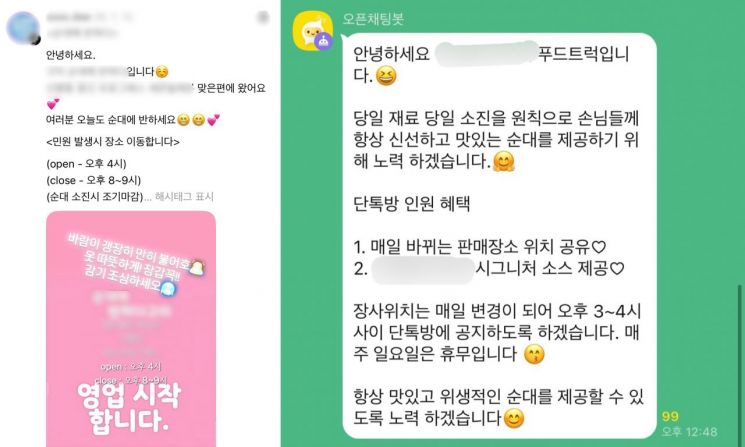 A food truck company that announces its daily changing business locations through social media. SNS screenshot.
An increasing number of people are sharing the locations of food trucks that sell items such as sundae (Korean blood sausage), hotteok (sweet pancakes), and fried snacks as they move from place to place. However, there are also growing concerns about legal issues, such as the need for permits for these business locations.
On the secondhand trading platform Danggeun, there are active groups dedicated to sharing food truck locations. This is because food trucks selling sundae, hotteok, and similar items do not have fixed operating hours or locations.
Some food trucks announce their daily changing business locations through open chat rooms and social media. They inform customers, "The business location changes every day, so we will announce it around 3-4 p.m.," and add, "If there are any complaints, we will move to a different location."
There are also food trucks that hold "location recommendation events" for customers. This is because it is difficult to find suitable business locations due to complaints and coordination issues with other trucks. If a recommended spot is deemed profitable and can be operated consistently for three weeks, the person who made the recommendation receives a gift voucher.
These issues arise because there are only a limited number of places where food trucks can operate stably. While mobility is a key advantage of food trucks, they cannot operate just anywhere. According to the Food Sanitation Act, food truck operators must register their vehicles with the local government and can only do business in locations approved by the municipality. Even if local ordinances allow business in communal residential areas such as apartment complexes, a separate contract must be signed with the residents' representative council or similar bodies.
In fact, according to the national food truck permit zone standard data from public sources, as of January 26, there are 364 approved business locations for food trucks nationwide. Of these, operations have already ended in about 200 locations.
A representative from the Korea Food Truck Association stated, "Food trucks must be authorized under the Constitution, and business cannot be conducted in places without contracts with local governments or companies. Those who change locations daily to set up stalls in apartments or on the street are aware that they are operating illegally."
Lee Geonsu, a professor in the Department of Police Science at Baekseok University, said, "The locations and environmental conditions specified in the Food Sanitation Act must be clearly announced in advance," and added, "A systematic management system for moving locations is needed." He also emphasized, "For violations, administrative penalties such as fines should be strengthened."
© The Asia Business Daily(www.asiae.co.kr). All rights reserved.

















