Kim Daejung: "Immediate in 2026" vs Lee Jeongseon: "Too Soon"
"Mega Education Office to Overcome Regional Decline" vs "Only Confusion on the Ground"
As discussions on the administrative integration of Gwangju Metropolitan City and Jeonnam Province accelerate, the education sector is also experiencing conflict over the timing of integration.
The Gwangju Metropolitan Office of Education announced on January 22 that it would hold a series of public hearings and forums on the integration of Gwangju and Jeonnam's education systems to gather public opinion. The Jeonnam Provincial Office of Education has also been holding public hearings with the province since January 20 to listen to the opinions of residents and the education community.
According to the education sector, Daejung Kim, Superintendent of Jeonnam Education, and Jeongseon Lee, Superintendent of Gwangju Education, both agree on the need for integration, but have clear differences regarding the timing.
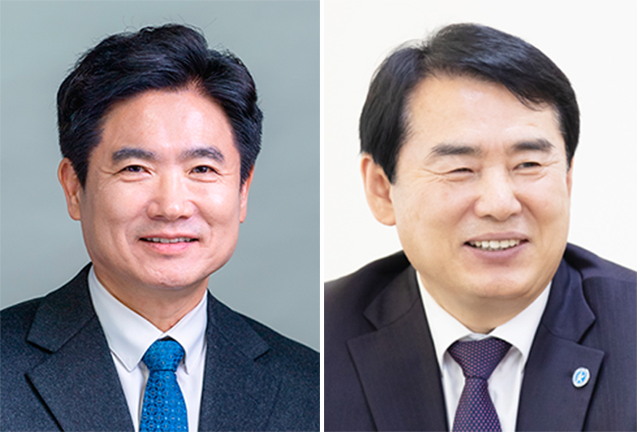 Daejung Kim, Former Superintendent of Jeonnam Education (left), Jeongseon Lee, Superintendent of Gwangju Education (right)
Superintendent Kim advocates for "immediate integration," proposing that a unified superintendent be elected in the upcoming local elections in June. Kim argues that "educational integration is essential to fully realize the value of administrative integration," and maintains that aligning the integration of administrative districts and education will maximize policy efficiency.
On the other hand, Superintendent Lee has called for a more cautious approach, suggesting that integration should occur in the following election after a grace period. Lee emphasized that "integration without sufficient financial and institutional support will only cause confusion in the field," stressing the need for a thorough deliberation process.
The difference in their stances is believed to be influenced by the results of recent public opinion polls.
In a poll on the suitability of candidates for the unified superintendent position conducted by OhmyNews Gwangju-Jeolla Headquarters on January 19, Superintendent Kim ranked first with 20.8%, significantly ahead of Superintendent Lee, who received 9.8%, outside the margin of error. However, among respondents from the Gwangju area only, Superintendent Lee led with 14.3%.
Notably, in the "December 2025 Superintendent Job Performance Evaluation" released by Realmeter, Superintendent Kim ranked first nationwide with 53.6%, while Superintendent Lee ranked 12th with 36.3%, highlighting a stark contrast.
The fact that Jeonnam has a larger population than Gwangju and that Superintendent Kim has higher recognition appears to have contributed to Superintendent Lee's cautious stance.
On the ground, there is a mix of anticipation and concern. There is considerable optimism about integration, with some suggesting that combining Gwangju's excellent educational infrastructure with Jeonnam's ecological education resources could create an educational environment comparable to that of the Seoul metropolitan area.
In particular, some analyses suggest that if financial incentives from the government upon integration are invested in improving educational conditions, it could help prevent the outflow of local talent. The creation of a mega education office serving a population of 3 million would increase the education budget and accelerate the development of high-quality educational programs and the expansion of educational facilities.
An education expert commented, "If the launch of an integrated education office brings together the educational capabilities of Gwangju and Jeonnam, it could provide an opportunity to overcome the crisis of regional decline through education," adding, "In the long term, it could mark a new turning point for educational development in the Honam region."
Among parents, there are also voices welcoming integration if it can provide better educational opportunities for their children. One parent expressed hope, saying, "If Gwangju and Jeonnam join forces, the quality of education will improve and students will have access to a wider variety of educational programs."
Some education officials emphasize that integration could enhance the consistency and efficiency of education policy. They explain that if the two regional education offices integrate projects that were previously duplicated, it could not only save budget but also improve the quality of educational services.
However, there are also significant concerns. The teaching community worries about personnel chaos, such as Gwangju teachers being reassigned to remote areas in Jeonnam. Parents are also busy weighing the pros and cons, with concerns in Jeonnam about the reduction of special admissions for rural areas, and in Gwangju about a potential decline in academic standards.
An education official stated, "The most important thing is consensus among residents and education stakeholders," adding, "The protection of personnel rights and support policies for rural education must be clearly stipulated by special law in order to drive integration forward."
© The Asia Business Daily(www.asiae.co.kr). All rights reserved.
![Clutching a Stolen Dior Bag, Saying "I Hate Being Poor but Real"... The Grotesque Con of a "Human Knockoff" [Slate]](https://cwcontent.asiae.co.kr/asiaresize/183/2026021902243444107_1771435474.jpg)
















