Per Household Agricultural Income Reaches 10.17 Million Won in 2025, Up 6.2% Year-on-Year
Driven by Rising Rice Prices and Lower Management Costs
"Agricultural Income Expected to Continue Rising This Year"
Last year, agricultural income surpassed 10 million won. This was attributed to a rise in rice prices, which has a significant impact on agricultural income, as well as reduced management costs resulting from lower international oil prices and support for agricultural materials.
On January 22, the Korea Rural Economic Institute released its report titled "2026 Trends and Outlook for Agriculture and Farmhouse Economy," which included these findings.
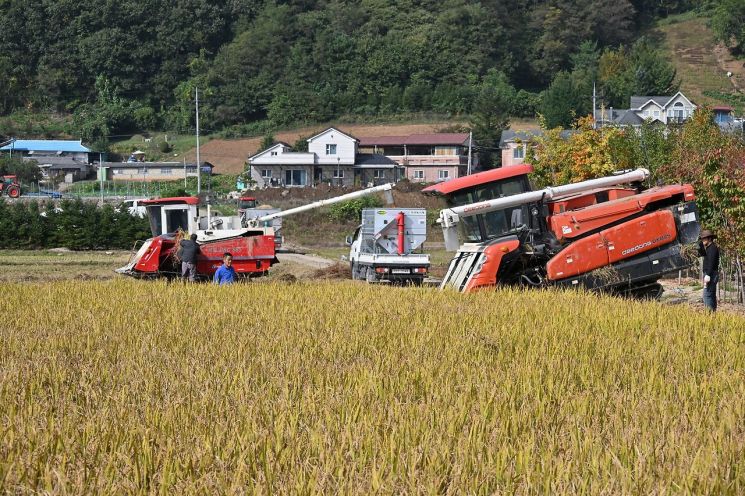
Kim Yongryul, Director of the Agricultural Outlook Center at the Korea Rural Economic Institute, stated, "In 2025, Korean agriculture faced difficult conditions, including intensifying climate change, global geopolitical instability, and record-breaking large-scale wildfires. However, due to government policies such as strategic crop direct payments and a reduction in rice cultivation area, rice prices recovered. As a result, both the total agricultural production value (up 3.2% year-on-year) and farm household income increased compared to the previous year."
The agricultural production value, which represents the total value of domestically produced agricultural products, was estimated at 62.7389 trillion won last year, a 3.2% increase from the previous year. Due to higher rice prices, a recovery in vegetable yields, and increased fruit production, the production value of crop farming rose by 1.4% year-on-year to 37.2084 trillion won. Meanwhile, the production value of the livestock industry increased by 6.1% to 25.5305 trillion won, driven by higher consumption demand for Korean beef and pork.
Farm household income per household, which includes agricultural income, non-farm income, transfer income, and non-recurring income, increased by 2.5% last year to 51.88 million won. In particular, due to higher total income such as rising rice prices, agricultural income per household was estimated at 10.17 million won, a 6.2% increase from the previous year. Agricultural income, which stood at 11.14 million won in 2023, had dropped below 10 million won to 9.58 million won in 2024, but has now recovered to the 10 million won range.
With the diversification of rural economic activities, non-farm income per household increased by 0.4% year-on-year to 20.23 million won, while transfer income per household rose by 3.8% to 18.93 million won, driven by an expansion in direct payment programs. This year, the agricultural production value is projected to increase by 1.0% year-on-year to 63.3757 trillion won, due to policy support such as strategic crop direct payments and increased production of food crops, vegetables, and fruits.
Both farm household income and agricultural income are expected to continue rising this year. The institute forecasts that farm household income per household will reach 53.33 million won, up 2.8%, and agricultural income will reach 10.74 million won, up 5.6%. Director Kim commented, "In 2026, economic uncertainties such as rising exchange rates and geopolitical risks will persist. However, with ongoing policy support efforts such as declining international oil prices, support for agricultural materials, and expanded public direct payments, the management environment for farm households is expected to improve. As the total agricultural production value increases, the upward trend in farm household income is likely to continue."
This year, grain consumption is expected to rise, while fruit and meat consumption is projected to decline. According to the institute, per capita grain consumption is forecast to increase by 1.0% year-on-year to 135.6 kg, while meat consumption is expected to decrease by 1.1% to 59.3 kg. Vegetable consumption is expected to remain at a similar level to the previous year, while consumption of both domestic and imported fruits is projected to decrease by 1.9% and 1.2%, respectively, compared to the previous year.
The agricultural and food trade deficit is expected to narrow as exports increase. This year, agricultural and food exports (excluding forest products) are projected to reach 10.7316 billion dollars, a 9% increase. Including forest products (wood and forest by-products), total exports are expected to exceed 11.1761 billion dollars. Agricultural and food imports are forecast to decrease by 0.6% year-on-year, resulting in a trade deficit of 26.1304 billion dollars, a 4.0% reduction from the previous year.
© The Asia Business Daily(www.asiae.co.kr). All rights reserved.

















