Calls for Participation from Stakeholder Local Governments and Civil Society in Seocheon and Gunsan
"Phased Restoration Is More Realistic Than Full Opening"
With the Geumgang Estuary now included in President Lee Jaemyung's national agenda for estuarine ecological restoration, the initiative has entered a full-fledged implementation phase. However, concerns have been raised that a government-led approach alone has its limitations.
It has been argued that establishing a public-private governance structure-one that includes the local governments of Seocheon County in South Chungcheong Province, Gunsan City in North Jeolla Province, local civil society, and farmers and fishers-is essential to the success of the restoration effort.
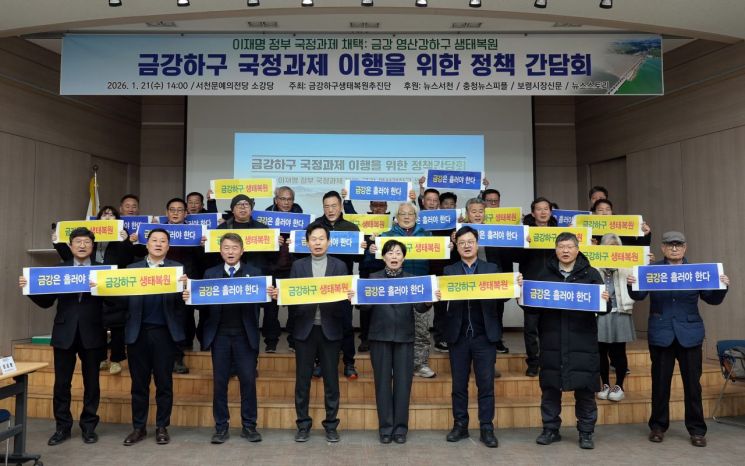
The Geumgang Estuary Ecological Restoration Task Force held a 'Geumgang Estuary National Agenda Implementation Policy Meeting' on January 21 in the small auditorium of the Seocheon Culture and Arts Center in South Chungcheong Province, where they discussed the direction of the national agenda and strategies for regional cooperation.
More than 50 people attended the meeting, including members of the task force, local assembly members, former and current public officials, and representatives from environmental, farming, and fishing organizations.
Yang Geumbong, head of the Geumgang Estuary Ecological Restoration Task Force, stated, "Restoring the Geumgang Estuary is a matter of agriculture, fisheries, and the survival of the region," and emphasized, "Now that it has been adopted as a national agenda item, we must approach it with the determination that this is our last opportunity."
In a presentation at the meeting, Kim Youngil, Senior Researcher at the Chungnam Institute, explained, "The estuary barrage has led to water quality deterioration, sediment accumulation, and the collapse of the brackish water ecosystem, all of which are negatively impacting agriculture and fisheries as a whole." He added, "If the water intake facilities are relocated upstream, the water usage issue can be technically resolved."
Lee Kyungseok, team leader of the Water Management Policy Division at the South Chungcheong Provincial Government, stated, "The Ministry of Environment is currently conducting a feasibility study on the Geumgang Estuary, and is in discussions with the central government to enact a special law for estuary restoration."
Kim Eoksu, Secretary-General of the Task Force, noted, "The Geumgang Estuary involves multiple local governments in South Chungcheong and North Jeolla Provinces, making it difficult to approach as a simple administrative project." He added, "While full opening is the ultimate goal, a phased restoration within a 10-kilometer radius is a realistic alternative for now."
Some attendees called for the formation of an inter-municipal consultative body.
Nam Daejin, Co-Representative of the Gunsan Environmental Movement Union, proposed, "If Seocheon and Gunsan do not respond jointly, it will be difficult to resolve the issue. After the local elections, an official consultative body involving the heads of both local governments should be established."
Jeong Chungsik, Secretary-General of the Jeonbuk Provincial Federation of the Korean Peasants League, said, "Farmers have vague anxieties about the distribution of seawater. The authorities must take the initiative to provide sufficient explanations and build trust."
Yoo Seungkwang, former Standing Chair of the National Estuary Ecological Restoration Council, emphasized, "Adoption as a national agenda item is only the beginning. Enactment of a special law for estuary restoration and a responsible role by metropolitan governments must follow."
Nah Soyul, former Vice Governor for Culture and Sports of South Chungcheong Province, stated, "Although there were various constraints in past negotiations with Gunsan, this time, since it has been adopted as a national project, we must achieve tangible results."
Yang Geumbong, head of the task force, remarked, "The cost of restoration will snowball as time passes. If we do not make a decision now, the next generation will bear an even greater burden."
He also criticized the passive attitude of some local governments, saying, "Slogans without action cannot protect the livelihoods of fishers and residents."
Meanwhile, the task force plans to soon meet with Prime Minister Kim Minseok to urge the prompt implementation of the Geumgang Estuary ecological restoration national agenda and to request comprehensive government support.
© The Asia Business Daily(www.asiae.co.kr). All rights reserved.

![Clutching a Stolen Dior Bag, Saying "I Hate Being Poor but Real"... The Grotesque Con of a "Human Knockoff" [Slate]](https://cwcontent.asiae.co.kr/asiaresize/183/2026021902243444107_1771435474.jpg)















