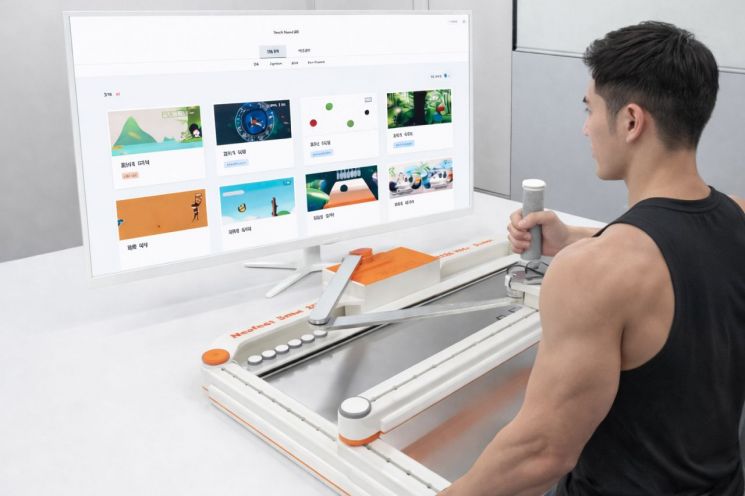
Neofect, a company that has grown based on artificial intelligence (AI) and robotics technology, is introducing a next-generation rehabilitation device by combining an advanced robotics module with its existing flagship product, the "Smart Board." The core concept is "Evolution." The strategy is to maintain its existing user base while significantly enhancing robot control and interaction capabilities.
On January 22, Neofect announced that it will unveil its new product, tentatively named "Smart Board Robotics," for the first time at the "WHX Dubai 2026" International Medical Device Exhibition, which will be held in Dubai, UAE, on February 9.
WHX Dubai 2026 is considered the world’s largest healthcare exhibition, attracting over 270,000 visitors from more than 180 countries. Approximately 4,800 companies participate, sharing global medical device market trends and expanding connections with regional buyers.
The existing Smart Board is a digital rehabilitation device designed for patients who have lost upper limb motor function due to neurological diseases such as stroke or musculoskeletal disorders. When a patient places their arm on the board and moves it, the device tracks the movement, facilitating shoulder and elbow joint range-of-motion improvement and cognitive rehabilitation training. Since its launch in 2016, it has become Neofect’s flagship product, currently used in over 600 hospitals and clinics in Korea and abroad.
The newly unveiled "Smart Board Robotics" is a modular, upgraded version that adds intelligent robot control functions to the existing manual device. Notably, it is designed with a plug-and-play structure, allowing existing board users to add the robotics module without replacing the entire hardware, thereby ensuring both cost efficiency and scalability.
Key features include CPM (Continuous Passive Motion), Active Assist, and Resist modes, enabling customized training tailored to each patient's stage of recovery. In addition, haptic feedback technology has been applied to deliver a more immersive user experience.
A Neofect representative stated, "The core lies in robotic interaction that enables more precise control throughout the entire rehabilitation process," adding, "We believe we can expand our target market to include the bio-rehabilitation AI robot sector."
Based on its accumulated research and development expertise, Neofect has steadily built up its robotics technology capabilities by jointly carrying out government projects such as the Core Robot Technology Development Project (Korea Evaluation Institute of Industrial Technology), Healthcare Technology R&D (Ministry of Health and Welfare), and the implementation of ultra-realistic services maximizing communication and experience (Electronics and Telecommunications Research Institute).
With this exhibition, Neofect plans to actively target the Middle Eastern market. Following the acquisition of medical device approval in Saudi Arabia last year, the company aims to further strengthen its supply chain connecting the Middle East and Europe through collaboration with its European subsidiary.
Through this new product, the company expects to improve profitability by expanding sales of high-value-added robotics modules in addition to the stable revenue generated from its existing customer base. The structure of selling high-margin modules to its established user base is said to be advantageous for increasing per-unit profitability.
Neofect's own analysis suggests that this growth in revenue and improved profitability could lead to a revaluation of the company’s overall valuation. Leveraging its accumulated robotics technology, extensive data and operational know-how from multinational patients in rehabilitation, and overseas sales subsidiaries, Neofect plans to diversify its application areas and further solidify its position in the overall bio-robotics market.
© The Asia Business Daily(www.asiae.co.kr). All rights reserved.
![Clutching a Stolen Dior Bag, Saying "I Hate Being Poor but Real"... The Grotesque Con of a "Human Knockoff" [Slate]](https://cwcontent.asiae.co.kr/asiaresize/183/2026021902243444107_1771435474.jpg)
















