The "Caregiving SOS Project," a program initiated by Gyeonggi Province to provide caregiving cost support for low-income seniors-the first of its kind among metropolitan governments in Korea-will be expanded to 16 cities and counties this year.
The Caregiving SOS Project is designed to proactively address the growing burden of caregiving as the region enters a super-aged society. It provides up to 1.2 million won per year in caregiving expenses to low-income residents aged 65 and older within the province.
In its first year of implementation last year, the project was carried out in 15 cities and counties, including Pyeongtaek and Icheon, resulting in 1,346 cases of support and establishing itself as a highly effective care policy. Starting this year, Pocheon City has joined the project, expanding its coverage to 16 cities and counties.
Low-income seniors aged 65 and older residing in the designated areas can apply for caregiving support for cases occurring this year through their local eup, myeon, or dong administrative welfare centers, or via the Gyeonggi Minwon 24 online platform.
According to the Gyeonggi Welfare Foundation, among last year’s Caregiving SOS Project beneficiaries, those in their 80s accounted for the largest share at 42.1%, followed by those in their 70s (33.7%), those aged 90 or older (12.2%), and those in their 60s (12.0%). In terms of support amounts, 65.1% received more than 1 million won, the highest proportion, followed by 500,000 to 1 million won (21.4%) and 500,000 won or less (13.5%).
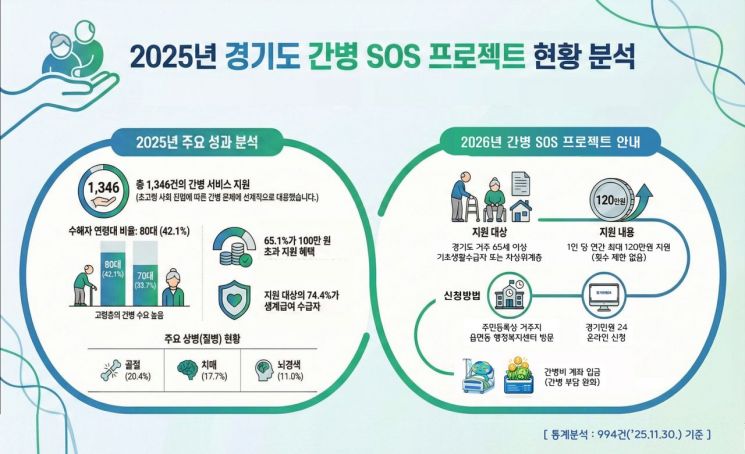
By eligibility category, recipients of basic livelihood benefits made up the majority at 74.4%, followed by housing benefit recipients (10.9%), medical benefit recipients (8.4%), and the near-poor (6.3%).
An analysis of the medical service usage patterns of these beneficiaries showed that general hospitals and hospitals were used most frequently at 52.8%, followed by long-term care hospitals (39.8%) and tertiary hospitals (7.4%). The main diagnoses were fractures (20.4%), dementia (17.7%), cerebral infarction (11.0%), pneumonia (9.3%), and cancer (7.9%), indicating a high demand for caregiving among those with severe or chronic illnesses that make daily living difficult.
In terms of caregiving duration, short-term use of 15 days or less was most common at 41.6%, followed by 31-90 days (28.4%), 16-30 days (16.1%), and long-term care of 91 days or more (13.9%).
Park Mijeong, Director of Senior Welfare at Gyeonggi Province, stated, "The Caregiving SOS Project is more than just financial support; it is a policy aimed at alleviating the economic, physical, and mental burdens that come with family caregiving. Based on the research findings of the Gyeonggi Welfare Foundation, we will continue to coordinate with local governments to ensure that more residents can benefit from this initiative."
© The Asia Business Daily(www.asiae.co.kr). All rights reserved.
![Clutching a Stolen Dior Bag, Saying "I Hate Being Poor but Real"... The Grotesque Con of a "Human Knockoff" [Slate]](https://cwcontent.asiae.co.kr/asiaresize/183/2026021902243444107_1771435474.jpg)
















