First Citywide Opening in Korea
Call for Participating Companies Next Month
"A Chance to Narrow the Gap with the US and China"
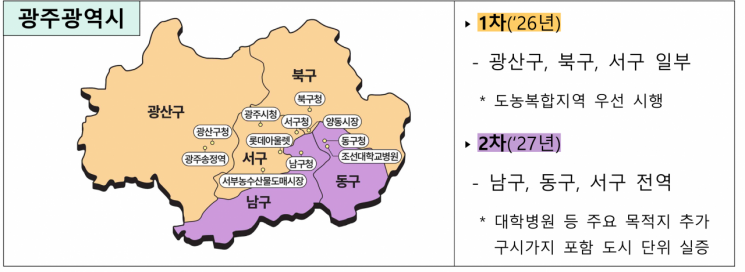
The government has designated the entire city of Gwangju as an autonomous driving demonstration zone and will deploy 200 dedicated vehicles. This is the first time in Korea that an entire city, rather than specific routes or districts, will be opened to autonomous vehicles.
On January 22, the Ministry of Land, Infrastructure and Transport announced the "Autonomous Driving Demonstration City Promotion Plan," which includes these measures. The initiative aims to boost Korea's lagging competitiveness in autonomous driving technology compared to the United States and China by conducting large-scale demonstrations on public roads.
Lagging Behind the US and China: "Elementary School Level"
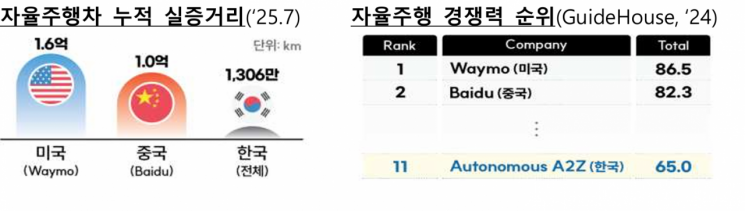 Cumulative Autonomous Vehicle Test Distance as of July Last Year (Left), 2024 Autonomous Driving Competitiveness Rankings. Ministry of Land, Infrastructure and Transport
This plan stems from a sense of crisis that Korea's autonomous driving technology is falling behind in global competition. According to the Ministry, Waymo from the United States ranked first and Baidu from China ranked second in the autonomous driving competitiveness rankings, while Korean companies were placed at 11th. In terms of cumulative test mileage, Waymo recorded 160 million kilometers, Baidu 100 million kilometers, but Korea only reached a combined total of 13.06 million kilometers.
The gap in technology is attributed to differences in capital. Baidu has invested 36 trillion won in autonomous driving, Waymo 16.2 trillion won, but Korea's leading company, Autonomous A2Z, has invested only about 82 billion won. The Ministry of Land, Infrastructure and Transport analyzed that since the domestic autonomous driving sector is centered around startups, there are limitations in securing expensive graphics processing units (GPUs), recruiting artificial intelligence (AI) talent, and increasing the number of vehicles.
Minister Kim Yoonduk of the Ministry of Land, Infrastructure and Transport stated, "If the level of autonomous driving technology in the US and China is that of adults, ours is at an elementary school level," adding, "This may be our last chance to overcome the technology gap."
Alleyways and Commutes Included in Demonstrations
Gwangju was selected as the first demonstration city because, as a metropolitan city with a population of over 1.3 million and both urban and rural characteristics, it enables large-scale demonstrations in diverse environments. Although 55 pilot operation zones have been designated nationwide, most are focused on specific routes, making it difficult to train for various scenarios such as intersections, alleyways, and rush hours.
The demonstrations will be expanded in stages. This year, they will begin in new town and suburban areas with low traffic and good road infrastructure, such as parts of Gwangsan-gu, Buk-gu, and Seo-gu. Next year, the scope will be expanded to include all of Nam-gu, Dong-gu, and Seo-gu, covering major destinations such as university hospitals and old city centers.
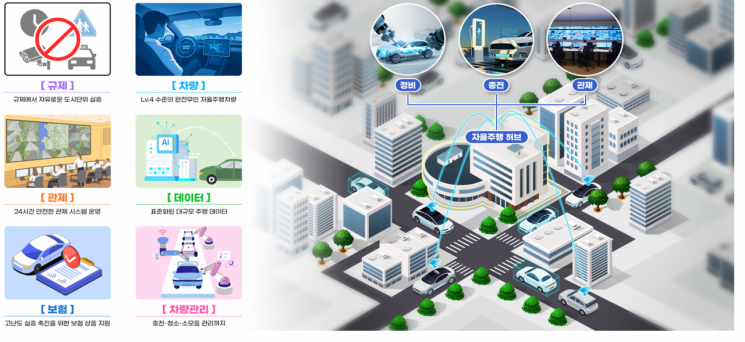
Regulatory exemptions will also be granted so that autonomous driving companies can focus on technology development. Gwangju City plans to apply for a regulatory sandbox to lift restrictions on AI training using original video data, demonstrations in school zones, and remote control operations.
Three Companies Selected, 200 Vehicles Allocated Differently
The Ministry of Land, Infrastructure and Transport will accept applications from participating companies for about a month starting early next month and will select around three companies by April. The target is domestic autonomous driving companies capable of large-scale demonstrations at Level 3 or higher. Through document reviews and real vehicle driving tests at K-City, 200 dedicated vehicles will be allocated according to each company's technical and operational capabilities.
Unlike before, the dedicated vehicles will not be retrofitted production cars but software-defined vehicles (SDVs) optimized for autonomous driving technology. Steering, braking, power, and communications systems will be designed with redundancy to prepare for unmanned autonomous driving.
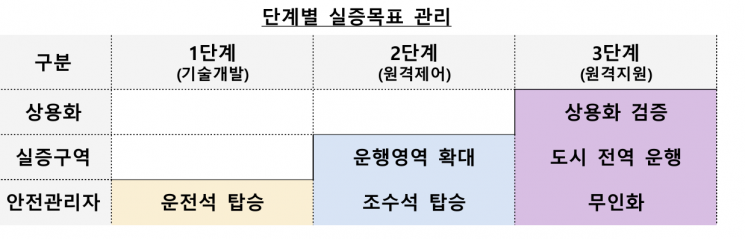
In the first stage of the demonstration, a test driver will remain in the driver’s seat while developing full-route autonomous driving and remote control technologies. In the second stage, the driver will move to the passenger seat, and in the third stage, the service will transition to fully unmanned autonomous driving to verify commercial viability. If the same type of accident is repeated due to technical issues or if there is no improvement over a certain period, the number of vehicles allocated to the company will be reduced.
Support for GPUs, Insurance, and Personnel
The government will also provide the necessary infrastructure for data training. In cooperation with the Gwangju National AI Data Center, it will provide 200 dedicated H100 GPUs for end-to-end AI training and is considering allocating more than 2,000 out of the 5,000 B200 GPUs secured for national projects to autonomous driving.
An operational system for 24-hour service will be established. The 200 vehicles will be managed as a fleet, and in the early stages of the demonstration, more than 500 personnel-including 400 test drivers working in two shifts, as well as control, emergency response, and vehicle management staff-will be deployed.
A dedicated insurance product is also being developed with the goal of launching in May to reduce the burden on companies in case of accidents. The structure bundles general insurance combining automobile, product liability, AI, control, and cybersecurity coverage, compensates victims first, and then allocates responsibility according to the cause of the accident.
© The Asia Business Daily(www.asiae.co.kr). All rights reserved.
![Clutching a Stolen Dior Bag, Saying "I Hate Being Poor but Real"... The Grotesque Con of a "Human Knockoff" [Slate]](https://cwcontent.asiae.co.kr/asiaresize/183/2026021902243444107_1771435474.jpg)


















