Court Finds Han Guilty on Most Charges
"If Han Had Fulfilled His Duties as Prime Minister, Yoon's Martial Law Could Have Been Prevented"
Taken Into Custody in Court... First Time for a Former Prime Minister
Former Prime Minister Han Ducksoo, accused of aiding and abetting the leader of the insurrection, was sentenced to 23 years in prison and was taken into custody in court after the first trial. This is a much heavier sentence than the 15 years in prison requested by Special Prosecutor Cho Eunseok's team, exceeding it by 8 years. The court determined that former President Yoon Sukyeol's December 3 Martial Law Incident constituted a "palace coup d'etat" that falls under the crime of insurrection as defined by the Criminal Act.
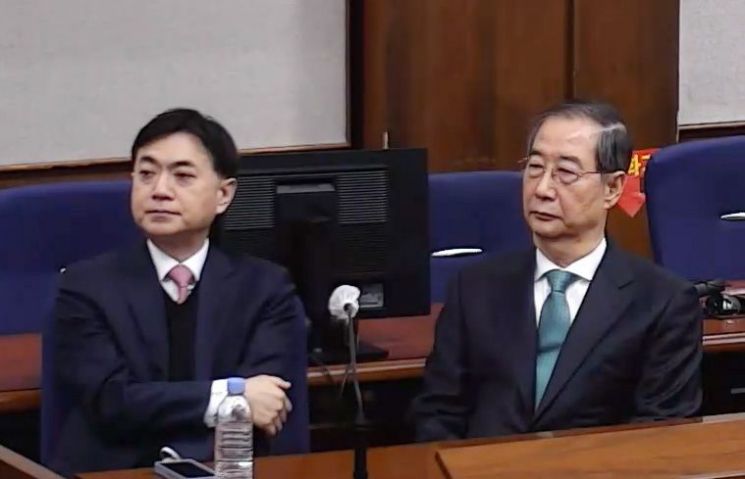 Han Ducksoo, former Prime Minister, accused of engaging in important duties related to internal rebellion, is attending the first trial sentencing hearing held at the Seoul Central District Court on the 21st. Photo by Yonhap News Agency, provided by Seoul Central District Court
The 33rd Criminal Division of the Seoul Central District Court (Presiding Judge Lee Jinkwan) sentenced former Prime Minister Han to 23 years in prison at 2 p.m. on the 21st on charges including aiding and abetting the leader of the insurrection, engaging in important duties related to the insurrection, and perjury.
The court found that the declaration of martial law on December 3 and the issuance of proclamations constituted insurrection as defined by Article 73 of the Criminal Act, and found Han guilty of most of the charges against him. Specifically, the court found him guilty for creating the appearance that the declaration of martial law was made after deliberation by the Cabinet, attempting to have Cabinet members sign related documents after the declaration, discussing with former Minister of the Interior and Safety Lee Sangmin ways to block key institutions and cut off power and water to media companies, and committing perjury at the Constitutional Court last year.
However, the court found Han not guilty on some charges, such as calling then-ruling party floor leader Chu Kyungho after the declaration of martial law to check the situation at the National Assembly and whether it had been notified, delaying Cabinet deliberation on lifting martial law, and exercising the false document "post-facto martial law proclamation."
The court stated, "The December 3 insurrection shook the very foundation of the people's faith in democracy and the rule of law by having an elected leader disregard and violate the Constitution and laws through acts of insurrection. The economic and political shock that South Korea will experience from the occurrence of a 'palace coup d'etat' is incomparable to previous acts of insurrection."
The court continued, "Although there were no deaths during the December 3 insurrection and the insurrection itself ended within a few hours, this was due to the courage of the people who defended the National Assembly unarmed against the martial law troops. It was also due to the efforts of certain politicians who quickly entered the National Assembly to demand the lifting of martial law, and the actions of some military and police officers who either resisted illegal orders or, even if they complied, did so passively. It was never due to the actions of those who participated in the insurrection."
The court further stated, "Even indirectly, as Prime Minister, who is entrusted with democratic legitimacy and responsibility, the defendant had a duty to comply with the Constitution and laws and to do everything possible to defend and realize the Constitution. Nevertheless, believing that the December 3 insurrection might succeed, he ultimately neglected these duties and responsibilities and chose to participate as a member of the plot." The court added that if Han had fulfilled his role as Prime Minister, the insurrection, including President Yoon's declaration of martial law, could have been easily prevented.
The court also said, "When his crimes were revealed and he faced criminal punishment, he reluctantly expressed regret only during his final statement, but it is difficult to accept the sincerity of that apology. There is no evidence that the defendant has seriously reflected on his actions or made any effort to remedy the harm suffered by the nation and its people as a result of his crimes."
Han Ducksoo Taken Into Custody for "Risk of Evidence Destruction"... "I Will Humbly Accept the Court's Decision"
After the sentencing, the court conducted a separate hearing to determine whether Han should be taken into custody and decided to detain him in court, citing "risk of evidence destruction." Sitting in the defendant's seat, Han quietly said, "I will humbly accept the court's decision," when asked for his opinion on the detention.
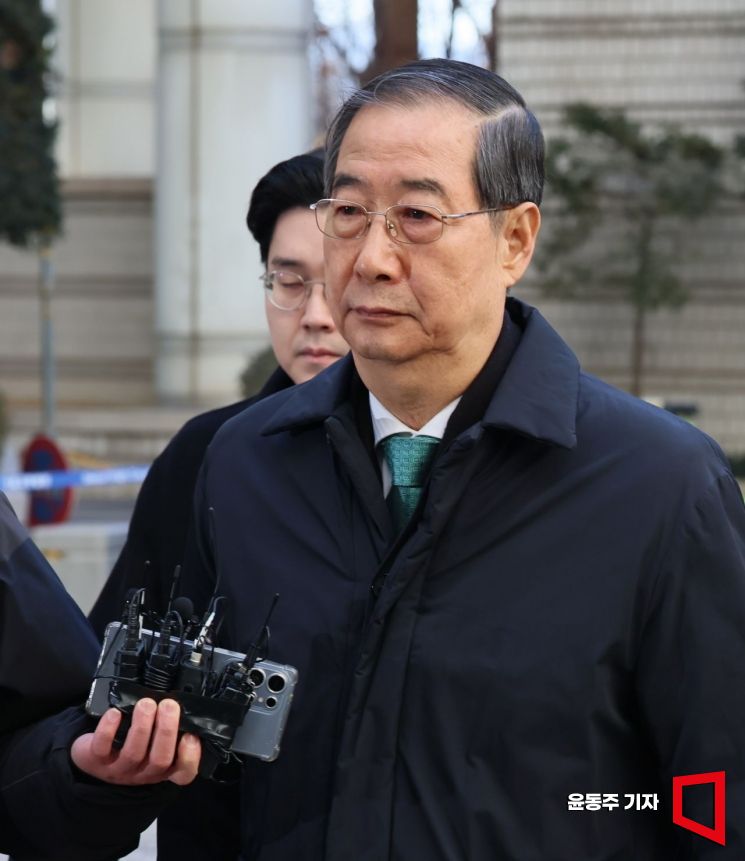 Former Prime Minister Han Duck-soo, accused of aiding and abetting the leader of the insurrection, is attending the first trial sentencing hearing held at the Seoul Central District Court on January 21, 2026. Photo by Yoon Dongju
As the "second-in-command" of the government, Han had a duty to check the arbitrary abuse of presidential power, but he was indicted on August 29 last year for aiding and abetting the insurrection by helping to create a "procedural appearance" through convening Cabinet meetings and urging the attendance of Cabinet members before and after the declaration of martial law. He also faces charges of instructing the drafting and destruction of a false martial law proclamation and perjury for testifying as a witness in the Constitutional Court's impeachment trial, claiming he was unaware of the proclamation.
Special Prosecutor Cho's team requested a 15-year prison sentence at the final hearing on November 26 last year. The prosecution pointed out, "Although he was virtually the only person who could have stopped the insurrection, he abandoned his duty as a servant of the entire people and participated in the insurrection through a series of actions before and after the declaration of martial law."
In his final statement, Han argued, "Although I failed to prevent the declaration of martial law, I never supported or tried to help it. The moment the President said he would declare martial law, I was shocked beyond words and said I could never agree, but I thought there was no way to stop it." His defense team also argued that Han could not have intentionally aided the insurrection because he was unaware of the specific acts, and that it is not possible to connect the Prime Minister's constitutional and legal duty to stop martial law to criminal liability.
The sentencing was broadcast live on TV and other media. Of the three special prosecutor cases (insurrection, Kim Gunhee, and the death of a Marine in the line of duty), this was the second time a sentencing was broadcast live, following the January 16 sentencing of former President Yoon Sukyeol for obstruction of arrest. This is the first time the sentencing of a defendant who is not a former president has been broadcast live.
© The Asia Business Daily(www.asiae.co.kr). All rights reserved.


















