Industry Expects Policy Direction to Become More Favorable
Watching for Falling Overseas Interest Rates and Rising Investor Demand
Hyundai Most Proactive; Shinhan, Woori, Hana Also Considering
As the USD-KRW exchange rate surged, it has been revealed that many credit card companies are considering issuing foreign debt. The intention is to actively secure funding through foreign debt issuance if signals such as lower overseas market interest rates and increased investor demand are detected. Credit card companies and other specialized credit finance companies (SCFCs), which have been facing difficulties as the interest rates on SCFC bonds, their main funding source, have risen to the mid-3% range, believe that increasing foreign debt issuance could help diversify their risks.
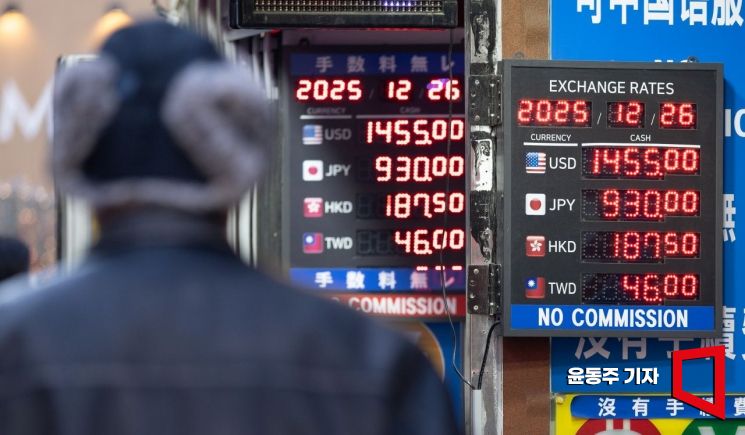 On the 26th, amid the government's strong response, the USD-KRW exchange rate is rapidly falling, and the rates are displayed on an electronic board at a currency exchange street in Myeongdong, Jung-gu, Seoul. 2025.12.26 Photo by Dongju Yoon
According to the financial sector on January 22, seven major credit card companies (Samsung, Shinhan, Hyundai, KB Kookmin, Woori, Hana, and Lotte Card), excluding BC Card, which has little overseas funding demand, are closely monitoring exchange rate trends and government policies while considering diversification of funding channels, including foreign debt issuance. The previous day, the USD-KRW exchange rate closed at 1,471.3 won in the Seoul foreign exchange market, down 6.8 won from the previous trading day. This represents a 2.2% (31.8 won) increase compared to the same period last year.
Recently, the government has been considering measures such as having the National Pension Service issue foreign debt to defend against the surging exchange rate and to diversify risks. This is because issuing bonds overseas and converting the proceeds into won during periods of rapid exchange rate increases can boost demand for the won, leading to a lower exchange rate (appreciation of the won).
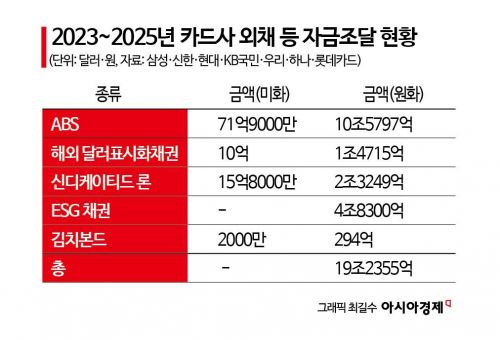
Credit card companies have continued to expand their funding sources, including foreign debt, in preparation for industry downturns and economic recessions. The total amount of asset-backed securities (ABS), overseas dollar-denominated bonds, syndicated loans, ESG (Environmental, Social, and Governance) bonds, and Kimchi bonds issued by the seven major credit card companies over the past three years, from 2023 to last year, reached approximately 19.2355 trillion won.
On January 19, Hyundai Card resumed the issuance of Kimchi bonds worth 20 million dollars (about 2.94 billion won), taking the most proactive stance in the industry. This is the first time in 15 years since investments in Kimchi bonds for won currency exchange purposes were restricted in 2011. Kimchi bonds refer to foreign currency-denominated bonds issued by domestic or foreign companies in the Korean market.
Hyundai Card is the most active in planning future foreign currency borrowing, including Kimchi bonds, and Shinhan, Woori, and Hana Card have also established plans to consider issuing foreign currency bonds. Samsung, KB Kookmin, and Lotte Card have not yet established concrete plans but are closely monitoring market conditions. Lotte Card, in particular, is considering issuing ABS worth 300 million dollars (about 450 billion won).
However, the fact that the interest rates on foreign debt issuance are higher than those of domestic bonds remains a burden. There is also a cautious view that it is desirable to proceed with issuance only after confirming strong investor demand. Seo Jiyong, Professor of Business Administration at Sangmyung University, advised, "Unlike in the past, it is highly likely that financial authorities will review foreign debt issuance favorably," and added, "Credit card companies should actively secure funding sources other than SCFC bonds by leveraging macroeconomic conditions."
A credit card company representative stated, "Going forward, we expect financial authorities to implement foreign currency funding policies flexibly to improve foreign currency liquidity and ease downward pressure on the won." Another representative also emphasized, "Attracting overseas funds through foreign debt issuance, such as Kimchi bonds, is positive not only for stabilizing the exchange rate but also for diversifying funding sources from a corporate perspective."
© The Asia Business Daily(www.asiae.co.kr). All rights reserved.
![Clutching a Stolen Dior Bag, Saying "I Hate Being Poor but Real"... The Grotesque Con of a "Human Knockoff" [Slate]](https://cwcontent.asiae.co.kr/asiaresize/183/2026021902243444107_1771435474.jpg)

















