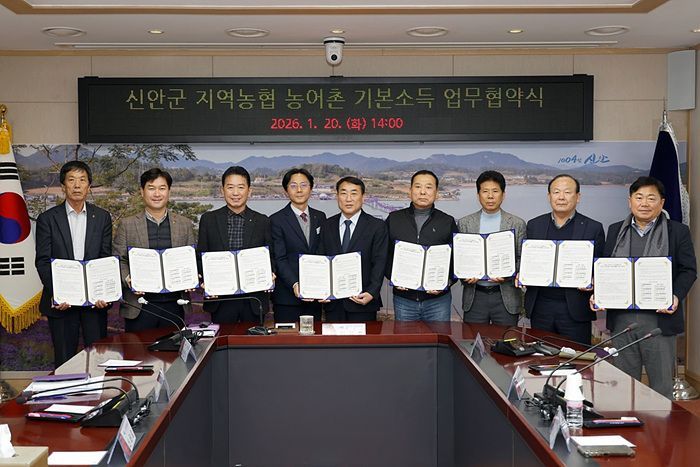
 On the 20th, a basic income business agreement for agricultural and fishery villages was signed with local agricultural cooperatives in Sinan County. (From left) Jang Raehoon, head of Namsinan Agricultural Cooperative; Jin Wansan, head of Imja Agricultural Cooperative; Kim Kyungcheol, head of Docho Agricultural Cooperative; Bang Hyunyong, head of Mokpo Sinan branch of the National Agricultural Cooperative Federation; Kim Daein, deputy governor acting as Sinan County governor; Yang Youngmo, head of Buksinan Agricultural Cooperative; Cho Youngbeom, head of Sinan Agricultural Cooperative; Choi Seungyoung, head of Bigeum Agricultural Cooperative; Kim Wankyu, head of Aphae Agricultural Cooperative. Provided by Sinan County
Sinan County in South Jeolla Province announced on January 20 that it had signed a 'Rural Basic Income Regional Coexistence Activities Memorandum of Understanding (MOU)' with seven local agricultural cooperatives in the county.
According to the county, this agreement was established to enhance the effectiveness of the rural basic income pilot project scheduled for implementation in 2026-2027, and to improve the quality of life for residents of islands and remote areas.
In principle, the rural basic income can only be used at certain large retail facilities such as Hanaro Mart. However, the county decided to allow the use of basic income at Hanaro Mart, on the condition that local agricultural cooperatives actively carry out regional coexistence activities and reinvestment projects.
As a result, the cooperatives will independently implement community-focused support projects, not only for their members but also for all residents of towns, townships, and affiliated islands, as well as remote island residents.
Key areas of support include operating mobile stores and markets for remote islands, delivery services for daily necessities, mart goods, fuel, and agricultural materials, rental and repair of agricultural machinery, farm work agency services, lunchbox services, subsidies for ferry and vehicle transportation fees, and sharing of side dishes and kimchi with vulnerable groups.
The county plans to regularly monitor the performance and results of the cooperatives' coexistence activities to ensure that basic income can be practically used in residents' daily lives. The county will also improve payment accessibility and institutionally link the cooperatives’ regional reinvestment functions to strengthen the coexistence structure.
This agreement also includes measures to establish a community fund to support goods and services that are difficult to supply locally. In addition, it contains provisions for the cooperatives to contribute or donate a portion of the revenue generated from the use of basic income.
A county official stated, "For basic income, it is more important how conveniently residents can use it in their daily lives than the payment itself," adding, "Through this agreement, we aim to improve the quality of life for all county residents, including those on remote islands, and to build a coexistence model in which basic income circulates within the local community."
© The Asia Business Daily(www.asiae.co.kr). All rights reserved.
![Clutching a Stolen Dior Bag, Saying "I Hate Being Poor but Real"... The Grotesque Con of a "Human Knockoff" [Slate]](https://cwcontent.asiae.co.kr/asiaresize/183/2026021902243444107_1771435474.jpg)
















