Sculptures and Paintings That Express Love and Parting Through Formative Language
Figures of Humanity Enduring an Age of Turmoil
"Longing is not a feeling that reminisces about the past, but a gesture of life that we must embrace and live with."
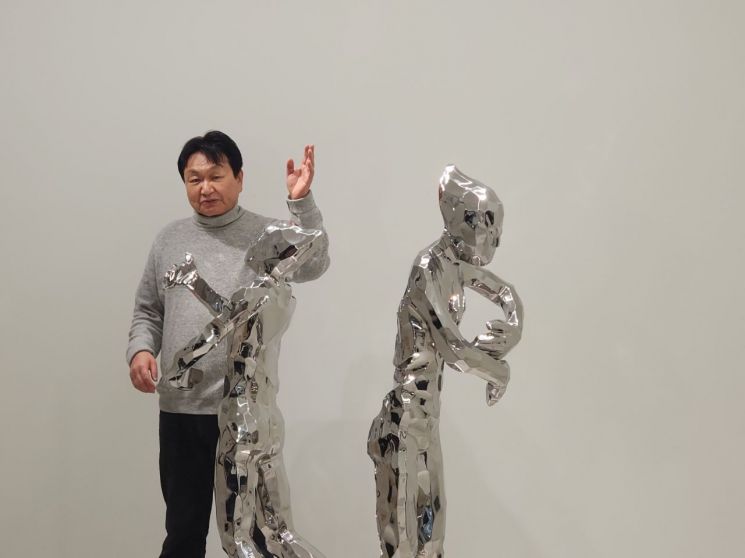 At a press conference held on the 21st at Noh Gallery in Jongno-gu, Seoul, sculptor Kim Seongbok is explaining his work. The deep indentations at the waists of the two interlocking sculptures represent the marks where their hands once were, symbolizing longing. Photo by Seomideum
At a press conference held on the 21st at Noh Gallery in Jongno-gu, Seoul, sculptor Kim Sungbok defined the theme of his solo exhibition, "longing," in these terms. He explained that longing, which begins with love, leads to loss and pain, and ultimately becomes the force that enables us to live on.
Noh Gallery is hosting Kim Sungbok's solo exhibition "Shadow of Longing" as its first show of the new year 2026, running until February 5. This exhibition commemorates his receipt of the 14th Artist Award from the Korean Art Critics Association and features over 100 works, including 20 sculptures and 80 paintings.
Kim Sungbok, who studied sculpture at Hongik University and its graduate school, has consistently explored the formative and material qualities of Korean sculpture, focusing on stone. He has held 18 solo exhibitions to date and participated in more than 400 group exhibitions both in Korea and overseas, including the Gangwon Triennale. He has also devoted many years to nurturing younger artists in education. Since receiving the "Art World Artist Award" in 2002, he has accumulated numerous honors, most recently winning the 2025 Artist Award from the Korean Art Critics Association.
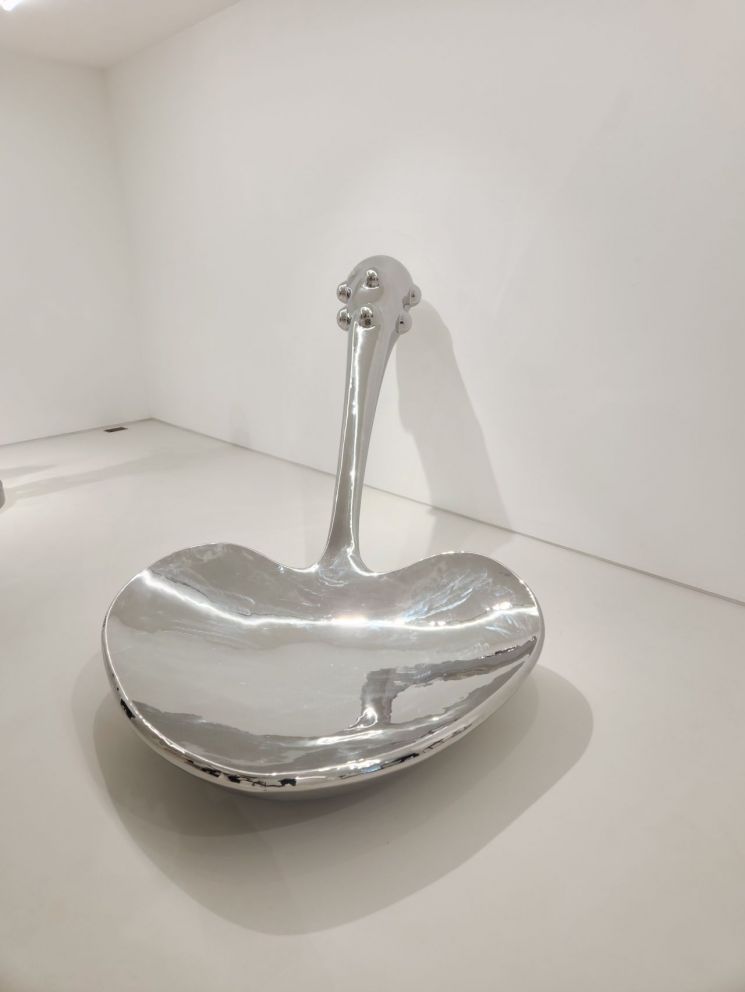
This exhibition features many of the artist's representative works. "Dream Spoon" (2018) originated from a conversation with his son in his twenties. In response to his son's remark that "these days, even doing your best feels meaningless," Kim Sungbok conceived "Dream Spoon" as a symbol challenging the discourse of "gold spoons and silver spoons." Made of stainless steel, the piece metaphorically expresses the will of individuals living in uncertain times, maintaining its balance despite a precarious structure. The handle, shaped like a dokkaebi club, draws on folk imagination to suggest "making dreams a reality."
"Love Left Behind Longing" (2024) encapsulates the emotional tone of the exhibition. The two mismatched sculptures each bear deeply indented handprints, representing traces of time spent together and the wounds that remain after parting. Kim Sungbok explained, "Longing is essentially a wound, an emotion directed toward what cannot be grasped."
The exaggerated hands and feet of the figures in his works are also notable. This is an intentional choice to portray humans who live not with their heads, but with their hearts. Kim Sungbok said, "As I tried to express the desire to stand firmly on the ground and grasp the world, the hands and feet became larger," adding that it is a "deliberate sculptural approach to transforming forms." Despite their strong appearance, his figures are not complete superhumans but rather embody the anxieties of being human.
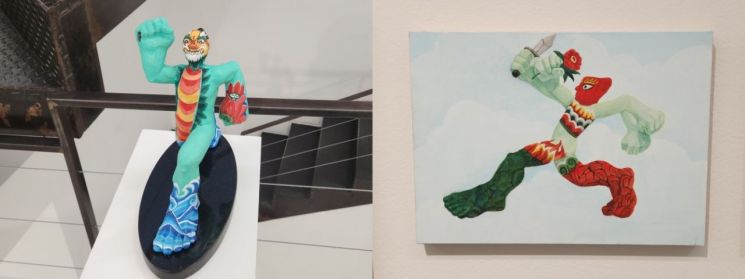 The sculpture on the left is connected to the painting on the right through a sketch. It symbolically reveals the duality of modern humans, holding a flower in one hand and a knife in the other. Photo by Seomideum.
The paintings presented alongside the sculptures are another key pillar of this exhibition. Contrary to the common perception that painting is secondary for sculptors, Kim Sungbok's drawings and acrylic paintings stand out for their delicate sensibility. Sometimes, he first translates images that come to mind into paintings before developing them into sculptures, while at other times he revisits sculptural images on canvas. This creative process serves as an "esquisse" that bridges sculpture and painting, vividly revealing the artist's formative thought process.
Imagination drawn from folklore and myth, and a sculptural language imbued with humor and fable, are hallmarks of Kim Sungbok's work. Symbols such as the dokkaebi club, haetae, and oversized hands and feet carry socially critical messages, yet they lean more toward affirmation and faith than cynicism. His work seeks to capture the human figure who, even amid chaotic times, does not easily collapse and steadfastly holds their ground.
"Shadow of Longing" is a concentrated showcase of the formative thought and aesthetics Kim Sungbok has accumulated over decades. While confronting feelings of loss and anxiety head-on, this exhibition also invites viewers to discover the strength that enables life to continue beyond them.
© The Asia Business Daily(www.asiae.co.kr). All rights reserved.



















