"Real Estate Supply Measures to Be Announced Soon by the Ministry of Land"
Emphasis on Venture Startups as New Growth Engines
Exchange Rate Expected to Fall to Around 1,400 Within a Month or Two
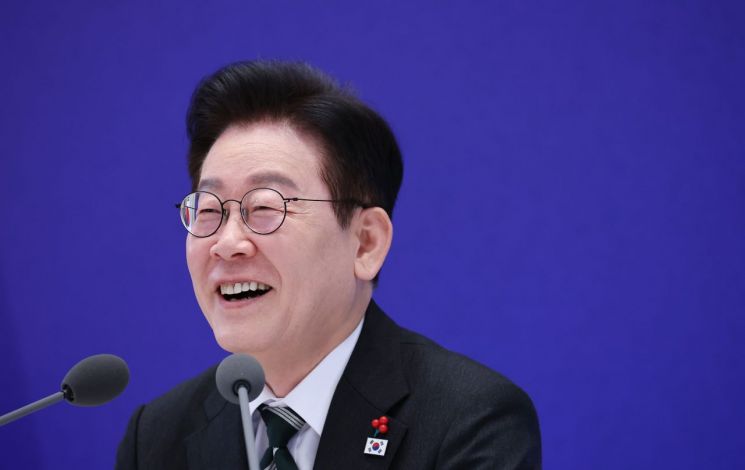
On January 21, President Lee Jaemyung stated that while he would approach the possibility of mobilizing tax measures and other tools in relation to real estate policies with caution, there is no reason to rule them out entirely.
During the New Year’s press conference, President Lee addressed the recent surge in real estate prices, saying, “Taxation is a sensitive issue, so I am cautious about commenting,” and added, “When taxes are applied to other policy objectives, side effects can occur, so it is better to avoid them if possible.” This indicates that he prefers not to consider introducing tax measures as part of real estate policies. However, regarding unavoidable situations, he said, “There is no reason not to use them,” and expressed hope that such circumstances would not arise.
In addition, President Lee stated his intention to present realistic supply measures. He remarked, “In the past, there was much talk about building one million homes, but you probably haven’t heard that recently,” and added, “Rather than just plans, we will present realistic figures based on actual construction starts, so please wait for them.” President Lee also left open the possibility of introducing additional regulations on speculative demand in the real estate market.
Regarding the exchange rate issue, President Lee mentioned the possibility of stabilization within a month or two. He said, “According to the relevant authorities, it is predicted that in about one or two months, the exchange rate will fall to around 1,400 won per dollar.” Addressing the issue of the exchange rate approaching 1,500 won per dollar at the New Year’s press conference, President Lee stated, “If there were any special countermeasures, we would have already implemented them,” and explained that “the government has already carried out many useful policies within its capacity.”
He also pointed out that the high exchange rate phenomenon is not unique to the Korean economy. President Lee said, “Some refer to the high exchange rate situation as the ‘new normal,’” highlighting that it is a global phenomenon. He especially emphasized that the degree of depreciation is smaller compared to the weakening of the Japanese yen.
Through the press conference, President Lee stressed the need for a major shift in growth strategy and expressed his determination to devote the nation’s full capabilities. He called for moving away from the “old formula for success” and opening a new path for growth through transformation.
President Lee reintroduced the “five paths of major transformation” he had emphasized in his New Year’s address, stating, “These will be the shortcut to lead Korea into a new era of great advancement, and serve as a new model of growth and progress for the world.”
The five paths of major transformation are: “region-led growth,” “growth for all that shares opportunities and fruits,” “sustainable growth based on safety,” “attractive growth driven by culture,” and “stable growth underpinned by peace.”
Region-led growth involves fostering an “economy of scale” in which regions, starting with the integration of Daejeon-Chungnam and Gwangju-Jeonnam, drive Korea’s growth. The aim is to enable regions, not just the greater Seoul area, to serve as engines of growth for the national economy. In his New Year’s address, President Lee said, “We will utilize Korea’s territory more broadly with Seoul as the economic capital, the central region as the administrative capital, and the southern region as the maritime capital, establishing a multi-polar system.”
He also expressed his intention to make venture startups a new engine for economic growth. By encouraging a startup boom, he aims to enhance the structure of the Korean economy. President Lee especially noted, “The startup boom is both a job creation policy and a youth policy,” and added, “Local startups that leverage regional culture and resources will serve as a strategy for balanced development, while tech startups nurturing future talent will become a national growth strategy. The government will focus its capabilities on these goals.”
President Lee also reiterated his commitment to actively address industrial accidents, an issue he has emphasized since the start of his term. He said, “If we create a structure in which the costs and consequences of disregarding life are much higher than now, we will bring about real changes that reduce industrial accidents.” He also announced his intention to make support and investment in culture a core growth strategy. Stressing peace as a condition for growth, President Lee once again expressed his commitment to easing tensions between North and South Korea.
© The Asia Business Daily(www.asiae.co.kr). All rights reserved.

















