Government: "AI Framework Act Applies to Providers of Products and Services"
High-Impact AI to Be Pre-Designated Based on Technological Advancement
At Least One-Year Grace Period... Support Center and Consulting Services to Be Offered
If an individual develops an artificial intelligence (AI) solution to generate images, are they required to fulfill obligations such as watermark labeling as an AI operator under the AI Framework Act?
The government clarified that the answer depends on the intended purpose. If the images are generated purely as a hobby or on a one-off basis, the individual is not considered an AI operator. However, if the solution is continuously used and updated for promotional or commercial purposes, the developer is classified as an AI operator. AI operators must ensure that (in)visible watermarks are embedded when users generate images. As long as this process is followed, users who utilize AI-generated images for purposes such as webtoon production are not at fault even if they remove the watermark afterward.
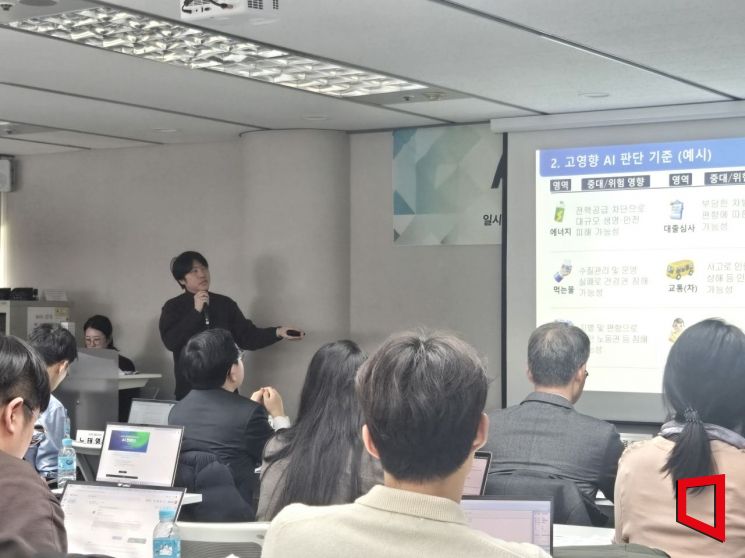 Siseop Shim, Officer of the Artificial Intelligence Safety and Trust Policy Division at the Ministry of Science and ICT, is presenting at a press briefing on the AI Framework Act on the 20th. Photo by Gyeongjo Noh
Siseop Shim, Officer of the Artificial Intelligence Safety and Trust Policy Division at the Ministry of Science and ICT, stated at a press briefing on the AI Framework Act held on the 20th, "One must be providing AI services or products to be considered an AI operator."
He added, "The AI Framework Act imposes only the minimum necessary obligations on operators to enhance safety and trust. Users who extract results such as photos or videos via generative AI are not subject to the law."
In other words, media outlets that broadcast results, or creators who upload them to social networking services (SNS) or YouTube, are considered users and do not bear legal obligations. Instead, AI operators are subject to regulation regardless of whether they are domestic or foreign. Among global big tech companies, those with global annual sales exceeding 1 trillion won in the previous year, domestic AI service sales exceeding 10 billion won, or more than 1 million daily domestic users are required to designate a local representative. Currently, only Google and OpenAI meet these criteria.
Regarding concerns that the criteria for determining "high-impact AI" are ambiguous, he explained, "We are referring to AI that has a significant impact on fundamental human rights or is used in high-risk work. However, if a human is involved in controlling the process, it is not classified as high-impact AI."
For example, if an AI system in a bank's loan screening process could cause financial harm to an applicant based solely on its evaluation, this would be considered high-risk work. However, if a bank employee reviews the AI's output and makes the final loan approval, it is ultimately excluded from the high-impact AI category. In the transportation sector, only systems at 'autonomous driving level 4 or above,' where a vehicle can operate fully autonomously under certain conditions without driver intervention, are subject to high-impact AI regulation.
However, fully automated AI systems, where safety is critical, must have a cumulative computational capacity of at least 10 to the 26th power floating point operations (FLOPs), and currently, there are no systems that meet this threshold. Kim Kyungman, Director General of the AI Policy Office, commented, "The intent is to preemptively address potential side effects anticipated from the advancement of AI technology," adding, "It is not easy to respond after problems arise in the future."
The AI Framework Act will take effect on January 22, becoming the first of its kind in the world. The government has emphasized that it serves as a 'foundation for industrial development,' and plans to establish a platform (AI Framework Act Support Desk) to respond to corporate inquiries, offer consulting services, and compile a casebook. The regulatory grace period will be set at a minimum of one year. During this period, fact-finding investigations will only be conducted in exceptional cases that cause social issues such as loss of life, human rights violations, or national damage.
Director Kim stated, "The AI Framework Act is not about boasting of being the world's first. As we venture into uncharted territory, our aim is to minimize the negative aspects of regulation so that AI can be approached with trust. We will also approach this from the perspective of ensuring that our companies meet global standards when expanding overseas, and determining what support the government can provide."
© The Asia Business Daily(www.asiae.co.kr). All rights reserved.
![Clutching a Stolen Dior Bag, Saying "I Hate Being Poor but Real"... The Grotesque Con of a "Human Knockoff" [Slate]](https://cwcontent.asiae.co.kr/asiaresize/183/2026021902243444107_1771435474.jpg)
















