Actual Transaction Prices Vary with Taxes and Processing Fees
Gold Prices Must Rise Over 20% to Realize Profits
On January 21, Yonhap News reported that online communities and Naver Cafes are filled with posts such as, "The news says gold prices have risen, but when I try to sell, the price is completely different," and, "I calculated based on the online price, but the actual purchase price is much lower." The article shed light on the gap between perceived and actual gold prices when buying or selling.
 As gold prices soar to new heights causing a shortage of gold bars, a customer is seen inquiring about purchasing gold bars at the Korea Gold Exchange Jongno Main Branch in Jongno-gu, Seoul. Photo by Kang Jin-hyung
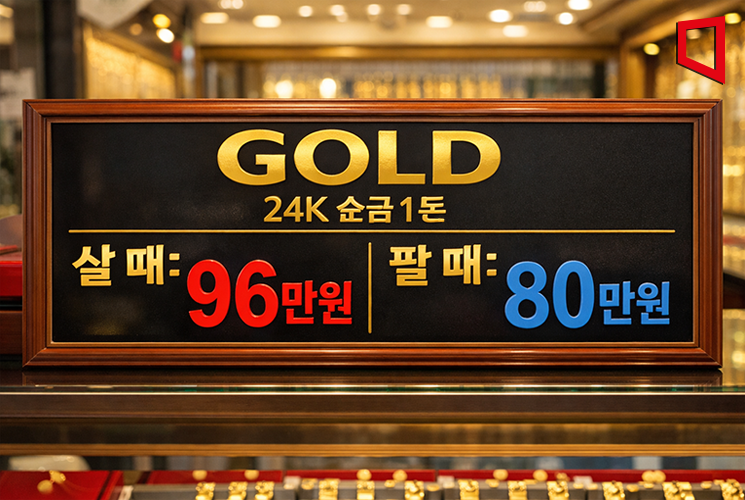
The main reason consumers experience confusion about gold prices is that the pricing structures for buying and selling gold are different. Recently, the price gap between buying and selling one don (3.75g) of pure gold has widened to over 160,000 won. The gold prices consumers see on portal sites or in the news are usually based on international gold prices converted to Korean won, or they reflect the reference prices suggested by domestic gold exchanges.
Internet Gold Prices Are 'Reference Prices'... Fluctuate with Exchange Rates
Because international gold prices are traded in US dollars, the domestic price in Korean won changes depending on exchange rate fluctuations. Even on the same day, if the exchange rate rises or falls, domestic gold prices will also vary. Industry insiders explain that domestic gold prices should be seen as reference values rather than absolute prices. Since each seller has different cost structures and distribution expenses, actual transaction prices inevitably vary.
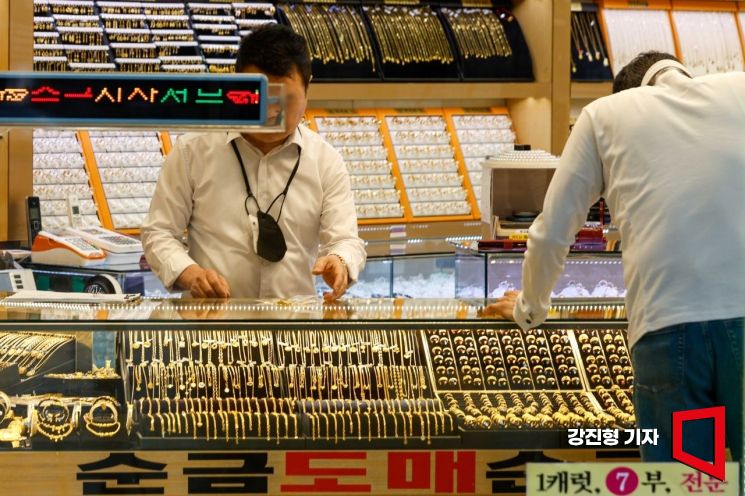 During periods of rapid gold price surges like recently, the influx of people trying to sell gold can cause the purchase price to drop further. Photo by Jin-Hyung Kang
The biggest misconception in gold trading is that the buy and sell prices for the same gold can be vastly different. As of mid-January, major gold exchanges were selling one don of 24K pure gold at around 960,000 to 970,000 won, while the purchase price was in the low 800,000 won range. For the same gold, the difference between buying and selling can exceed 160,000 won.
This discrepancy is not due to arbitrary pricing by gold shops, but rather structural costs. When purchasing gold, a 10% value-added tax (VAT) is added to the price. In addition, there are processing fees for making gold bars, labor costs, transportation costs, and distribution margins. On the other hand, when selling gold, only the gold price excluding VAT is applied, and processing fees are not refunded. As a result, the purchase price is significantly lower than the selling price. Industry sources explain that, on average, about 15% in additional costs are added to the purchase price.
Even Pure Gold Prices Vary by Purity
During periods of rapid gold price increases like now, the influx of people trying to sell gold can cause the purchase price to drop further. An employee at a gold shop in the jewelry district of Jongno, Seoul, said, "As gold prices rise, more people try to sell gold to realize profits," adding, "According to the law of supply and demand, the purchase price is often set somewhat lower than the market price on site."
Even with the same 24K pure gold, the trading price varies depending on the purity. Most gold bars have a purity of 99.99% (four nines), while stone rings or souvenirs often have purities of 99.9% or 99.5%. Gold with lower purity incurs costs during the refining process, so its selling price is lower. An industry insider explained, "Four nines, three nines (99.9%), and 99.5% each have different prices applied."
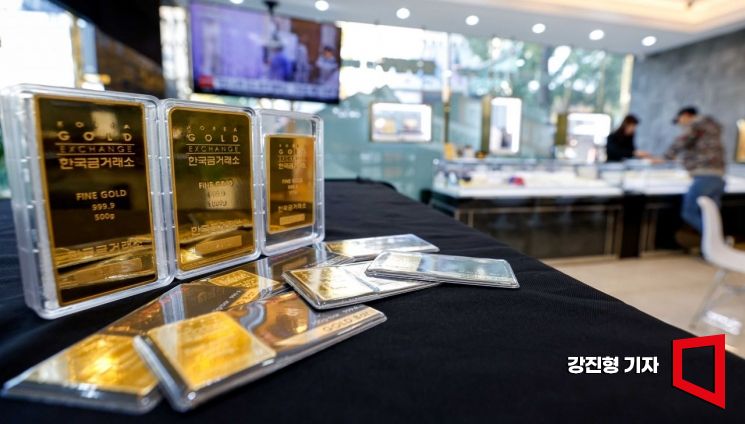 Even with the same 24K pure gold, the trading price varies depending on the purity. Most gold bars have a purity of 99.99% (four nines), while stone rings or souvenirs often have purities of 99.9% or 99.5%. Gold with lower purity incurs costs during the refining process, so its selling price is lower. Photo by Kang Jin-hyung
Given this structure, industry experts commonly explain that, when investing in physical gold, the gold price needs to rise by at least 20% from the purchase price to expect any real profit. Experts recommend choosing gold bars over jewelry when investing in physical gold, as rings or necklaces incur high processing costs that are difficult to recover upon resale. They also advise that products certified by reputable institutions such as Korea Minting, Security Printing & ID Card Operating Corporation, Korea Gold Exchange, or Samsung Gold Exchange, or those bearing the Taeguk mark or hallmark, are advantageous for resale.
Meanwhile, there are also options to invest in gold through financial products such as gold savings accounts or gold ETFs instead of physical gold. In these cases, the same reference price applies to both buying and selling, making transactions simple. However, as these are financial products, the principal is not guaranteed and capital gains tax is imposed on profits. An industry expert stated, "Although gold prices have surged recently, gold is not an asset for short-term gains," and advised, "It is best to approach gold as a hedge against inflation from a long-term perspective of at least 10 years."
© The Asia Business Daily(www.asiae.co.kr). All rights reserved.



















