Special Prosecution Requests 15-Year Sentence for Aiding Rebellion
Han: "I Did Not Agree, But Believed There Was No Way to Stop It"
Verdict May Set the Stage for Next Month’s Ruling on Yoon’s Rebellion Leadership
Sentencing to Be Broadcast Live at 2 p.m.
The first trial verdict for former Prime Minister Han Duck-soo, who faces charges of aiding and abetting the leader of a rebellion, will be delivered on January 21. This marks the first judicial decision on whether the December 3 Martial Law Incident constitutes "rebellion" under the Criminal Act. Observers note that this ruling could serve as a key indicator of how the court will establish its criteria for defining "rebellion," ahead of the first trial verdict for former President Yoon on rebellion leadership charges scheduled for February 19.
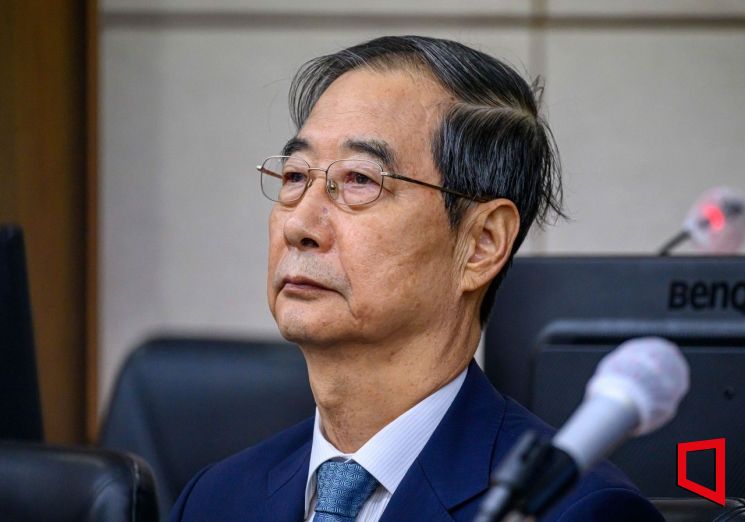 Former Prime Minister Han Duck-soo appeared as a defendant on the 30th at the Seoul Central District Court in Seocho-gu, Seoul, for a trial on charges including aiding and abetting the leader of a rebellion and perjury. 2025.9.30 Photo by Joint Press Corps
The 33rd Criminal Division of the Seoul Central District Court (Presiding Judge Lee Jinkwan) will hold the first trial verdict hearing for former Prime Minister Han on charges including aiding and abetting the leader of a rebellion, engaging in major rebellion-related duties, and perjury at 2:00 p.m. on January 21 in Courtroom 417 of the Seoul Central District Court. The court has approved a request for live broadcasting, allowing the sentencing process to be televised. The proceedings will be filmed and streamed live using the court’s own equipment, though the court has noted there may be delays due to technical reasons. This is the first time a defendant who is not a former president will have their sentencing broadcast live.
Jo Eunseok, head of the special prosecution team for rebellion, argues that former Prime Minister Han, as the "second-in-command" of state affairs, had a duty to check the president’s arbitrary abuse of power. However, Han is accused of facilitating the appearance of procedural legitimacy by convening cabinet meetings and urging cabinet members to attend before and after the declaration of martial law, thereby aiding and participating in the rebellion. CCTV footage from the presidential reception room reportedly shows Han carrying documents, sharing them with cabinet members, and, after a cabinet meeting, remaining with former Minister of the Interior and Safety Lee Sangmin to discuss documents believed to be related to power and water supply cuts. Han is also accused of ordering the drafting and destruction of a false martial law proclamation and committing perjury by testifying before the Constitutional Court that he was unaware of the proclamation. At the final hearing, the special prosecution requested a 15-year prison sentence.
In his final statement, former Prime Minister Han asserted, "Although I was unable to prevent the declaration of martial law, I absolutely did not support or assist it in any way." He added, "The moment the president announced martial law, I was in indescribable shock and made it clear I could never agree, but I believed there was no way to stop it." His defense team has argued that Han lacked intent to aid the rebellion because he was not aware of specific rebellious acts and that it is not possible to hold the prime minister criminally liable for failing to prevent martial law based on constitutional or legal obligations.
The central issue in this verdict is whether the martial law declaration not only violated the Constitution and the law but also meets the requirements for the crime of rebellion. For rebellion to be established, there must be both the intent to disrupt the constitutional order and a riot severe enough to disturb the peace of a region. Since the charges of aiding and abetting and engaging in major rebellion-related duties against Han are premised on martial law being considered "rebellion," many expect the court will first determine whether the crime of rebellion has been constituted.
Previously, the first trial court in former President Yoon Seokyeol’s "obstruction of arrest" case found that the martial law declaration was "unconstitutional and illegal, lacking substantive and procedural requirements," but did not directly rule on whether the crime of rebellion was established. Legal experts believe that while this verdict will not legally bind other cases, its findings on the nature and scope of responsibility of the cabinet meeting on the day of martial law, as well as the facts surrounding the proclamation and the deployment of military and police forces, could become the starting point for future legal disputes. If former Prime Minister Han, who has been tried without detention, is sentenced to prison, there is a possibility he could be taken into custody in court.
This is also the first verdict for a cabinet member indicted on rebellion charges. Depending on the outcome, it may serve as a bellwether for the "rebellion leadership" judgment in the upcoming case against former President Yoon, in which the special prosecution has requested the death penalty.
© The Asia Business Daily(www.asiae.co.kr). All rights reserved.

















