A residual pesticide inspection was conducted on 4,316 agricultural products distributed in the Gwangju area last year, and 98% were found to meet the standards.
According to the Gwangju Metropolitan City Health and Environment Research Institute on January 21, the inspection targeted agricultural products distributed at the Seobu and Gakhwa Agricultural and Marine Products Wholesale Markets, large supermarkets, and local food direct stores. The analysis covered 3,047 samples from wholesale market auctions both before and after the sale, as well as 1,269 samples from products distributed in the market, testing for 345 types of residual pesticides.
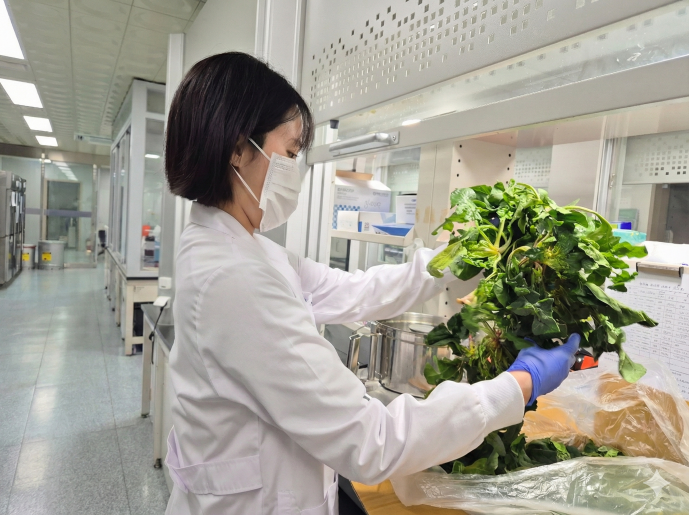 A researcher at the Gwangju Metropolitan City Health and Environment Research Institute is inspecting samples of distributed agricultural products. Provided by Gwangju City
The results showed that 87 cases (2.0%) exceeded the standard levels. The corresponding volume, totaling 2,626 kg, was immediately seized and disposed of to prevent it from entering the market. This represents a decrease of 0.3 percentage points compared to the 97 non-compliant cases (2.3%) in 2024.
Non-compliance was relatively high among leafy vegetables. There were 11 cases in lettuce, 7 each in perilla leaves and chwinamul, and 5 each in angelica leaves and crown daisy. Leaf-stem vegetables such as sweet potato stems and chives, as well as root vegetables such as carrots, were also included. A total of 40 types of pesticides, including terbufos, pendimethalin, and diniconazole, were found to exceed the standard levels.
The institute disposed of all non-compliant agricultural products in accordance with the Food Sanitation Act and the Agricultural Products Quality Control Act. It also notified the authorities in charge of the production areas to impose shipment restrictions and fines as administrative measures.
The institute plans to strengthen residual pesticide inspections, focusing on items with high non-compliance rates such as leafy vegetables and during periods of increased distribution, such as holidays and peak seasons.
Jung Hyuncheol, Director of the Health and Environment Research Institute, stated, "We are continuously strengthening safety inspections across the entire distribution network, including wholesale markets, large distribution channels, and local food direct stores," adding, "We will transparently provide food safety information that meets the expectations of our citizens."
© The Asia Business Daily(www.asiae.co.kr). All rights reserved.
![Clutching a Stolen Dior Bag, Saying "I Hate Being Poor but Real"... The Grotesque Con of a "Human Knockoff" [Slate]](https://cwcontent.asiae.co.kr/asiaresize/183/2026021902243444107_1771435474.jpg)
















