At the 4th HMPDC Meeting,
Six of Twelve Models Presented by the Estimation Committee Reviewed as Key Focus
The government has projected that the future shortage of physicians will range between 2,500 and 4,800, and has decided to continue discussions regarding the medical school enrollment quota for 2027.
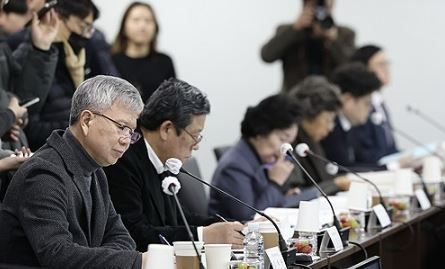 Taekwoo Kim, President of the Korean Medical Association, is attending the Health and Medical Policy Deliberation Committee held at the International Electronics Center in Seocho-gu, Seoul on the 20th, continuing the discussions. Ministry of Health and Welfare
The Ministry of Health and Welfare announced this on the 20th during the Health and Medical Policy Deliberation Committee (HMPDC) meeting held at the International Electronics Center in Seocho-gu, Seoul.
During the meeting, the HMPDC discussed all 12 alternative models presented by the Physician Workforce Supply and Demand Estimation Committee, which were created by combining various demand and supply models. The models included: ▲ the basic ARIMA (AutoRegressive Integrated Moving Average) model reflecting time-series trends in medical demand, ▲ an ARIMA model reflecting changes in the future medical environment, ▲ an ARIMA model reflecting changes in health and medical policy, ▲ an ARIMA model reflecting both future environment and health and medical policy changes, ▲ Composition Method Model 1, ▲ Composition Method Model 2-making up six demand models-and two supply models, Supply Model 1 and Supply Model 2.
Through previous discussions, the HMPDC has gradually specified the criteria for determining the scale of physician training, focusing on: ▲ strengthening regional, essential, and public healthcare, ▲ considering changes in the future medical environment and health and medical policies, ▲ ensuring the quality of medical school education, and ▲ securing predictability and stability.
At this fourth meeting, the committee discussed the characteristics, strengths, and weaknesses of each of the 12 models according to these criteria. As a result, it was decided to focus further discussions on six of the models, taking into account the potential for changes in medical technology, work environment, and policy directions such as improvements in the healthcare delivery system. According to these models, the projected physician shortage by 2037 is between 2,530 and 4,800.
The HMPDC also agreed that, considering that public medical schools and medical schools in regions without such institutions may begin recruiting new students from 2030, 600 positions should be excluded from the required workforce during the estimation period, and the training scale for general medical schools should be reviewed accordingly.
The Ministry of Education also announced the results of its review of the educational conditions at 32 out of 40 medical schools, excluding eight located in Seoul, focusing on faculty, educational facilities, and teaching hospitals. It was reported that each medical school meets the legal requirements for faculty numbers, educational facilities, and teaching hospitals, and that, overall, they also satisfy the standards for medical education accreditation.
Meanwhile, the Ministry of Health and Welfare plans to hold a public expert forum on January 22 to gather social opinions regarding the increase in physician workforce. At the next HMPDC meeting, the committee plans to continue discussions by comprehensively considering the results of this forum and the review of medical education conditions.
Minister of Health and Welfare Chung Eun-kyung stated, "We will swiftly proceed by widely gathering opinions from experts and all sectors of society to ensure that the physician training scale can be reflected without delay in the 2027 university admissions process."
© The Asia Business Daily(www.asiae.co.kr). All rights reserved.

















