Minister Choi Hwi-young Reports 'Dual Signboard' Plan
"Historical Flexibility Needed"?Heritage Administration Also "Agrees"
Will This Mark the End of the Half-Century-Long 'Signboard Debate'?
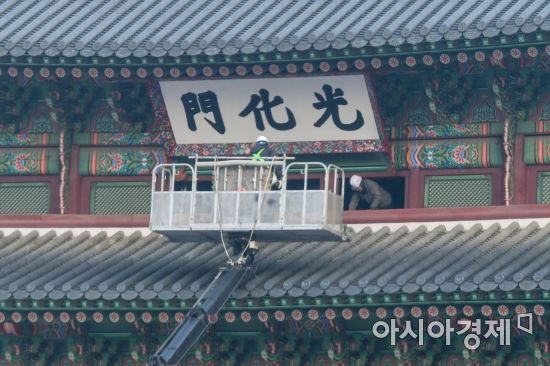 On the morning of the 8th, workers are inspecting the signboard in Gwanghwamun, Jongno-gu, Seoul. The Gwanghwamun signboard underwent a life-size experimental signboard photography session last summer for scientific analysis of its color. Photo by Kang Jinhyung aymsdream@
The decades-long debate over whether the Gwanghwamun signboard should be written in Hangul or Chinese characters has entered a new phase. The government has decided to maintain the existing Chinese character signboard on the third floor of the pavilion, while additionally installing a Hangul signboard on the second floor-a so-called "dual display" approach. This compromise is aimed at both "preserving the original form" of the cultural heritage and highlighting the "symbolic status of Hangul as its country of origin." On January 20, Minister of Culture, Sports and Tourism Choi Hwi-young reported this plan for "considering the additional installation of a Hangul signboard at Gwanghwamun" to President Lee Jaemyung during a Cabinet meeting.
580th Anniversary of Hunminjeongeum..."Balancing Preservation and Contemporary Demands"
The core of the proposal is "coexistence." The black-background, gold-letter (Chinese character) signboard, which was restored in 2023 after historical verification and is currently installed on the third-floor eaves, will remain. Meanwhile, a new Hangul signboard in the Hunminjeongeum style will be installed on the second-floor eaves below it.
Minister Choi stated, "Gwanghwamun is not just a relic of the past, but a living, dynamic space in our modern history," and emphasized, "It is time for a rational alternative that preserves the original form of our cultural heritage while also embracing the symbolic significance of Hangul to meet the demands of the present era." He further stressed that this year marks both the 580th anniversary of the proclamation of Hunminjeongeum and the 100th anniversary of "Gagyanal," the precursor to Hangul Day, making this the perfect moment to introduce a Hangul signboard.
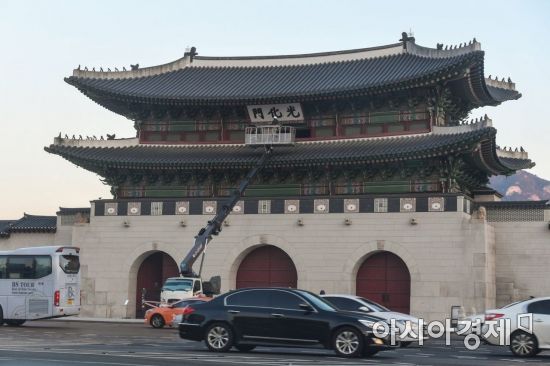 On the morning of the 8th, workers are inspecting the signboard in Gwanghwamun, Jongno-gu, Seoul. The Gwanghwamun signboard underwent a life-size experimental signboard photography session last summer for scientific color analysis research. Photo by Jinhyung Kang aymsdream@
When President Lee asked, "Are there any examples of dual signboards in other countries?" Minister Choi cited the Forbidden City in China as an example. He explained, "The Forbidden City also displays signboards in both Chinese characters and Manchu, which is an example of historical flexibility," and added, "It is worth reconsidering whether it is appropriate for the symbolic gate of a country recognized worldwide for the excellence of Hangul to display only Chinese characters."
The Ministry of Culture and Heritage Administration, Once at Odds, Now Speak with One Voice
Of particular note is the change in stance by the Cultural Heritage Administration, the main responsible agency. In 2024, under the Yoon Suk-yeol administration, Choi Eung-chun, then head of the Cultural Heritage Administration, directly opposed Minister Yoo In-chon’s proposal for a Hangul signboard, arguing that it violated the principles of cultural heritage restoration.
Heo Min, the current head of the Cultural Heritage Administration, expressed strong support for the Ministry of Culture’s proposal on this day, stating, "I deeply agree with the intent to globalize Hangul and its symbolic significance." However, he also noted, "Given the precedent in 2010, when cracks appeared on the signboard just three months after its restoration, we will ensure thorough technical review, including careful selection of wood."
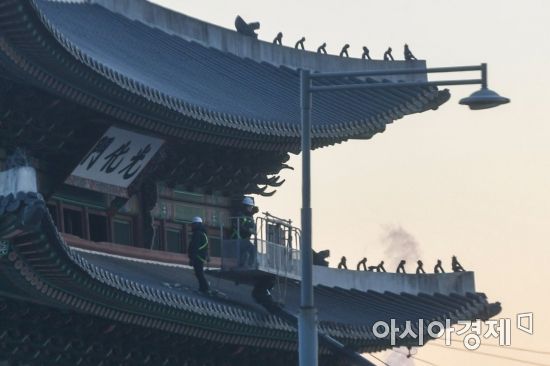 On the morning of the 8th, workers are inspecting the signboard in Gwanghwamun, Jongno-gu, Seoul. The Gwanghwamun signboard underwent a life-size experimental signboard photography session last summer for scientific color analysis research. Photo by Jinhyung Kang aymsdream@
After Many Twists and Turns, Coexistence...Civil Society Welcomes the Move
The Gwanghwamun signboard has experienced ups and downs depending on the character of each administration and the times, beginning with the installation of a Hangul signboard handwritten by former President Park Chung-hee in 1968. In 2010, the Lee Myung-bak administration replaced it with a Chinese character signboard under the banner of "restoring the original form," and after controversy over historical verification, the current black-background, gold-letter (Chinese character) signboard was installed in 2023.
Hangul organizations welcomed the decision. The "National Coalition for the Installation of a Gwanghwamun Hunminjeongeum Style Signboard," which consists of seventy-five groups including the Hangul Society, issued a statement saying, "We will actively cooperate to ensure the government’s decision is implemented without delay."
Going forward, the government plans to collect public opinion through expert consultations and public hearings before officially beginning the procedures for installing the signboard.
© The Asia Business Daily(www.asiae.co.kr). All rights reserved.
















