Special Committee Conducts On-Site Investigation at Muan Airport
Control Tower?Fire Department Communication Breakdown Confirmed
Bereaved Families: "Stop the Cover-up and Distortion"
On January 20, as the Special Committee for the National Assembly Investigation into the December 29 Passenger Plane Disaster (the Special Committee) conducted an on-site investigation at Muan International Airport in Jeollanam-do and the accident site near the runway, the bereaved families visiting the scene could not contain their anger.
The on-site investigation, which began in the morning, was attended by 18 members of the Special Committee including Chairman Lee Yangsoo, officials from the Ministry of Land, Infrastructure and Transport, and the bereaved families. The investigation team inspected the control tower, the integrated operations center, the accident site on the runway, and the concrete mound (localizer), reviewing the circumstances at the time of the disaster.
"No Fire Truck Dispatch Order"... Initial Response Failures Confirmed
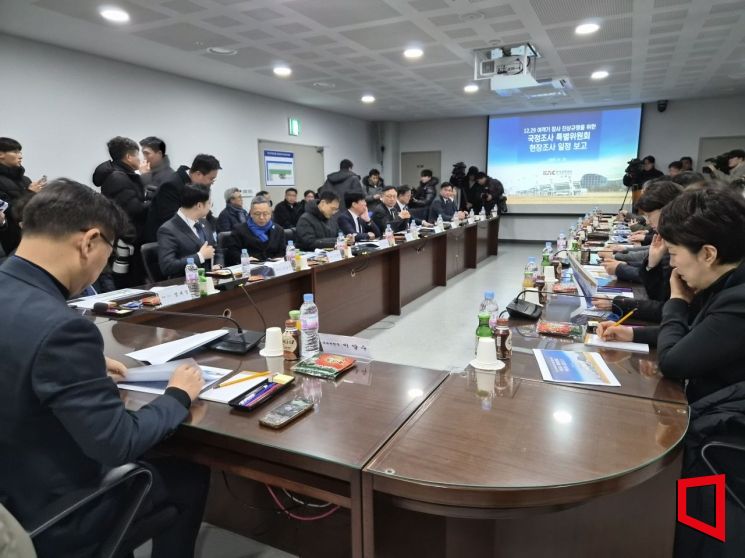 On the morning of the 20th, a briefing on the schedule for the on-site investigation by the Special Committee for the National Assembly Investigation into the December 29 passenger plane disaster was held in the conference room of the management building at Muan International Airport, Muan County, Jeollanam-do. Photo by Min Hyunki
The main issue was the response of the control tower and the delay in the fire department's dispatch at the time of the disaster. After intense questioning by the Special Committee members directed at the control tower, operations center, and fire department officials, it was confirmed that the control tower did not issue any specific dispatch order or directive to the airport fire brigade.
According to the airport's timeline of actions, at 9:01 a.m. on the day of the accident, the control tower notified the fire operations center of a possible emergency landing due to a "bird strike" and requested them to "stand by." However, there was no explicit dispatch order. It was not until 9:02:34 a.m. that the fire brigade received the dispatch alert, and just 23 seconds later, at 9:02:57 a.m., the aircraft collided with the mound and exploded.
The head of the airport's integrated operations center said, "The fire trucks only move when there is a dispatch order," and added, "There was a standby order from the control tower, but whether to dispatch or not should be checked with the fire department," shifting responsibility. The head of facilities also admitted, "There were no orders or directives other than the standby instruction."
When Chairman Lee Yangsoo asked, "If you were on standby, why did it take about two minutes to arrive at the scene?" the fire chief explained, "It took time due to headwinds and the process of veering off the runway." In response, Special Committee members strongly criticized the structural gaps in the initial response system, saying, "Even though the emergency landing situation was shared, the fire department only moved after the explosion," and "There were no proactive measures for four minutes after the mayday declaration."
During the on-site investigation at the control tower, further statements avoiding responsibility provoked outrage among the bereaved families. When asked about the detection of bird activity near the airport and involvement in the attempted return on the day of the disaster, the control tower chief replied that "the captain had operational priority during the go-around."
Regarding whether the air traffic controller visually checked the landing gear, the chief said, "That falls within the scope of the Aircraft and Railway Accident Investigation Board (ARAIB) investigation," avoiding a direct answer, and added, "If the captain does not respond to related questions, there is no reason for the controller to answer."
Watching this, the bereaved families protested, saying, "Shouldn't the control tower have taken more active measures?" and "The captain is dead, and now the controller is staying silent as well?"
"Who Gave Permission to Remove Them?"... Anger Over Missing Personal Effects
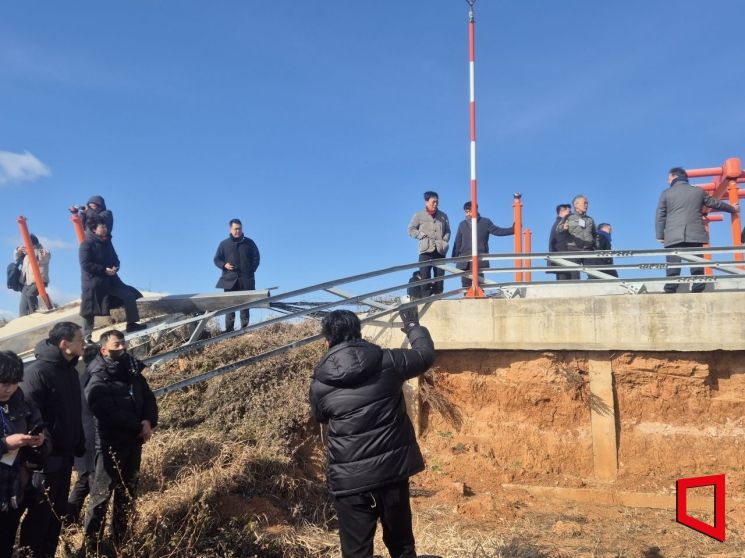 On the afternoon of the 20th, the Special Committee for the National Investigation of the December 29 Passenger Plane Disaster and the bereaved families examined the concrete mound (localizer) installed on the runway of Muan International Airport in Muan County, Jeollanam-do. Photo by Min Hyunki
During the afternoon investigation at the accident site, the anger of the bereaved families reached its peak. When a Ministry of Land, Infrastructure and Transport official briefed on bird deterrence methods unrelated to the accident, the families shouted, "Stop giving explanations unrelated to the accident."
The situation escalated when it was revealed that the victims' personal effects and aircraft debris, which had been around the concrete mound identified as the cause of the disaster, were removed without the consent of the bereaved families.
The families demanded, "Who gave you permission to remove the personal effects?" and "Did you think we wouldn't find out?" When the ARAIB repeatedly responded, "We will explain at the debris storage site," one enraged family member pushed over Lee Seungyeol, the head of the ARAIB investigation team, interrupting the briefing.
As their last stop, the bereaved families visited the debris storage site and were left speechless with a sense of futility as they saw the aircraft wreckage exposed to the elements for over a year.
Kim Yujin, head of the December 29 Muan Airport Jeju Air Bereaved Families Association, said, "There were definitely family members' personal effects near the mound, but for some unknown reason, the ARAIB completely cleared the site yesterday," and emphasized, "Today must mark the starting point for uncovering the truth and ending a year of distortion and cover-up."
The Special Committee plans to focus on determining whether the control tower issued orders and how the fire brigade decided to dispatch, based on the communication records, dispatch logs, and command system manuals between the control tower, fire department, and integrated operations center confirmed on this day.
Meanwhile, at around 9:03 a.m. on December 29, 2024, a Jeju Air passenger plane from Bangkok attempted an emergency landing at Muan International Airport and collided with a localizer concrete mound outside the runway, resulting in an explosion. Of the 181 people on board, 179 lost their lives in the accident.
© The Asia Business Daily(www.asiae.co.kr). All rights reserved.


















