Limitations of Integration Incentives for Chungnam and Daejeon Highlighted
Calls for Mandatory Joint Contracting with Local Companies
As discussions on the administrative integration of Chungnam and Daejeon are gaining momentum, concerns have been raised that integration without the transfer of financial resources and authority will be ineffective.
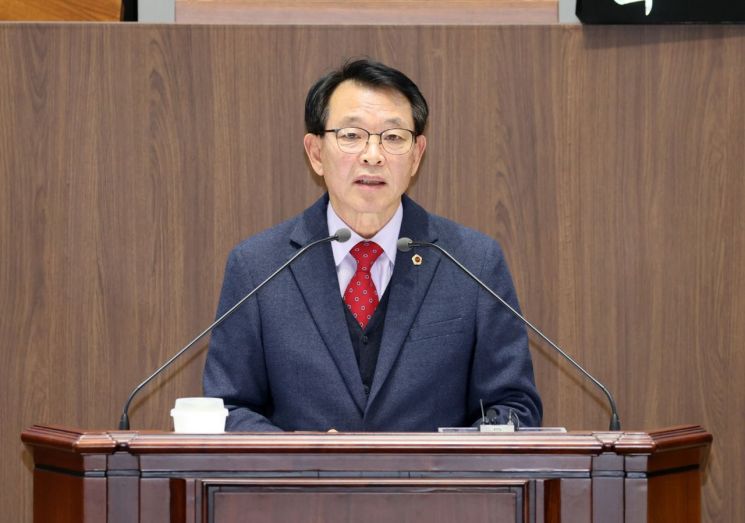
Chungnam Provincial Council Member Lee Haeseon pointed out the limitations of the integration incentives proposed by the government and urged for a substantial increase in the participation of local companies in public procurement.
On January 20, during a five-minute speech at the first plenary session of the 363rd extraordinary session, Lee Haeseon (Dangjin 2, People Power Party) stated, “While I agree with the purpose of administrative integration to overcome the dominance of the Seoul metropolitan area, integration may remain merely formal if it is not supported by financial resources and authority.”
Lee noted that the administrative integration of Chungnam and Daejeon has gone through several steps since its declaration in November 2024, including explanatory sessions, public opinion surveys, the drafting of a special law, and resolutions by city and provincial councils. He added, “The Chungnam Provincial Council passed a special law containing 257 special provisions, setting standards for genuine integration.”
However, regarding the administrative integration incentives recently proposed by the government, he pointed out, “The financial support is limited to 5 trillion won per year for up to four years, totaling 20 trillion won,” and added, “This falls short of the demand for a permanent strengthening of fiscal authority, such as annual increases of 8.8 trillion won through adjustments to the capital gains tax, corporate tax, and value-added tax rates.”
He continued, “While granting special city status and preferential relocation of some public institutions are meaningful, key transfers of authority-such as exemption from preliminary feasibility studies, the right to convert farmland, and the authority to designate national industrial complexes-are missing,” emphasizing that “integration without authority is unlikely to revitalize the local economy.”
Regarding the relocation of public institutions, he stated, “It is not desirable to present this as a condition for administrative integration, as it is a presidential pledge and should be implemented as a matter of course.”
Lee also mentioned the downturn in the local construction market, saying, “With a sharp decline in private sector orders, small and specialized construction companies are facing difficulties. The public sector should step in with early procurement to support the local economy.”
To this end, he called for institutional improvements such as ▲mandatory joint contracting with local companies for public projects above a certain scale, ▲restrictions on offsetting scores for local company participation, and ▲the establishment of minimum participation rates for local companies.
Lee stressed, “Both administrative integration and public procurement should be promoted in ways that provide tangible benefits to the lives of local residents.”
© The Asia Business Daily(www.asiae.co.kr). All rights reserved.

















