Bank of Korea Posts on Exchange Rate Two Days in a Row
This Time: "Misconceptions and Facts About Recent Liquidity and Exchange Rate Conditions"
Money Supply-to-GDP Ratio Differs Across Countries Due to Financial Structure
Recently Stabilized...
The Bank of Korea has firmly refuted claims from some quarters that the recent rise in the won-dollar exchange rate was caused by an excessive supply of Korean won in the market. The central bank publicly criticized this line of reasoning, warning that such logic, if amplified and reproduced as fact, could actually trigger a further decline in the value of the won.
On January 20, the Bank of Korea posted an article titled "Misunderstandings and Facts about Recent Liquidity and Exchange Rate Conditions" on its official blog, making its stance clear. This followed International Department Director Yoon Kyungsoo's statement the previous day that "there is sufficient dollar liquidity in the market, but the exchange rate is rising because investors are only looking to buy dollars rather than sell them." For the second consecutive day, the central bank published blog posts aimed at correcting public misconceptions about the exchange rate.
In a Q&A format, Lee Goodgeon, Director of the Monetary Policy Department at the Bank of Korea, and other authors systematically rebutted the argument that excessive growth in won liquidity has driven up the exchange rate.
Is the Money Supply Growth Rate Excessively High? "About Average Among Top 10 Economies, Lower Than the U.S."
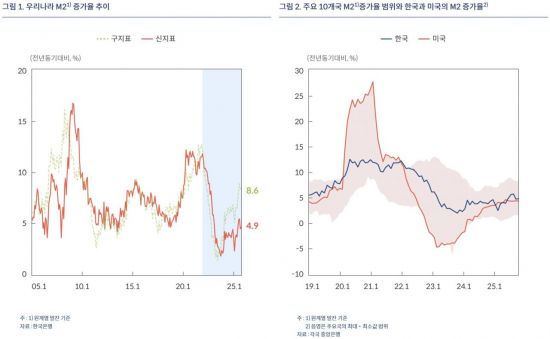
The Bank of Korea first dismissed the claim that the growth rate of the money supply (M2) has recently become excessively high. The M2 growth rate rose to 11-12% during 2020-2021 in response to COVID-19, but has since fluctuated in the 4-5% range. The central bank noted that, although there has been a slight rebound since 2024, the current level remains lower than the historical average. Even compared to the world's top 10 economies, Korea's recent M2 growth rate is about average. Some have argued that Korea's growth rate is higher than that of the United States, but the Bank of Korea pointed out that the U.S. has experienced the greatest volatility among the top 10 economies. Due to quantitative easing and tightening, the U.S. money supply growth rate has swung from a high of 27% to a low of -5%, showing significant fluctuations.
In response to claims that the Bank of Korea supplied an enormous 488 trillion won in liquidity last year through repurchase agreement (RP) purchases, the central bank strongly objected, stating, "This is a misunderstanding that greatly exaggerates the scale by simply accumulating RP purchases, without properly understanding the mechanism of RP transactions." RP purchases typically have a maturity of about two weeks, after which a reverse transaction automatically occurs and funds are withdrawn. The Bank of Korea explained, "For example, if you borrow and repay 100,000 won every week for a year, your wallet does not contain 5.2 million won (100,000 won x 52 weeks), but only 100,000 won at any given time." The central bank also added that its open market operations, such as issuing monetary stabilization bonds and selling RPs, actually absorb a large amount of market liquidity (reserve funds).
The Ratio of Money Supply to GDP Has Recently Stabilized..."Simple Cross-Country Comparisons Are Inappropriate Due to Differences in Financial Structure"
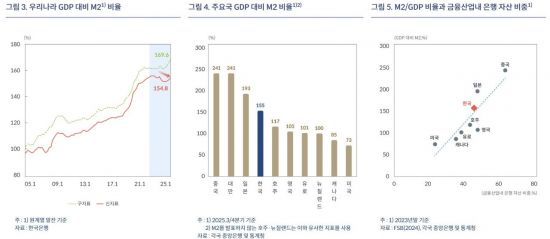
The Bank of Korea also assessed that the ratio of money supply to gross domestic product (GDP) has recently stabilized. Since the fourth quarter of 2022, this ratio has slightly declined and then remained steady. This trend is attributed to a continued decrease in household debt and a slowdown in corporate lending. The central bank explained that, while the ratio has risen over the long term, this is due to steady growth in the domestic banking sector as the financial industry has developed, as well as increased financial support from banks during the COVID-19 response.
The Bank of Korea also pointed out that, due to differences in financial structures between countries, it is inappropriate to simply compare the ratio of money supply to GDP across nations. Specifically, since money supply represents cash-like assets deposited by economic agents in deposit-taking institutions, Asian countries with a high reliance on banks tend to have a higher money supply-to-GDP ratio, while the United States, which relies more on capital markets, tends to have a ratio about half that of Korea.
The central bank also categorically rejected arguments based on the "purchasing power parity theory," which claims that an increase in money supply leads to higher inflation and, in turn, a rise in the exchange rate. The purchasing power parity theory posits that if domestic prices rise relative to foreign prices, demand for domestic goods shifts overseas, increasing demand for dollars and pushing up the won-dollar exchange rate.
However, the Bank of Korea stated that its analysis of data since 2005 found that the correlation between the difference in money supply growth rates between Korea and the U.S. and the rate of increase in the won-dollar exchange rate was only 0.10. The central bank added, "Some are emphasizing a connection by using data from only certain periods, but over the long term, there is almost no correlation, and recently the relationship has even moved in the opposite direction. Nonetheless, claims not based on actual data are spreading through various channels in the market and are influencing expectations of further exchange rate increases," the Bank of Korea warned.
If Not Money Supply Growth, Why Has the Exchange Rate Risen?..."A Result of Market Sentiment and Supply-Demand Imbalances"
The Bank of Korea analyzed that the recent rise in the exchange rate was not due to increases in money supply, but rather to market sentiment and supply-demand conditions. In fact, from January to November last year, the current account surplus was 101.8 billion dollars, but resident securities investment increased to 129.4 billion dollars, far exceeding the surplus and creating upward pressure on the exchange rate. In other words, more dollars flowed out than came in. This trend has continued into this year.
The central bank stated, "Claims of excessive liquidity growth do not align with objective facts, and the recent exchange rate situation appears somewhat disconnected from economic fundamentals. The government and the Bank of Korea have implemented various market stabilization measures, and their effects are expected to emerge over time. We will continue to closely monitor market conditions and make efforts to alleviate excessive expectations and supply-demand imbalances."
However, the Bank of Korea dismissed suggestions from some quarters that monetary policy tools such as interest rate hikes should be used directly to stabilize the exchange rate. The central bank stated, "We do not conduct monetary policy with the exchange rate as a direct target; instead, we consider the impact of the exchange rate on inflation indirectly. If monetary policy were to be conducted with the exchange rate as its target, it could have significant negative side effects on the economy and adversely affect various economic agents, and could even undermine exchange rate stability itself."
© The Asia Business Daily(www.asiae.co.kr). All rights reserved.


















