Revised Enforcement Decree for the Yellow Envelope Act
Separation of Bargaining Units Reflecting the Unique Circumstances of Subcontractor Unions
The Ministry of Employment and Labor has prepared a revised draft of the enforcement decree ahead of the implementation of the amended Labor Union Act, commonly referred to as the "Yellow Envelope Act," and has initiated a new legislative notice. The core of this revised draft is that it more clearly defines the criteria for separating bargaining units within the principal-contractor bargaining structure. However, the system of unifying bargaining channels, which has been a point of contention for labor unions, will remain in place, leaving room for continued conflict.
The Ministry announced on January 20 that, as a follow-up measure to the amended Labor Union Act scheduled to take effect on March 10, it has prepared a revised amendment to the enforcement decree of the Labor Union Act, which will be open for public comment from January 21 to February 6. Previously, the government had issued a legislative notice for amendments to the enforcement decree and rules at the end of last year, but after concerns were raised by both labor and management regarding the establishment of bargaining units between principal and subcontractors, the draft was revised and re-released.

Separation into 'General Criteria' and 'Principal-Subcontractor-Specific Criteria'
In the previous legislative notice, the criteria for separating or integrating bargaining units were contained within a single provision. As a result, there were concerns that labor-management relations within the principal company and bargaining relations between the principal and subcontractors could be evaluated using the same standards. Management expressed concern that this could lead to excessive division of bargaining units within the principal company, while labor unions argued that the unique circumstances of subcontracted workers would not be sufficiently reflected.
The revised draft directly addresses this issue. Article 14-11 of the enforcement decree has been completely overhauled to separately stipulate the general criteria for separating or integrating bargaining units and the criteria specifically applicable to subcontracted workers in principal-subcontractor relationships.
Specifically, Paragraph 3 sets out the general criteria that apply to all workplaces. It requires that the need for separation of bargaining units be assessed based on objective differences in working conditions such as the nature of work, working environment, wage systems, working hours, and welfare benefits, as well as employment type (including contract form and job category) and existing bargaining practices. These factors have been consolidated and codified from elements accumulated in previous court rulings and labor commission decisions. The government stated, "Through this, we aim to prevent concerns that bargaining units within the principal company, such as production and office unions, could be indiscriminately split."
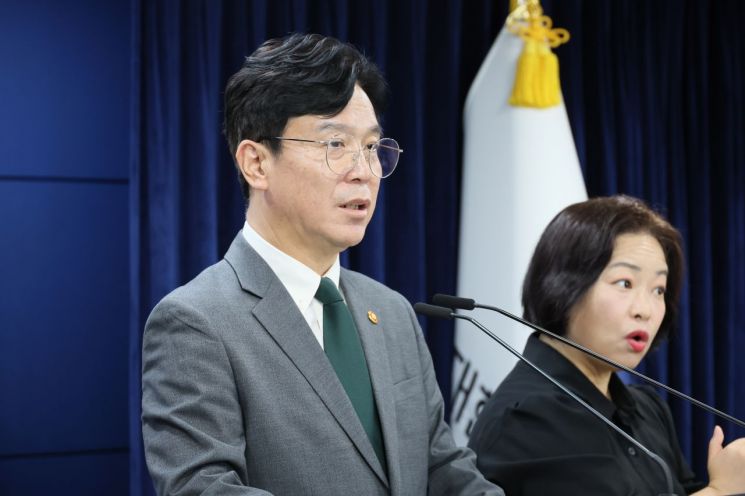 Minister Kim Younghoon Briefing on the Yellow Envelope Act (Seoul=Yonhap News) Reporter Lee Junghoon = Kim Younghoon, Minister of Employment and Labor, is giving a briefing on the amendment to the Labor Union and Labor Relations Adjustment Act (Yellow Envelope Act) at the Government Seoul Office in Jongno-gu, Seoul, on July 29, 2025. uwg806@yna.co.kr (End)
 Priority Considerations Specified for Subcontractor Bargaining
Instead, for bargaining involving subcontracted workers in principal-subcontractor relationships, a separate framework for evaluation will be applied. The newly established Paragraph 4 stipulates that when determining bargaining units between the principal employer and subcontractor unions, priority must be given to the commonality of interests among unions, the appropriateness of representation of interests, and the potential for conflict or distortion of labor-management relations if the bargaining unit is maintained.
This elevates elements that were previously only part of the general criteria to the core standards for subcontractor bargaining. The government explained that this allows for a more practical reflection of the reality that the work structure and interests of subcontracted workers differ from those of principal company workers. Ultimately, this means that while bargaining within the principal company remains unaffected, the legal basis for separating bargaining units tailored to the unique circumstances of subcontractor unions in principal-subcontractor bargaining has been clarified.
However, the exclusion of the unified bargaining channel system, which labor unions have consistently demanded, was not included in this revised draft. Labor unions have argued that if unified bargaining channels are applied at the principal company level, the independent bargaining rights of subcontractor unions could become merely nominal (meaning they would exist in name only, without substance).
In response, the government reiterated that the unified bargaining channel system is based on law, not the enforcement decree, and therefore must be maintained. Moreover, the government explained that through the unified channel procedure, the labor commission can determine the status of the employer prior to bargaining, and if bargaining is refused after employer status is recognized, sanctions for unfair labor practices can be imposed, thereby effectively promoting principal-subcontractor bargaining.
The government plans to finalize the amendment to the enforcement decree in February, after considering the opinions collected during this new legislative notice period. The amended Labor Union Act will officially take effect on March 10. The key points of the amendment are the expansion of the definition of "employer" to allow subcontractor unions to bargain directly with principal employers, and provisions to prevent excessive claims for damages related to union activities.
© The Asia Business Daily(www.asiae.co.kr). All rights reserved.
![User Who Sold Erroneously Deposited Bitcoins to Repay Debt and Fund Entertainment... What Did the Supreme Court Decide in 2021? [Legal Issue Check]](https://cwcontent.asiae.co.kr/asiaresize/183/2026020910431234020_1770601391.png)

















