SME Ombudsman New Year's Press Conference Held on the 20th
Only 2% of SMEs Seek Ombudsman for Regulatory Issues
"Multi-Faceted Efforts to Enhance Awareness and Accessibility"
The Small and Medium Business Ombudsman has decided to focus this year on establishing a regulatory linkage system with local governments to improve accessibility for businesses seeking regulatory solutions. Since small and medium enterprises (SMEs) most often turn to local governments first when facing regulatory difficulties, the Ombudsman plans to strengthen connections with each local government so that regulatory suggestions unresolved at the local level are referred to the Ombudsman.
At a New Year's press conference held at a restaurant in Jongno-gu, Seoul, on the 20th, Ombudsman Choi Seungjae stated, "Forty percent of SMEs experiencing regulatory difficulties seek help from local governments, while only two percent turn to the Ombudsman." He added, "The Ombudsman must enhance accessibility and convenience for submitting regulatory improvement proposals, while also pursuing stronger links with local governments."
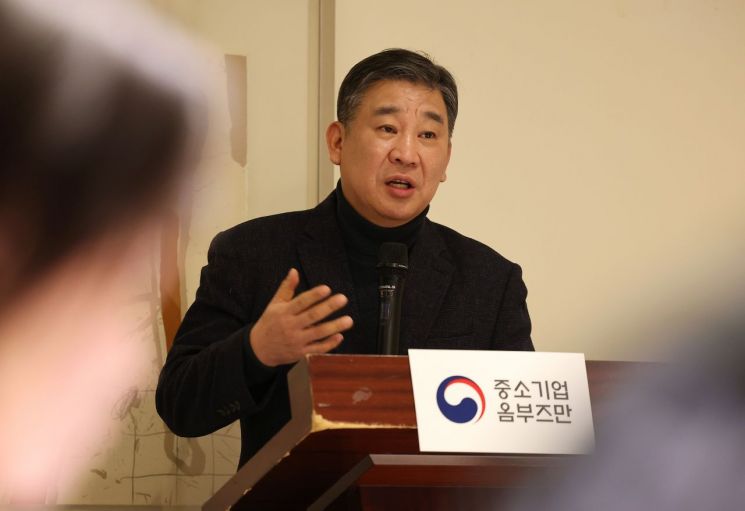 Choi Seungjae, Small and Medium Business Ombudsman, is explaining the current status of regulations on small and medium enterprises and this year's work plan at a press conference held at a restaurant in Jongno-gu, Seoul, on the 20th. Photo by Yonhap News Agency
According to the 'Survey on Regulatory Difficulties of Small and Medium Business Ombudsman' conducted in December last year among 500 SME employees and 500 members of the general public nationwide, 45 percent of SMEs reported having experienced regulatory difficulties while operating their businesses. However, only 37 percent of those affected made efforts to resolve these issues. Furthermore, 69 percent responded that they were unaware of the Ombudsman system, so this year the focus will be on raising awareness and improving channels for submitting and proposing cases.
Ombudsman Choi said, "This year, we plan to strengthen regional meetings," and added, "In particular, starting in the second half of the year, we will establish new regulatory centers within each local government, creating a system in which unresolved regulatory issues at the local level can be referred to the Ombudsman for resolution." He continued, "The current Ombudsman website mainly features a real-name bulletin board, but we also plan to introduce an anonymous bulletin board."
He noted, "Industries are changing rapidly and dynamically these days, but regulation and administration inevitably move more conservatively. Large corporations have the capacity to respond, but many SMEs are forced to either pivot their business or give up." He emphasized, "Although large corporations may appear bigger and more influential, it is SMEs that create innovative models. The process of resolving the regulatory challenges faced by SMEs is fundamental and critically important to South Korea's economic ecosystem."
He also mentioned the need for regulatory improvements at the central government level. Since regulations in emerging industries such as autonomous driving and biotechnology are often converged and involve multiple ministries, the Ombudsman aims to facilitate communication and foster more cases of inter-ministerial cooperation.
Meanwhile, on January 15, the Small and Medium Business Ombudsman, together with the Office for Government Policy Coordination, developed the 'Plan for Rationalizing On-Site Regulatory Difficulties for SMEs.' The plan includes resolving 21 cases of regulatory inconvenience related to startups and new industries, rationalizing 28 chronic regulations affecting SMEs and small business owners, and revising 30 hidden business regulations in administrative rules, for a total of 79 regulatory issues to be identified and resolved.
© The Asia Business Daily(www.asiae.co.kr). All rights reserved.

















