Youths "Taking a Break" Who Do Not Wish to Work
Number Rose from 287,000 in 2019 to 450,000 Last Year
Policy Should Focus on Attracting Youths with Associate Degrees or Lower into the Labor Market
Institutional Improvements Needed for Working Conditions at Small and Medium-Sized Enterprises
The proportion of young people classified as "taking a break" has increased, and the number of youths who do not wish to seek employment at all has also risen significantly. Experts emphasize the urgent need for policy design focused on attracting young people with associate degrees or lower into the labor market.

According to the Bank of Korea's report published on January 20, 2026, titled "Characteristics and Assessment of Youths 'Taking a Break': Comparative Analysis by Type of Unemployment" (Yoon Jinyoung, Kim Minjeong, Oh Samil), the number of young people aged 20 to 34 classified as "taking a break" within the economically inactive population has been steadily increasing. The share of those "taking a break" among the economically inactive youth population rose from 14.6% in 2019 to 22.3% in 2025, based on the Economically Active Population Survey.
Notably, there has been a marked increase in the number of youths "taking a break" who do not wish to work. This group grew by 163,000 over six years, from 287,000 in 2019 to 450,000 last year. Yoon Jinyoung, head of the Employment Research Team at the Bank of Korea's Economic Research Bureau, stated, "This indicates an increasing number of young people with a low likelihood of re-entering the labor market in the future." "Taking a break" refers to a classification within the economically inactive population, describing those who are not engaged in job-seeking, educational activities, or other specific reasons such as housework, childcare, or illness, but are simply resting without particular activities.
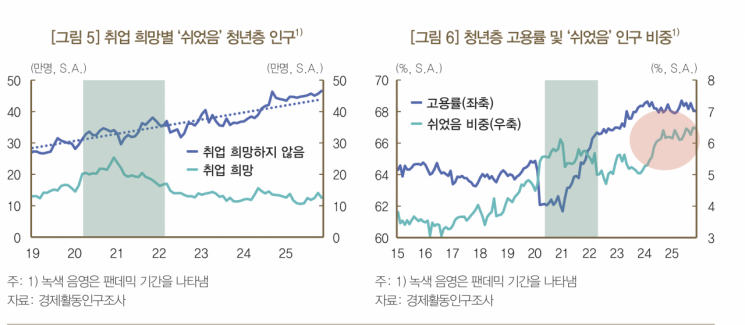
By educational attainment, the proportion of those with associate degrees or lower remains high, but recently, the number of youths with four-year university degrees or higher who are "taking a break" is also increasing. Structural changes such as the rise of artificial intelligence-based technologies and a preference for experienced workers have been identified as factors worsening the labor market situation for young people.
Using youth panel data, unemployment was classified into job-seeking, human capital investment, and taking a break. The analysis found that young people with associate degrees or lower were 6.3 percentage points more likely to be "taking a break" than those with four-year university degrees or higher. Youths with lower career adaptability were 4.6 percentage points more likely to be "taking a break" than those with higher adaptability. In contrast, those with higher education and career adaptability were more likely to invest in human capital. Yoon explained, "Expected returns based on individual potential influenced these decisions."
For each additional year of unemployment, the probability of being "taking a break" increased by 4.0 percentage points, while the probability of job-seeking decreased by 3.1 percentage points. The negative impact of prolonged unemployment was more pronounced among youths with lower educational attainment and career adaptability. These individuals are at greater risk of permanently leaving the labor market if their period of unemployment is extended.
According to the analysis, many young people continue to face difficulties entering the labor market, even though their job expectations are not particularly high. Yoon noted, "Contrary to the view that the increase in youths 'taking a break' is due to rising job expectations, the job expectations of these youths were not high in either absolute or relative terms." He pointed out, "The average reservation wage for youths 'taking a break' was 31 million won, which is not high and is similar to that of other types of unemployed youths." The analysis also showed that the largest share of youths "taking a break" preferred to work at small and medium-sized enterprises, indicating that their job expectations were actually lower than those of other unemployed youths, who most preferred large corporations and public institutions.
Yoon emphasized, "Policy design for youths 'taking a break' should focus more on attracting those with associate degrees or lower into the labor market." He added, "It is also necessary to provide career counseling programs to help young people clarify their career plans and enhance their adaptability to a changing job environment." He further explained that institutional improvements are needed to enhance working conditions at small and medium-sized enterprises, which account for a significant portion of youth employment.
© The Asia Business Daily(www.asiae.co.kr). All rights reserved.


















