Deputy Prime Minister Addresses Controversy Over First Dokpamo Evaluation Results
First Evaluation Reaffirms Crisis Management and Improvement Capabilities
"K-AI Strategy to Be Pursued Consistently for Long-Term Competitiveness"
Paik Kyung-hoon, Deputy Prime Minister and Minister of Science and ICT, emphasized the importance of "independence" in relation to the controversy surrounding the results of the first evaluation of the Independent Artificial Intelligence (AI) Foundation Model (DOKPAMO) project.
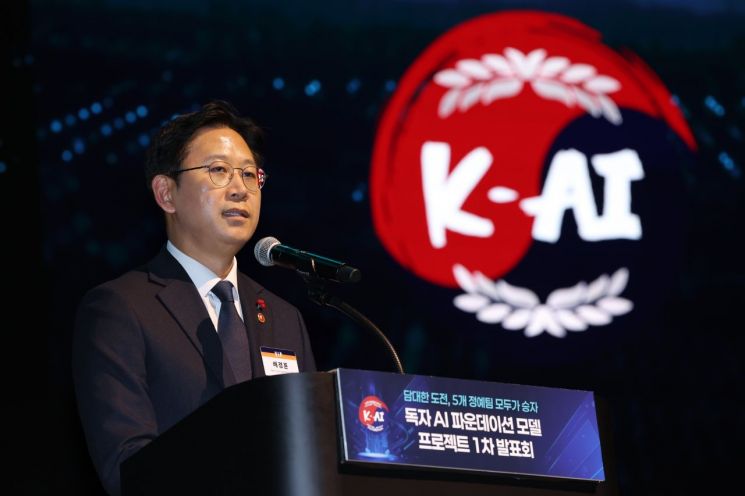 Paik Kyung-hoon, Deputy Prime Minister and Minister of Science and ICT, delivers a welcoming speech at the first presentation of the 'Independent AI Foundation Model' project held on the 30th at COEX in Gangnam-gu, Seoul. Photo by Yonhap News
On January 20, through his Facebook page, Deputy Prime Minister Paik stated, "DOKPAMO is not a project that requires 100% proprietary technology. However, even in times of crisis, we must secure core competencies that we can control and improve-namely, technological sovereignty."
He added, "This evaluation was a process of reaffirming that principle, and we had no choice but to strictly assess whether the pre-agreed implementation plans were being followed."
Deputy Prime Minister Paik recalled that the emergence of Deepseek-R1 in January last year sent shockwaves through the global AI market, saying, "It achieved top-level performance using low-spec chips, disrupted the big tech-centric structure, and even shook the global market's evaluation and industry landscape. This event also raised clear awareness of the issue for us."
He explained, "At that time, Korea essentially lacked its own inference models, and there were significant concerns about relying on external sources for core technologies. Within this awareness, the DOKPAMO project was launched with the determination that our companies would take the lead, and the government would take responsibility and provide support."
He continued, "Some have commented that the evaluation criteria are excessively strict, and others have pointed out that open-source utilization should be more broadly recognized. As someone with experience in the business field, I fully understand such concerns. However, since this project aims to create a national representative AI, the standards must be clear."
Deputy Prime Minister Paik said, "As the minister in charge, I take seriously the pain experienced by the companies that were eliminated, as well as the various concerns from the field regarding the reselection process." At the same time, he encouraged, "Even for the companies that did not advance to this stage, the technology and experience they have accumulated so far are important assets for Korea's AI capabilities."
He further stated, "The government's goal goes beyond becoming one of the world's top three technology powers. It is to make Korea the country that utilizes AI most effectively. The government will consistently pursue the K-AI strategy based on long-term competitiveness, not short-term results."
Previously, on January 15, the Ministry of Science and ICT announced the results of the first DOKPAMO evaluation. Among the five elite teams selected-LG AI Research, Upstage, SK Telecom, Naver Cloud, and NC AI-Naver Cloud and NC AI were eliminated. Naver, in particular, was criticized for failing to meet the "from scratch" requirement, which is the standard for "independence."
The government is currently seeking additional applications for elite teams. Since two out of the five teams were eliminated in the first evaluation, one spot remains vacant. While Naver, Kakao, and NC have announced that they will not reapply, Motif Technologies and Trillion Labs are expected to participate in the additional recruitment.
© The Asia Business Daily(www.asiae.co.kr). All rights reserved.