"Low Risk of Harm to Human Health"
The Ministry of Food and Drug Safety has found that triclosan was detected in 87% of six types of toothpaste imported by Aekyung Industrial. Based on these findings, the ministry plans to improve regulations related to the manufacturing and import of toothpaste.
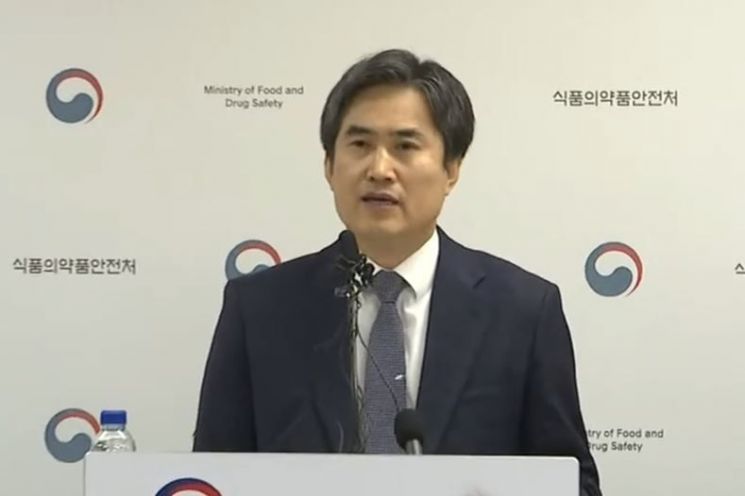 Shin Junsu, Director of the Biologics and Herbal Medicine Bureau at the Ministry of Food and Drug Safety, is announcing plans to improve regulations related to the manufacturing and import of toothpaste during a briefing held on the 20th at the Seoul Regional Office of Food and Drug Safety in Yangcheon-gu, Seoul. Ministry of Food and Drug Safety
On the 20th, the Ministry held a briefing at the Seoul Regional Office of Food and Drug Safety in Yangcheon-gu, Seoul, to announce the results of its investigation. The investigation covered six types of imported toothpaste manufactured by “Domi” overseas and brought into Korea by Aekyung Industrial since February 2023, as well as 128 types of 2080 toothpaste manufactured domestically.
According to the test results, triclosan was detected at levels up to 0.16% in 754 out of 870 available manufacturing batch numbers for the six imported toothpaste products. In contrast, there were no cases of triclosan detected in any of the 128 types of toothpaste manufactured by Aekyung Industrial in Korea.
The investigation found that the reason for triclosan contamination in the imported products was that Domi had used triclosan to disinfect and clean toothpaste manufacturing equipment since April 2023. It was analyzed that residual triclosan left on the equipment after cleaning was mixed into the products.
However, according to a review by an expert advisory panel, the detected levels of triclosan were found to pose a low risk. Triclosan was previously permitted for use in Korea at levels up to 0.3%, but the Ministry of Food and Drug Safety has proactively restricted its use in toothpaste since 2016 to enhance consumer safety and reduce exposure. Experts noted that triclosan is rapidly eliminated from the body and has a low potential for accumulation. They also assessed that the maximum detected concentration of 0.16% is below the safety threshold set by overseas agencies such as those in Europe (0.3% or less), and therefore does not present a significant risk to human health.
The investigation also revealed inadequate management by Aekyung Industrial, the importer. The Ministry stated that Aekyung Industrial failed to comply with procedures requiring immediate product recall after recognizing the safety issue. In particular, the company delayed necessary actions such as submitting a recall plan, which must be filed within five days.
As it was discovered that toothpaste containing triclosan was distributed domestically due to insufficient import quality control of overseas manufacturing sites, the Ministry of Food and Drug Safety plans to initiate administrative sanctions against Aekyung Industrial.
To address public concerns, the ministry will also pursue improvements to the safety management system for imported toothpaste. First, it will require submission of a triclosan test report at the initial import stage, and mandate self-quality inspections for each manufacturing batch at the time of sale.
During the distribution phase, the ministry will expand the scope of collection and testing by conducting annual inspections of all imported toothpaste for triclosan content. It will also broaden the range of overseas manufacturing sites subject to inspection, with a particular focus on monitoring for prohibited substances. Additionally, the monitoring cycle for potentially hazardous ingredients in quasi-drugs will be shortened from five years to three years.
The ministry is considering making Good Manufacturing Practice (GMP) standards mandatory for toothpaste production and quality control. It will also seek to establish a legal basis for imposing punitive fines to recover economic gains obtained from the manufacturing or import of hazardous quasi-drugs.
Shin Junsu, Director of the Biologics and Herbal Medicine Bureau at the Ministry of Food and Drug Safety, stated, "We will thoroughly examine the safety of toothpaste and strengthen the safety management of quasi-drugs such as toothpaste so that the public can have peace of mind."
© The Asia Business Daily(www.asiae.co.kr). All rights reserved.

















