Gwangsan District Proposes Plaza Redesign Alongside Station Expansion
Plans to Expand from 3,600㎡ to 13,120㎡
National Project Suggested for Improved Pedestrian, Green, and Transit Functions
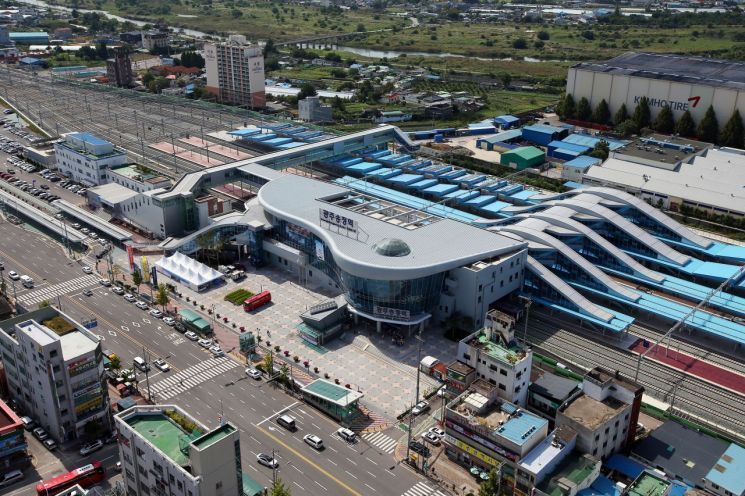
"What if the train station building gets bigger, but the plaza where citizens can breathe remains the same?"
Gwangsan District in Gwangju is promoting the "Gwangju Songjeong Station Plaza Expansion Project" to transform Gwangju Songjeong Station into a key gateway hub representing the Honam region. The district believes a redesign is necessary to secure a plaza where citizens can stay and to resolve traffic congestion issues, in line with the planned station expansion scheduled for 2028.
To mark the new year, Gwangsan District submitted an analysis highlighting the necessity of expanding the plaza at Gwangju Songjeong Station, along with recommendations and case studies from similar projects in other regions, to the Ministry of Land, Infrastructure and Transport and the National Assembly. The district also plans to continue phased promotional activities to build consensus on the need for this to become a national project.
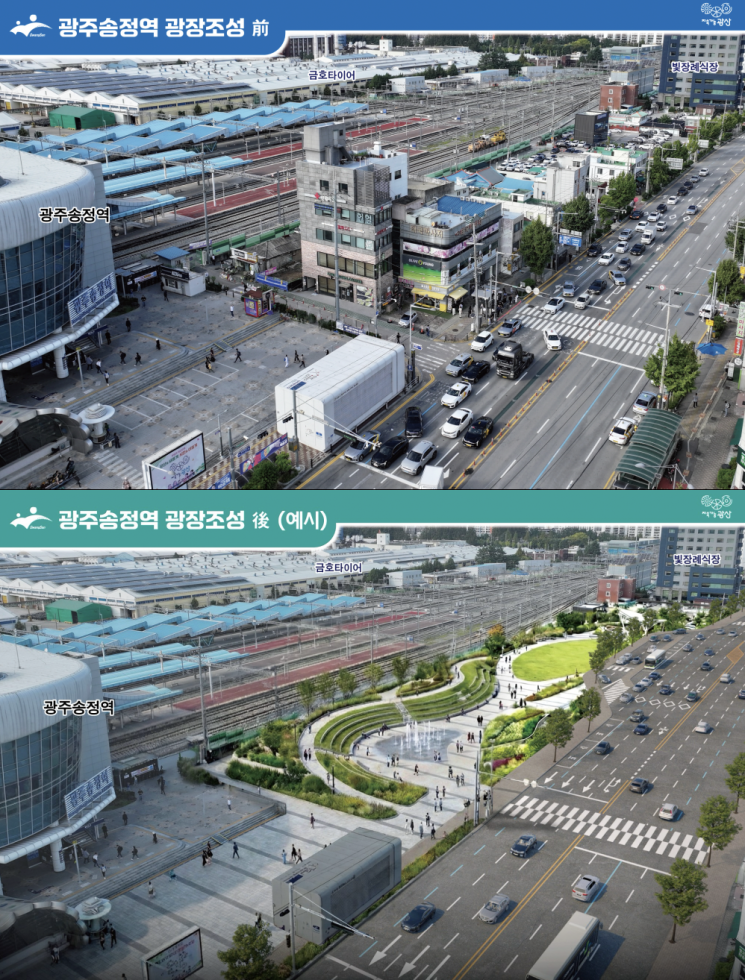 Perspective view related to the expansion project of Gwangju Songjeong Station Plaza. Provided by Gwangsan-gu, Gwangju.
Gwangju Songjeong Station is a key railway hub in the southwestern region. As of 2024, the station serves more than 27,000 passengers per day on average. The Korea Rail Network Authority expects the number of users to increase to about 37,000 by 2030 and has begun expansion work on the station building.
The issue lies with the plaza. According to the Korea Rail Network Authority's expansion plan, when construction is completed in 2028, the station building area will double in size, but the plaza area will remain unchanged at 3,600 square meters. Critics point out that the expansion plan does not include simultaneous improvements to the plaza and transportation system.
Gwangsan District noted that the daily floating population around Gwangju Songjeong Station already exceeds 40,000. According to a study commissioned by Gwangju City, by 2035, weekday users are expected to reach about 40,000, and weekend users could increase to 46,000. While expanding the station building is necessary to accommodate the growing number of users, the district explained that keeping the plaza size the same would clearly limit the station's capacity.
There is also a significant gap compared to other major regional stations. For example, compared to Dongdaegu Station, Gwangju Songjeong Station's building area is just one-fifth, and its plaza area is only one-seventh. The difference in open space where citizens can stay is particularly notable.
Transportation conditions are also problematic. The taxi stand within the Gwangju Songjeong Station transfer area has only 16 spaces. The two bus stops are located on the main road, causing chronic traffic congestion.
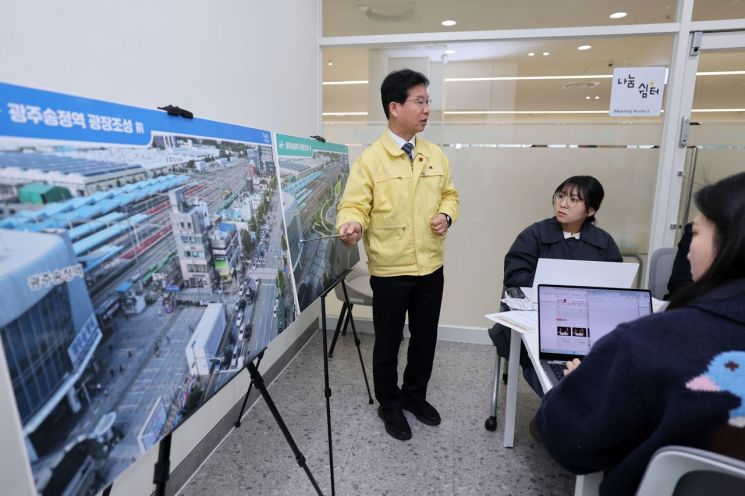 Park Byungkyu, mayor of Gwangsan District, held a press briefing on the 20th at the Everyone's Rest Area on the first floor of the district office to explain the necessity of the Gwangju Songjeong Station plaza expansion project. Provided by Gwangju Gwangsan District
Gwangsan District has proposed expanding the Gwangju Songjeong Station plaza to about 13,120 square meters and securing pedestrian and green spaces. The plan also includes improving the functions for bus and taxi drop-off, pick-up, and transfers. The estimated project cost is about 105.5 billion won.
Park Byungkyu, mayor of Gwangsan District, stated, "If the plaza expansion and transportation system improvements are not completed in tandem with the station building expansion, Gwangju Songjeong Station will struggle to become more than just a transit point," adding, "Support and attention from the government and the political community are needed to ensure that it can truly function as the main gateway to the Honam region."
© The Asia Business Daily(www.asiae.co.kr). All rights reserved.



















