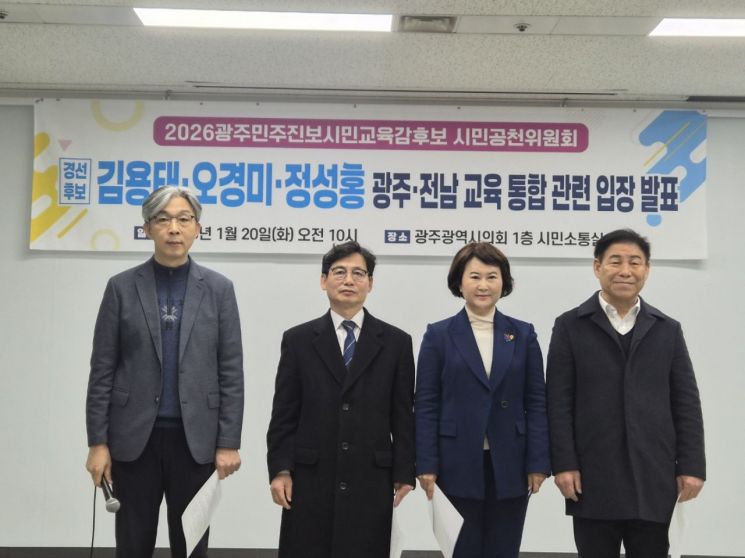
 Candidates Kim Yongtae, Oh Kyungmi, and Jung Sunghong of the Gwangju Democratic Progressive Civic Education Superintendent Candidate Citizens Nomination Committee are holding a press conference at the Gwangju City Council on the 20th. Photo by Song Bohyun
Prospective candidates for the Gwangju Superintendent of Education in the upcoming June election have argued that the integration of educational autonomy should be separated from administrative integration and undergo an independent process of public discussion.
On January 20, Kim Yongtae, Oh Kyungmi, and Jung Sunghong, candidates from the Gwangju Democratic Progressive Civic Education Superintendent Candidate Citizens Nomination Committee, held a press conference at the Gwangju City Council. They stated, "We fully support the overarching goal of administrative integration between Gwangju and Jeonnam, which is gaining momentum. However, while we do not oppose discussions on integrating educational autonomy, we are against a rushed and poorly prepared educational integration that is pushed forward without sufficient deliberation and preparation."
They emphasized, "Bundling two regions with vastly different educational conditions and challenges into a single framework without adequate discussion could cause serious confusion for students, teachers, and parents. For educational integration to have legitimacy, the opinions of educational stakeholders must be genuinely reflected."
They further explained, "In Gwangju, resolving overcrowded classrooms and easing excessive competition for advancement are urgent issues, while in Jeonnam, maintaining small schools and protecting rural educational infrastructure are matters of survival. Bundling two regions with such significantly different educational conditions and challenges into a single framework without sufficient discussion could cause serious confusion in the lives of students, teachers, and parents."
They also pointed out, "For educational integration to be legitimate, the opinions of educational stakeholders-including teachers' unions, teachers' organizations, education civil servant unions, parents, and students-must be genuinely reflected. Integration that is pursued while excluding the education sector, without measures to address confusion in the teacher personnel system, the collapse of living zones, and the deepening of educational disparities between regions, can never succeed."
They continued, "What is even more concerning is the recent actions of both city and provincial superintendents of education. Immediately after the administrative integration was declared, they hastily announced educational integration and quickly began discussing whether to integrate the superintendent positions. This is enough to raise suspicions that political interests are being prioritized over the essence of education."
They added, "Education is not an experiment, nor is it the property of the superintendent. Both city and provincial superintendents must set aside political calculations and first listen to the voices from the educational field."
© The Asia Business Daily(www.asiae.co.kr). All rights reserved.
![User Who Sold Erroneously Deposited Bitcoins to Repay Debt and Fund Entertainment... What Did the Supreme Court Decide in 2021? [Legal Issue Check]](https://cwcontent.asiae.co.kr/asiaresize/183/2026020910431234020_1770601391.png)
















