The Korea Institute of Civil Engineering and Building Technology (KICT) announced on January 20 that it has been selected for the European Union's largest research support program, "Horizon Europe."
This marks the second achievement for KICT since Korea joined Horizon Europe as an associate member in 2025.
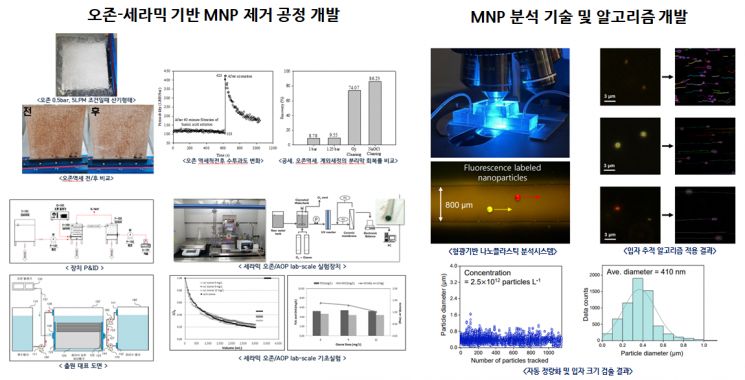 Schematic diagram of microplastic behavior analysis and removal technology. Provided by Korea Institute of Civil Engineering and Building Technology
The selected project aims to identify the sources of emerging contaminants such as high salinity, organic matter, perfluorinated compounds, and microplastics generated in the food and beverage industry. It also seeks to develop real-time behavior analysis technology and optimized treatment technologies for these contaminants.
Additionally, the project focuses on supporting the EU's Zero Pollution Action Plan and circular economy policies by reflecting new policies and regulations related to emerging contaminants and raising consumer awareness.
The project involves a consortium led by KICT's Environmental Research Division, comprising research teams from 10 countries and 19 institutions, including local European research teams. Over the next 48 months, the consortium will receive a total of 6 million euros (approximately 10 billion KRW) in research funding from the EU.
President Park Seongyu stated, "This project selection is a tangible result that recognizes the effectiveness of KICT's operation of overseas cooperation hubs," adding, "KICT will continue to strive to become a leading global research institute in the future construction industry ecosystem through ongoing international joint research."
Meanwhile, KICT currently operates overseas cooperation hubs in Germany, the United States, and Japan. Each hub plays a key role in attracting outstanding research talent, promoting KICT's technologies abroad, and supporting their entry into local markets. They also establish global research and development (R&D) cooperation networks in various fields and support the formation of bilateral and multilateral research cooperation consortia.
© The Asia Business Daily(www.asiae.co.kr). All rights reserved.

















