Five Technologies Selected, Including Earth Observation Sensors, Launch Vehicle Manufacturing Processes, and Satellite Communication Antennas
On January 20, the Korea Aerospace Administration announced that it has designated five innovative technologies with technological competitiveness and market potential in the fields of satellites, launch vehicles, and space observation and exploration as the first batch of "New Space Technologies." This system aims to enhance domestic space technology capabilities and vitalize a private sector-led space industry ecosystem. Starting this year, the designation of New Space Technologies will be conducted regularly every year.
The "New Space Technology Designation System" is based on Article 18-7 of the Space Development Promotion Act. It allows the government to designate technologies that have been developed for the first time in Korea or improved by incorporating foreign technologies, provided that they demonstrate outstanding novelty, advancement, and high potential for value creation. For this first round, a total of 52 applications were received: 22 in the satellite sector, 11 in launch vehicles, and 19 in space observation/exploration and other areas. After external expert verification (document review → on-site inspection → comprehensive evaluation), five technologies were ultimately selected.
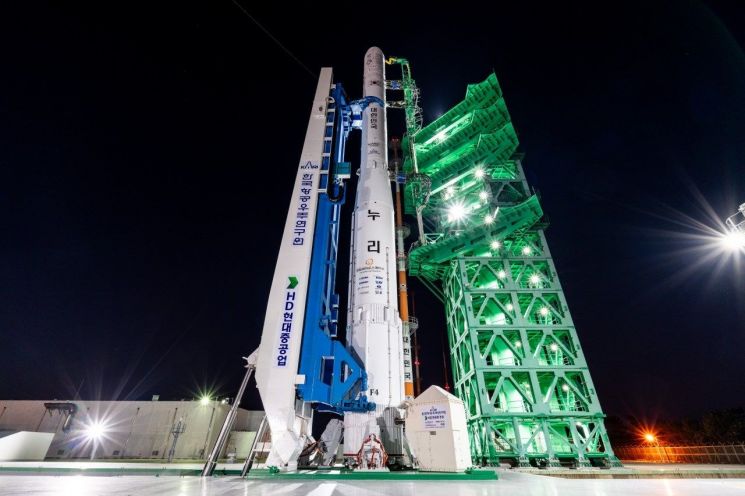 Nuri rocket developed with domestic space technology. Provided by Korea Aerospace Research Institute
Core Technologies Covering Earth Observation, Launch Vehicles, and Satellite Communications
The selected technologies include high-performance Earth observation sensors and infrared detectors, a manufacturing process for launch vehicle propellant tanks, and next-generation satellite communication antennas.
Sensohub's CMOS·CCD fusion multi-band TDI imaging sensor was evaluated as an optimal technology for high-speed Earth observation, as it achieves both high resolution and low power consumption. I3system's two-dimensional multi-channel mid-infrared detector is expected to enable the advancement of precision satellite imaging services by detecting subtle temperature differences.
In the launch vehicle sector, NDT Engineering's friction stir welding (FSW) process technology was selected. This manufacturing process achieves both weight reduction and structural reliability for propellant tanks, and is expected to enhance the competitiveness of launch vehicles. In the satellite communications sector, Intellian Technologies' gateway antenna for medium and low Earth orbit satellite communications and its flat panel antenna for low Earth orbit satellite communications were selected. These technologies enable real-time satellite tracking and seamless communication, and are regarded as core foundational technologies for the next-generation "space internet."
The five designated technologies are not only technically original but have also either already been commercialized or have reached a level of maturity that allows for rapid commercialization. The Korea Aerospace Administration expects these technologies to contribute to tangible growth in the aerospace industry through entry into domestic and overseas markets, while also reducing reliance on foreign suppliers for key components and helping to establish a stable supply chain.
To facilitate the market adoption of the designated technologies, the administration is considering supporting testing and evaluation processes. It also plans to provide public procurement benefits, such as pilot purchases by public institutions and the allowance of negotiated contracts, in connection with government innovative product designation. Two additional rounds of designations are scheduled for April and October this year, and the administration will strengthen promotional and consulting efforts targeting companies, universities, and research institutes.
Lee Hyohee, Acting Director of the Aerospace Industry Bureau, stated, "The newly designated space technologies are innovative solutions that will accelerate the localization of core components and equipment and secure competitiveness in the global market. Through the designation of new space technologies, we will further solidify a private sector-led space industry ecosystem."
© The Asia Business Daily(www.asiae.co.kr). All rights reserved.

















