Trump Signals Intent to Enforce High Tariffs
French Wine and Norwegian Salmon Could Be Directly Hit
"No Comment" on Military Options
EU Considers Anti-Coercion Instrument Proposal
President Donald Trump of the United States has once again warned that he will impose high tariffs on Europe if it continues to oppose the U.S. annexation of Greenland. However, he showed a cautious stance regarding the possible use of military options. As threats continue day after day, Europe has also begun to respond. Denmark has decided on additional countermeasures, and Europe is planning to implement strong trade restrictions. Some suggest that Europe could shock the U.S. economy by selling off U.S. Treasury bonds.
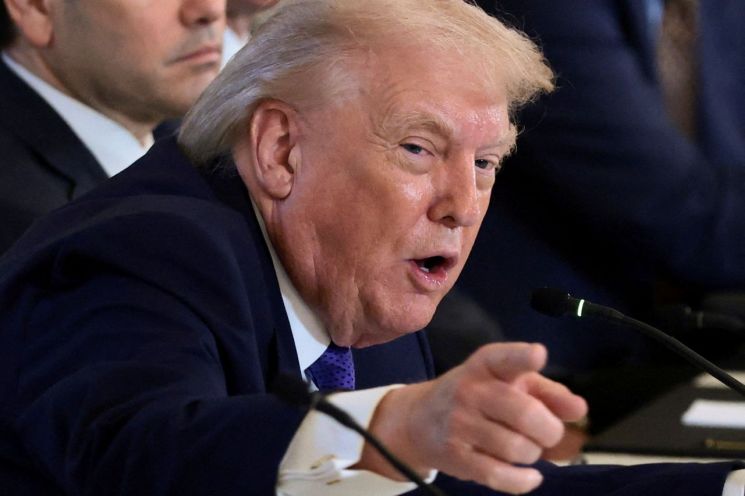 Donald Trump, President of the United States, is speaking at a meeting with executives from the oil industry held at the White House in Washington DC on the 9th (local time). Photo by Reuters Yonhap News
No Comment on Military Options... French Wine and Norwegian Salmon Could Face Tariffs
On the 19th (local time), President Trump stated in a phone interview with NBC News that he is "100% going to do it" when asked whether he would actually impose tariffs on European countries if the Greenland negotiations fail. On the 17th, President Trump had announced plans to impose tariffs on imports from eight European countries until a deal is reached for the "complete and comprehensive" purchase of Greenland. Accordingly, Denmark, Norway, Sweden, France, Germany, the United Kingdom, the Netherlands, and Finland will face a 10% tariff starting from February 1, and a 25% tariff from June 1.
Targeted items include French wine and cheese, Norwegian salmon, and Bang & Olufsen speakers assembled in Denmark. The Wall Street Journal (WSJ) mentioned brands such as Leica, Louis Vuitton, Le Creuset, and Herm?s as potentially affected by the tariffs, analyzing that the impact could be direct since their core production bases are in Europe.
President Trump also strongly criticized Europe's diplomatic and security response, referencing the Russia-Ukraine war. He emphasized, "What Europe should be focusing on is the Russia-Ukraine war, not Greenland." However, when asked whether he was willing to occupy Greenland by force, he replied, "No comment," avoiding a direct answer. NBC News analyzed that President Trump has shown a "guarded" attitude regarding how far the U.S. might go in its bid to annex Greenland.
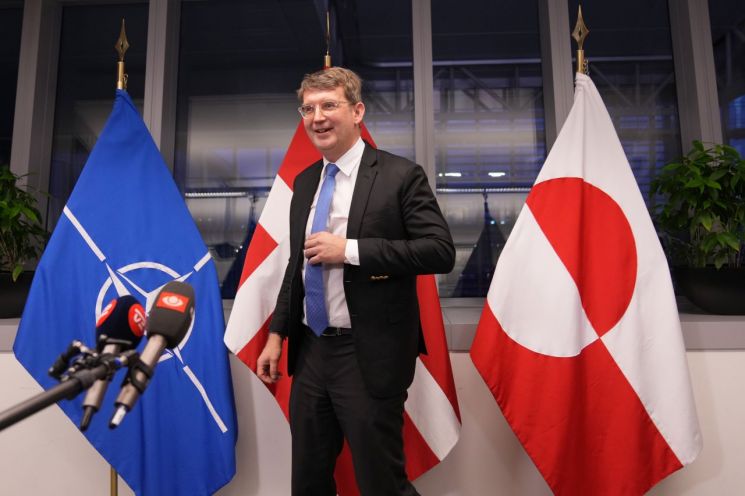 Troels Lund Poulsen, Denmark's Minister of Defense, is entering NATO headquarters in Brussels, Belgium, on the 19th (local time) to answer questions from the press. Photo by AP News Agency
Europe Discusses Triggering ACI... Potential Pressure on the U.S. Using American Financial Assets
Europe is also preparing a counteroffensive. The European Union (EU) is discussing the implementation of the so-called "trade bazooka," officially known as the Anti-Coercion Instrument (ACI), to respond to third countries that economically threaten member states. This measure would restrict trade in services, foreign direct investment, financial markets, public procurement, and intellectual property rights with countries that pose economic threats to the EU or its member states.
Deutsche Bank predicted that Europe could use its large holdings of U.S. financial assets as a bargaining chip. Europe is the largest holder of U.S. debt, with European countries holding approximately $8 trillion in U.S. Treasury bonds and stocks (according to Deutsche Bank). This is more than twice the amount held by all other countries combined. If Europe were to sell these assets, it could destabilize the U.S. economy. George Saravelos, Global Head of FX Research at Deutsche Bank, explained in a recent report, "Despite America's overwhelming military and economic power, it has one decisive weakness: it relies on other countries to finance its budget."
However, a significant portion of U.S.-related financial assets are held by the private sector, such as pension funds, insurance companies, banks, and asset management firms, rather than by governments, making it unlikely that such measures would be implemented in reality. For European countries to be induced to sell U.S. assets, mandatory measures such as legally restricting investment ratios would be necessary. This is politically and institutionally unlikely to happen and would take years even if pursued.
Above all, if Europe even hints at reducing or curbing its purchases of U.S. assets, the value of U.S. Treasury bonds could plummet. The resulting shock would likely return to Europe. A sharp decline in the value of the dollar would relatively strengthen the euro, which could directly hit European exports. This could push many European countries into an economic recession.
© The Asia Business Daily(www.asiae.co.kr). All rights reserved.


















