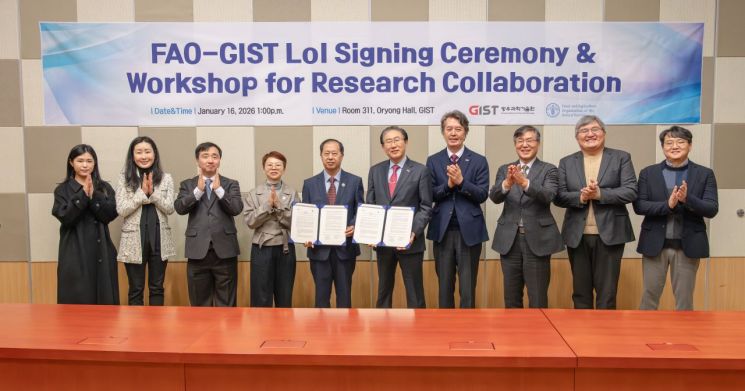
Gwangju Institute of Science and Technology (GIST) announced on January 20 that it has signed a Letter of Intent (LOI) with the Food and Agriculture Organization of the United Nations (FAO) to initiate full-scale cooperation in the areas of food security and sustainable agri-food systems, which are facing increasing uncertainty due to climate change.
This collaboration is being pursued as part of a strategic partnership to leverage GIST's advanced education and research capabilities in environmental, life sciences, and artificial intelligence (AI) fields to support FAO's global food and agriculture agenda through science and technology, strengthen the domestic agri-food ecosystem, and make practical contributions to the international community.
The signing ceremony was attended by GIST President Lim Gicheol, Vice President for External Affairs Jung Yonghwa, Dean of the Graduate School of Technology Management Kim Sangho, and other key GIST officials, as well as Tang Shengyao, Head of the FAO Korea Partnership Office, Deputy Head Lee Nara, and other representatives from both organizations.
GIST and FAO agreed to jointly generate innovative research outcomes by linking Korea's advanced technologies with policy needs in the food and agriculture sectors, and to develop these outcomes into collaborative models that can be applied to international policies and on-site practices.
With this agreement, GIST plans to establish a collaborative network connecting domestic universities, national research institutes, farms, and companies in the Honam region, and to begin developing Korean-style agri-food solutions.
In particular, GIST will use the Honam region as a field demonstration hub (testbed), conduct pilot projects there, and then expand the results to the international community (FAO member countries). The institute also aims to strengthen its AI-based climate and agri-food technology capabilities to contribute to FAO's global goals.
This LOI signing is the result of ongoing exchanges and discussions between the two organizations. In April last year, GIST invited Tang Shengyao, Head of the FAO Korea Partnership Office, to give a special lecture on "AI-Based Resilient Food and Agriculture Systems." In September, GIST hosted a session on "Digital Technology and Sustainable Livestock Management Innovation" at the FAO-organized Interregional Digital Agriculture Solution Forum (IDASF), confirming the potential for further collaboration.
Following the LOI signing ceremony, a "GIST-FAO Joint Workshop" was held to discuss concrete cooperation measures for applying advanced technologies to climate change, food security, and sustainable food systems. The workshop consisted of special lectures, research and technology sessions, and panel discussions.
During the special lecture session, strategies and technological applications for structural transformation in the climate and agri-food sectors were presented. ▲ Professor Kim Kibae of GIST's Graduate School of AI Policy and Strategy proposed a "grand architecture" for GIST-FAO cooperation in response to climate change. ▲ Ahn Changwon, Digital Convergence Program Manager at the Institute for Information & Communications Technology Planning & Evaluation, presented ways to utilize AI-based digital twins to address uncertainties in climate change and the food and agriculture sectors.
In the research and technology session, GIST researchers presented a range of achievements combining AI with environmental and agri-food technologies. ▲ Professor Kim Eunseok (Department of Environmental and Energy Engineering) introduced the principles of plant-microbe interactions. ▲ Professor Kim Hyungrok (Department of Environmental and Energy Engineering) proposed ways to address water resource uncertainty caused by climate change through water resource distribution detection technology using satellite image analysis.
GIST President Lim Gicheol stated, "This marks the starting point for international cooperation in sharing our advanced technological capabilities with the global community in an era of unprecedented climate change, aging, and population decline," adding, "GIST will fulfill its responsible role as a national science and technology institution in addressing the agri-food crisis faced by the international community."
Tang Shengyao, Head of the FAO Korea Partnership Office, emphasized, "The combination of GIST's scientific and technological capabilities with FAO's global agenda will make significant contributions to global food production, nutrition supply, environmental improvement, and quality of life."
© The Asia Business Daily(www.asiae.co.kr). All rights reserved.

















