Burden of Proof for Employee Status Shifts to Employers
Administrative Mediation for Issues Such as Non-Payment of Compensation
The push for a legislative package to protect 8 million workers outside the scope of current labor rights stems from the reality that the existing labor law framework has failed to keep pace with increasingly diverse forms of employment. The Labor Standards Act was designed based on traditional employment relationships, leaving a significant number of specially employed, platform, and freelance workers outside the protection of the law.
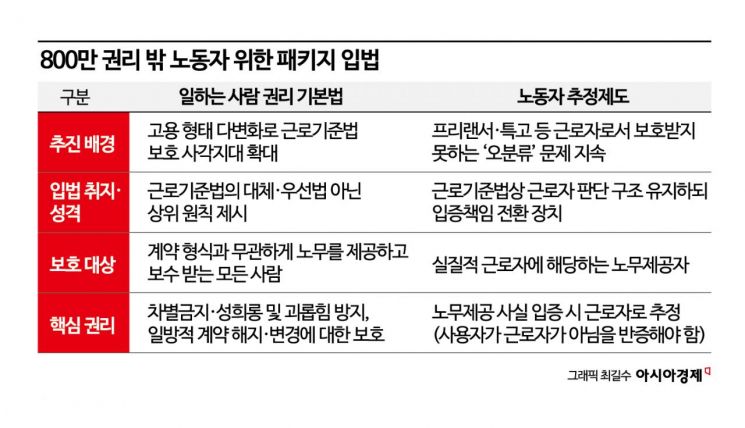
According to the Ministry of Employment and Labor on January 20, since 2006, six separate bills have been proposed to protect specially employed workers, but efforts to enact a single comprehensive law have repeatedly failed amid criticism that such laws create divisions among workers. In the meantime, some incremental improvements have been made, such as expanding the coverage of employment and industrial accident insurance. However, fundamental disputes, such as contract termination and unpaid compensation, remain unresolved.
This legislative package aims to address the structural limitations of current employment types. The core is to enact a basic law that declares minimum rights for all providers of labor, regardless of employee status, and to amend the Labor Standards Act to correct cases where actual workers were denied protection due to the form of their contracts. A representative from the Ministry of Employment and Labor explained, "The initiative started with the awareness of whether the constitutional concept of a worker should be limited only to those defined as workers under the Labor Standards Act. We believe a basic law is necessary because fragmented individual laws have their limits."
The "Basic Law on the Rights of Working People" is notable for its declarative and foundational nature, which is rare in the labor law system. It broadly enumerates constitutional rights such as non-discrimination, safety and health, fair contracts, and appropriate compensation, while focusing more on the responsibilities of the state and employers than on direct penalties or mandatory provisions. Therefore, in the short term, it is more likely to serve as a reference point for future amendments to individual labor laws rather than immediately changing workplace practices. Heo Kihun, Director of the Labor Provider Support Division at the Ministry of Employment and Labor, stated, "Given the nature of a basic law, it is inevitable that individual laws will take precedence. However, once the basic law is established, individual laws should be revised to reflect its spirit."
In terms of effectiveness, the key is the establishment of a dispute mediation function within the Labor Relations Commission and a separate support system. The plan is to resolve the most common issues faced by freelancers and labor providers-contract termination and unpaid compensation-through administrative mediation, which can significantly reduce the costs and time associated with litigation. However, since mediation requires an application and agreement from the parties involved, there are clear limitations if the employer refuses to participate or if the dispute is highly contentious.

The government intends to address these limitations by strengthening administrative investigation powers. Key measures include granting labor inspectors the authority to request documents, establishing an advisory body to determine employee status, and linking income data with the National Tax Service. For example, the "Working People’s Rights Support Foundation" will provide legal remedies for victims of sexual harassment or bullying, and cases with complex employee status issues will be professionally reviewed by a separate determination committee. If an individual takes disadvantageous action against someone for applying for administrative guidance or dispute mediation, a fine of up to 5 million won will be imposed as part of the support system.
The presumption of employee status is expected to have a more direct impact. By shifting the burden of proof to employers, this measure aims to structurally address the so-called "fake freelancer" problem. However, the government's decision to limit the effect of this presumption to civil disputes is a clear restriction. The government has stated that it will not apply this presumption to cases involving criminal liability, such as wage arrears or minimum wage violations, due to the constitutional principle of presumption of innocence. Kang Sungjin, Professor of Economics at Korea University, commented, "If the burden of proof is shifted to employers, the definition of a worker could become very broadly interpreted. Since the government has left the definition open, confusion may increase unless clear guidelines are established."
There are both hopes and concerns among labor and management regarding the legislative package. Labor groups have pointed out that "the basic law may remain merely declarative," while business circles have warned that "a surge in employee status disputes could lead to greater labor market rigidity." In particular, they cited the risk of an increase in cases where former workers claim employee status after their contracts have ended. A Ministry of Employment and Labor official stated, "Before the law comes into effect, we plan to review Supreme Court precedents, strengthen training for inspectors, and prepare clear criteria for major occupations."
© The Asia Business Daily(www.asiae.co.kr). All rights reserved.


















