Social Media Accounts Continue to Expose School Violence
Calls to "Abolish the Juvenile Law" Gain Momentum
In Japan, a social media account dedicated to exposing the realities of school violence has once again released a shocking video, further fueling public controversy. The latest incident, which shows a victim being strangled and then thrown into the sea, has sparked criticism that goes beyond school violence, with some calling it attempted murder. On January 19, according to Yonhap News TV, major Japanese media outlets reported that on January 17, the social networking service (SNS) account "Death Note," which exposes cases of school violence, posted a video and a message stating, "A middle school student in Osaka strangled an elementary school student and pushed him into the sea," causing widespread outrage.
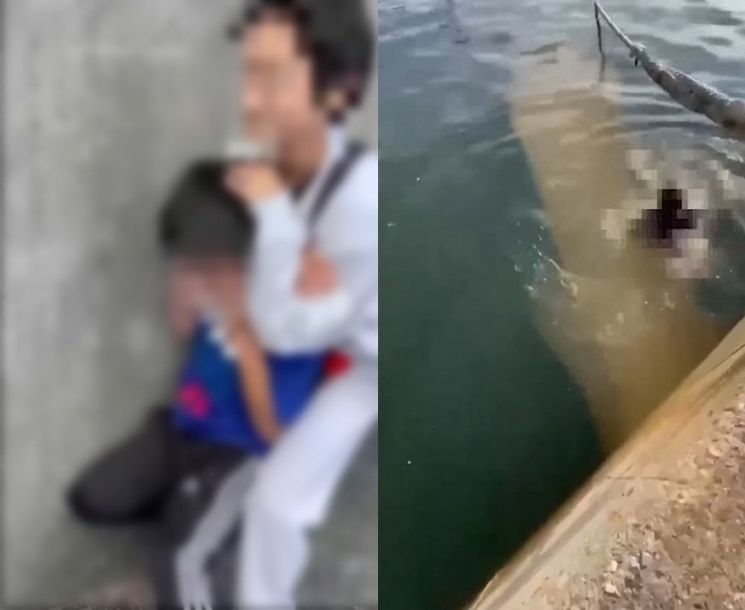 The image shows the perpetrator student strangling the victim student's neck, and as a result, a person presumed to be the victim is seen submerged in seawater. X
The video shows a middle school student forcefully strangling an elementary school student who appears younger, with the victim's face turning red in pain before eventually being released. The footage also captures the victim falling into the sea, provoking widespread public anger. What is particularly shocking is that the children nearby did not intervene; instead, they were seen laughing and making fun of the situation. The video, which vividly depicts both bystander apathy and mockery, spread rapidly across social media platforms.
Japanese netizens reacted to the video with outrage, describing it as "an attempted murder that goes beyond mere bullying" and insisting that "juvenile law should not protect children like these." As a result, a phenomenon known as "doxxing" has emerged, with the perpetrator's personal information and even their parents' workplaces being made public. There have also been reports that the company where the student's parents work has become the target of negative reviews on Google Maps.
"Similar to the Hinata Case" - Past Incidents Revisited
Some Japanese netizens who viewed this incident were reminded of the 2019 drowning case in Kochi Prefecture involving an elementary school student. At that time, seven-year-old Hinata died while playing in a river with friends, and it was later revealed that the children present did not call for help but instead ran away, raising suspicions of school violence. The bereaved family stated, "Hinata's friends witnessed him falling into the river but took no action," and requested that the incident be officially recognized as a case of school violence. In 2023, five years after the accident, a fact-finding committee was established to reinvestigate the case.
 Recently, in Okinawa Prefecture, Japan, a video showing a group of middle school students assaulting a classmate in the restroom was circulated, causing controversy. X (X)
Previously, in Okinawa Prefecture, a similar controversy erupted when a video showing a group of middle school students assaulting a classmate in a restroom was circulated. The victim has since refused to attend school due to psychological trauma. Meanwhile, the perpetrators have continued their studies without punishment, leading to criticism that victim protection is being neglected. Procedurally, under Japan's "Act on the Promotion of Measures to Prevent School Violence," when school violence such as assault, threats, or bullying is confirmed, the school and the board of education are required to investigate.
Disciplinary actions against perpetrators can include warnings, suspension, or expulsion, and in severe cases, police investigations for assault or bodily injury charges may proceed concurrently under criminal law. However, under Japanese criminal law, those under the age of 14 are not held criminally responsible, and even minors aged 14 or older are subject to the Juvenile Law, which focuses on protective measures such as referral to juvenile detention centers or probation. This has led to ongoing criticism that actual punishments are too lenient, as well as calls for strengthened preventive education at the school and community levels. The Asahi Shimbun predicted that this incident would further broaden the discussion of school violence issues within Japanese society.
© The Asia Business Daily(www.asiae.co.kr). All rights reserved.
!["The Woman Who Threw Herself into the Water Clutching a Stolen Dior Bag"...A Grotesque Success Story That Shakes the Korean Psyche [Slate]](https://cwcontent.asiae.co.kr/asiaresize/183/2026021902243444107_1771435474.jpg)

















