Positive Impact of K-Culture, Including "K-Pop Demon Hunters"
UAE Leads with 94.8% Favorability, Followed by Egypt and the Philippines
With global interest in Korean cultural content such as "K-Pop Demon Hunters" and "Maybe Happy Ending" on the rise, it has been found that foreigners' favorability toward Korea has reached an all-time high.
According to the results of the "2025 Korea National Image Survey" announced by the Ministry of Culture, Sports and Tourism on January 20, foreigners' favorability toward Korea last year rose by 3.3 percentage points to 82.3%. This marks the third consecutive year of increase and the highest figure since the survey began in 2018.
The Korea National Image Survey was first conducted in 2018 to examine foreigners' perceptions of Korea and trends in these perceptions, serving as reference material for developing national public relations strategies. Foreigners' favorability toward Korea was 78.7% in the first survey in 2018 and dropped to an all-time low of 76.7% in 2019. The figure exceeded 80% for the second time, following 80.5% in 2021.
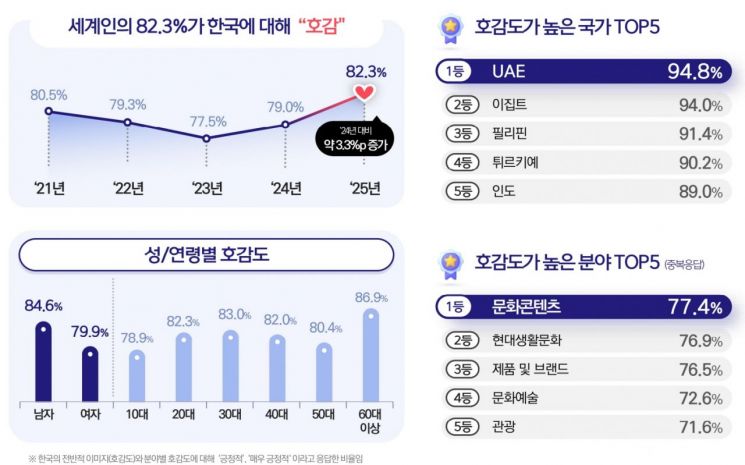
The country with the highest favorability toward Korea was the United Arab Emirates (UAE) at 94.8%, followed by Egypt (94.0%), the Philippines (91.4%), T?rkiye (90.2%), India (89.0%), and South Africa (88.8%).
In Thailand (86.2%) and the United Kingdom (87.4%), favorability toward Korea rose sharply by 9.4 percentage points each compared to the previous year. Thailand overcame a temporary sharp decline in favorability from the previous year and returned to a recovery trend. Favorability in Thailand had plummeted from 88.8% in 2023 to 76.8% in 2024. The United Kingdom not only recorded above-average favorability for the first time since the survey began but was also the only European country to do so.
Favorability toward Korea in China and Japan was relatively lower at 62.8% and 42.2%, respectively. However, both countries saw increases compared to the previous year, with China up by 3.6 percentage points and Japan by 5.4 percentage points. In particular, Japan recorded its highest favorability since the survey began, exceeding the 40% mark for the first time.
The factor that most positively influenced Korea's overall favorability was cultural content (45.2%). Various cultural content such as K-pop, dramas, and films are expanding Korea's cultural influence and contributing to improving the national image. The impact of cultural content was especially significant in the Asia-Pacific region, including the Philippines (69.3%), Japan (64.4%), Indonesia (59.5%), and Vietnam (58.4%).
Other factors that positively influenced favorability toward Korea included modern lifestyle (31.9%), products and brands (28.7%), and economic level (21.2%). In the Middle East and Africa, in addition to cultural factors, economic factors such as products, brands, and economic level also contributed to increasing favorability toward Korea.
The main channels through which people come into contact with Korea were video platforms (64.4%), social networking services (56.6%), internet sites (46.7%), and broadcasting (32.8%), indicating a variety of contact points. Among the major video platforms, YouTube (77.4%), Netflix (65.1%), and Amazon Prime (27.8%) were most commonly used, while among social networking services, Instagram (63.7%), TikTok (56.2%), and Facebook (53.6%) were the primary platforms.
Koreans' favorability toward their own country was calculated at 60.4%, an increase of 8.2 percentage points from the previous year.
This survey was conducted over the month of October last year, targeting 500 people each in 26 countries, including Korea, for a total of 13,000 respondents. The 26 countries surveyed included 12 from the Asia-Pacific, 4 from the Americas, 7 from Europe, and 3 from the Middle East and Africa, with online panel surveys conducted among those aged 16 and older.
Meanwhile, in-depth interviews related to the national image survey, conducted with key information holders on Korea, revealed that over the past year, the global perspective on Korea has broadened. Whereas in the past, Korea was mainly recognized for security issues, idols, or K-pop, over the past year, interest has expanded to cultural, economic, social, and political spheres. The in-depth interviews were conducted with about 70 people, including international students studying in Korea, foreign correspondents, and foreigners living abroad. In particular, they viewed positively the resilience of Korea's democratic system in overcoming political turmoil through the power of its citizens. Although the political issues of the past year may have appeared unstable on the surface, the interviews assessed that, at a deeper level, these events served as evidence of the dynamism of Asian democracy.
The "2025 National Image Survey Report" can be found on the Ministry of Culture, Sports and Tourism's website.
Gong Hyungsik, Director of Public Communication at the Ministry of Culture, Sports and Tourism, stated, "Through the results of this survey, we could truly feel the high favorability toward Korea among people worldwide and the influence of 'K-Culture' and 'K-Content.' Going forward, we will conduct more in-depth analyses of the results through expert forums and support their utilization across various fields."
© The Asia Business Daily(www.asiae.co.kr). All rights reserved.
!["The Woman Who Threw Herself into the Water Clutching a Stolen Dior Bag"...A Grotesque Success Story That Shakes the Korean Psyche [Slate]](https://cwcontent.asiae.co.kr/asiaresize/183/2026021902243444107_1771435474.jpg)
















