Amendment of the Enforcement Decree and Notification of the Radioactive Waste Management Act
Spent Nuclear Fuel Management Fee for Light Water Reactors Raised by 92.5%
Annual Reserve Requirement for Korea Hydro & Nuclear Power Increases by 300 Billi
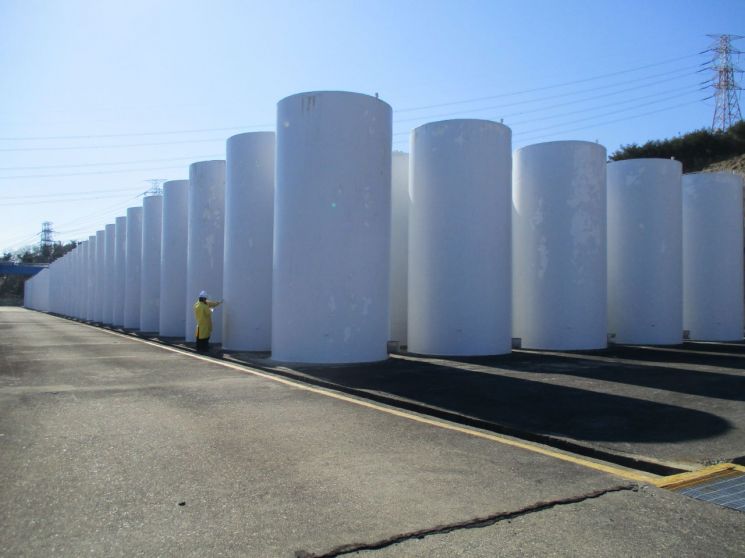 A view of the canister at the dry storage facility for spent nuclear fuel, constructed prior to the MAXSTOR at the Wolseong Nuclear Power Plant. Korea Hydro & Nuclear Power Photo by Yonhap News
The spent nuclear fuel management fee, which had been frozen since 2013, will be raised for the first time in 12 years. As a result, the annual amount that Korea Hydro & Nuclear Power must set aside will increase by 300 billion won, and the cost of nuclear power generation is expected to rise by up to 3 won per kilowatt-hour.
The Ministry of Climate Energy and Environment announced on the 20th that a partial amendment to the Enforcement Decree of the Radioactive Waste Management Act was approved at a Cabinet meeting. In accordance with the revised enforcement decree, the ministry will amend the “Regulations on the Calculation of Radioactive Waste Management Costs and Spent Nuclear Fuel Management Fees (Notification)” and implement them starting January 27.
Under this amendment, the spent nuclear fuel (high-level radioactive waste) management fee, which has been frozen since 2013, will be increased by 92.5% for light water reactors and by 9.2% for heavy water reactors. The management cost for intermediate- and low-level radioactive waste will be raised by 8.5% compared to 2021.
The annual cost that Korea Hydro & Nuclear Power must bear will increase from about 800 billion won to 1.1 trillion won, an increase of 300 billion won. The cost of nuclear power generation is expected to rise by 2 to 3 won per kilowatt-hour.
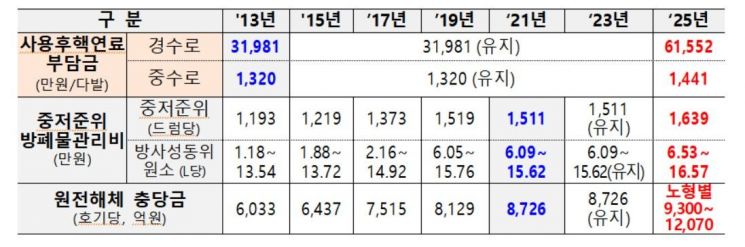
The spent nuclear fuel management fee, which is used for the construction and operation of interim storage and disposal facilities, is imposed on Korea Hydro & Nuclear Power based on the quarterly amount generated and is accumulated in the Radioactive Waste Management Fund.
The spent nuclear fuel management fee had been frozen since 2013. Although there were two rounds of public discussion on spent nuclear fuel management policy (from October 2013 to June 2015, and from May 2019 to April 2021), the fee remained frozen due to the lack of a finalized policy for high-level radioactive waste management. As a result, there were concerns that the burden of handling high-level radioactive waste would be passed on to future generations.
The ministry explained, "We promoted the revision of the spent nuclear fuel management fee in consideration of policy conditions, such as the enactment of a special law on high-level radioactive waste management."
The management cost for intermediate- and low-level radioactive waste is used for the construction and operation of the Gyeongju intermediate- and low-level radioactive waste disposal facility. The ministry stated that it calculated the cost by reflecting the projected volume of radioactive waste generation according to the 11th Basic Plan for Electricity Supply and Demand, and by converting the future project cost to present value.
With this amendment, the nuclear power plant decommissioning reserve has also been subdivided to reflect the characteristics of each nuclear reactor type, and the latest decommissioning project costs have been incorporated. The nuclear decommissioning reserve refers to the project costs required for decommissioning and waste disposal, and is set aside as a provision in Korea Hydro & Nuclear Power’s financial statements. However, the amount required for one reactor unit is held in cash.
An Sejin, Director of Nuclear Industry Policy at the Ministry of Climate Energy and Environment, stated, "By objectively reflecting the latest policy, technology, and economic variables, we have adjusted the post-operation costs for radioactive waste management and decommissioning to be more realistic. We expect this will help secure stable funding for the sustainability of nuclear power and public safety, and improve fairness in the distribution of burdens between current and future generations."
Meanwhile, the Enforcement Decree of the Radioactive Waste Management Act requires that the funding needed for post-operation nuclear power plant processing-including radioactive waste management costs, spent nuclear fuel management fees, and decommissioning reserves-be reviewed and announced every two years.
The ministry explained that, starting in August 2025, it will calculate the costs after expert review, stakeholder opinion gathering, deliberation by the Radioactive Waste Management Fund Management Committee, and the Fee Management Deliberation Committee.
© The Asia Business Daily(www.asiae.co.kr). All rights reserved.
![Clutching a Stolen Dior Bag, Saying "I Hate Being Poor but Real"... The Grotesque Con of a "Human Knockoff" [Slate]](https://cwcontent.asiae.co.kr/asiaresize/183/2026021902243444107_1771435474.jpg)

















