Banks Begin One-Hour Shortened Workdays
Early Leave Policy Introduced
Government Also Promotes 4.5-Day Workweek
Further Discussion Needed on Wage Reduction Issues

As major commercial banks are increasingly adopting shorter working hours, discussions on the 4.5-day workweek are gaining momentum in the financial sector.
According to the financial industry on the 20th, labor and management at KB Kookmin Bank recently reached a tentative agreement to introduce a one-hour shorter workday on Fridays. The plan is to move the Friday closing time up to 5 p.m. and forcibly shut down all PCs in the bank at that time.
IBK Industrial Bank of Korea has been officially implementing a one-hour shorter workday on Wednesdays and Fridays since the 7th. Employees leave work one hour earlier than before, and participate in training programs remotely. However, the policy is currently managed autonomously by each branch.
NH Nonghyup Bank also plans to introduce a one-hour shorter workday once a week within the first half of the year, in the form of an early leave policy on Fridays. Shinhan Bank and Hana Bank are also discussing similar measures. Woori Bank is expected to begin full-scale discussions after the inauguration of the new union leader on the 23rd. Given that banks tend to maintain similar working conditions, it is highly likely that most will sequentially agree to shorter working hours.
Financial public enterprises are also showing related moves. Labor and management at Korea Asset Management Corporation (KAMCO) recently agreed to pilot a KAMCO-style early leave system. Korea Credit Guarantee Fund also decided at a labor-management council meeting in July last year to discuss the introduction of a 4.5-day workweek after the government finalizes its guidelines.
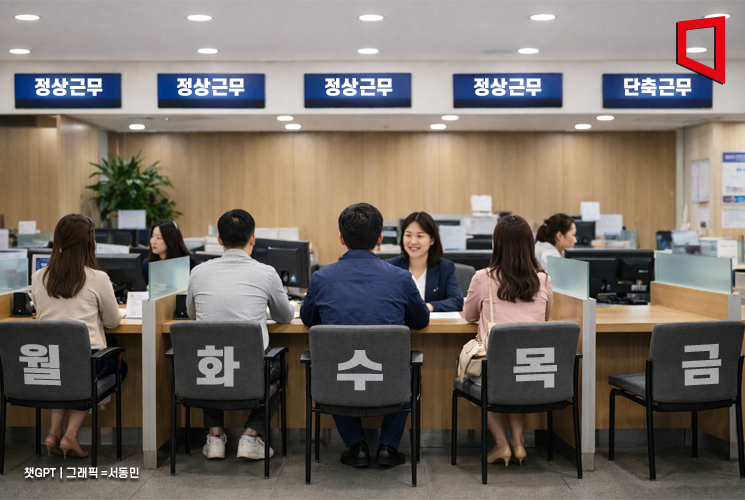
These moves by the banks are the result of labor-management consultations between the National Financial Industry Labor Union and the Korea Federation of Banks. In October last year, labor and management in the financial sector reached a tentative agreement to implement a one-hour shorter workday on Fridays and to form a task force to introduce the 4.5-day workweek.
With banks starting to introduce shorter working hours, there is growing interest in whether the 4.5-day workweek will become widespread. The 4.5-day workweek was a presidential campaign pledge by President Lee Jaemyung and is one of the government’s key policies to reduce actual working hours this year. On the 14th, the Ministry of Employment and Labor launched the 'Roadmap Implementation Task Force for Reducing Actual Working Hours.' Starting this year, the ministry plans to provide up to 7.2 million won per employee annually to workplaces that adopt the 4.5-day workweek or other reduced working hour systems.
However, some believe that significant discussions are still needed before the 4.5-day workweek can be implemented. An official at a major commercial bank stated, "There are concerns about possible wage cuts and practical issues at bank branches, so the policy may not be realistic." However, the official also noted, "If the government remains strongly committed and a leading example emerges in the financial sector, adoption could spread rapidly."
© The Asia Business Daily(www.asiae.co.kr). All rights reserved.


















