6.6cm Rise Over the Past Decade... Nearly Double the Rates of the East and South Coasts
Heo Jongsik: "Sea Level Rise Is a Key Factor Exacerbating Disaster Damage"
The rate of sea level rise off the coast of Incheon has been found to be more than 40% higher than the national average.
According to data received on January 19 from the Korea Hydrographic and Oceanographic Agency by Heo Jongsik, a member of the Democratic Party of Korea (representing Dong-gu and Michuhol-gu Gap in Incheon), the average annual sea level rise off the coast of Incheon over the past decade was 6.61mm.
This figure is more than 40% higher than the national average annual sea level rise of 4.72mm over the past 10 years, and is nearly double the rates observed in the southern coast (3.30mm) and the eastern coast (2.94mm).
Over the past 36 years, the sea level off Incheon has risen by approximately 11.7cm, with more than half of this increase-6.6cm-occurring in the past 10 years alone. This indicates that the rise in sea level along the west coast has accelerated sharply in recent years.
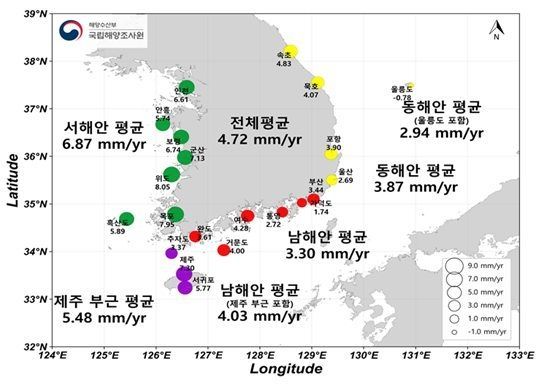
While there have been fragmented forecasts and concerns about the climate crisis, Heo's office stated that this is the first time the speed of sea level rise and the risk index for each coastal area in Incheon have been specifically confirmed using official government data.
Such elevated sea levels serve as a "risk catalyst" that exacerbates flood damage in the event of sudden typhoons or tidal waves. In fact, an analysis of the "Incheon Coastal Flood Scenario," which takes sea level rise into account, showed that the area at risk of flooding would expand significantly from primarily low-lying regions to encompass the entire Incheon coastline, including Ganghwa, Yeongjong, North Port, Inner Port, South Port, and Soraepogu.
The government's "2024 Coastal Disaster Risk Assessment" also clearly revealed Incheon's structural vulnerabilities. Approximately 94% (950.5km) of Incheon's total coastline was classified as "Grade 5 (High)"-the highest level based on sea level rise indicators. The coastal disaster risk index, which comprehensively reflects vulnerabilities such as population and facilities, was highest in Namdong-gu (0.79), followed by Dong-gu (0.76), Seo-gu (0.63), and Jung-gu (0.62), indicating a severe level of disaster sensitivity in the original urban coastal areas where infrastructure is densely concentrated.
However, despite these circumstances, the lack of coastal erosion management-which forms the foundation of disaster preparedness-has been pointed out as a serious problem. As of 2024, only 15 out of 368 coastal erosion survey sites nationwide (4%) are located in Incheon. This is a very small number compared to other regions such as Gangwon (102 sites) and Jeolla (101 sites), leaving the Incheon coastline effectively outside the scope of risk management.
Heo stated, "Sea level rise is not simply an environmental change, but a key variable that determines the scale of damage from major disasters," and emphasized, "The Incheon Metropolitan Government and the Ministry of Oceans and Fisheries must work closely together to establish proactive disaster prevention measures."
© The Asia Business Daily(www.asiae.co.kr). All rights reserved.
![Clutching a Stolen Dior Bag, Saying "I Hate Being Poor but Real"... The Grotesque Con of a "Human Knockoff" [Slate]](https://cwcontent.asiae.co.kr/asiaresize/183/2026021902243444107_1771435474.jpg)
















