Participation Rate in Recreational Sports Rose by 2.2 Percentage Points Last Year
Main Activities: Walking, Bodybuilding, and Hiking
The rate of participation in recreational sports among teenagers in South Korea is significantly lower than that of other age groups.
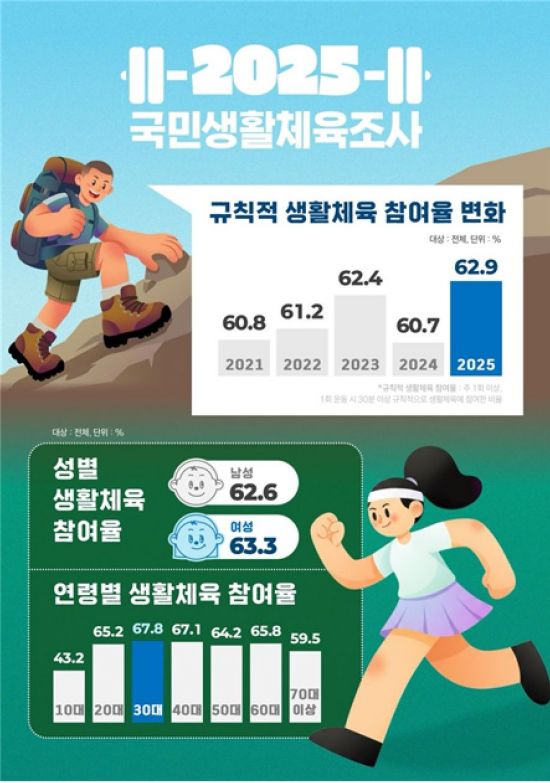
According to the results of the "2025 National Survey on Sports for All," released by the Ministry of Culture, Sports and Tourism on January 19, the participation rate in recreational sports among Koreans last year (defined as at least once a week for 30 minutes or more) was 62.9%, marking a 2.2 percentage point increase from the previous year. The rate of participation at least twice a week also rose by 2.7 percentage points to 52.2% compared to the previous year.
By age group, the participation rates among people in their 20s to 60s were relatively even at around 65%. However, teenagers (43.2%) and those aged 70 and above (59.5%) showed notably lower rates compared to other age groups.
The most popular activities were walking (40.5%), bodybuilding (17.5%), and hiking (17.1%). Hiking saw the largest increase in participation, rising by 5.0 percentage points from the previous year.
When asked about the average duration per session for their main sports activities (first, second, and third choices), 67.3% responded "between 1 hour and less than 1 hour 30 minutes," making it the most common answer. In the past year, 91.4% reported participating in sports activities for "nine months or more." The average participation period among regular participants was 14 months, up from 11 months the previous year.
Public sports facilities were the most commonly used venues, with 81% of respondents reporting their use. In addition to public sports facilities, private sports centers and outdoor spaces such as parks were also frequently utilized.
The average monthly expenditure on sports activities per person was 62,000 won, an increase of 16,000 won compared to the previous year. The proportion of respondents who reported "no expenditure" on sports activities was 40.8%, a decrease of 16.3 percentage points from the previous year. When asked about activities they would like to participate in if conditions allowed, "swimming" (16.2%) was the top choice if they had more free time, while "golf" (19.0%) was the most desired if they had more financial resources.
The most common reason for not participating regularly in sports activities was "lack of available time" at 61.3%, followed by "lack of interest in sports activities" (50.8%) and "lack of access to sports facilities" (31.3%). By age group, "lack of time" was the top response among those in their 50s and younger, "lack of interest" was most common among those in their 60s, and "health issues" was the leading reason among those aged 70 and above. The rate of participation in recreational sports at least once in the past year was 79.4%, with 37.4% participating in only one type of activity.
Based on the results of this survey, the Ministry of Culture, Sports and Tourism plans to further develop its "Sports Participation Incentive" program, aiming to establish lifelong exercise habits among all citizens. The ministry will provide up to 50,000 won in annual incentive points per person to those who participate in activities such as physical fitness assessments and sports activities. These points can be used for registering at sports facilities, purchasing sports equipment, and for services in the health sector such as hospitals, pharmacies, and insurance. The number of private and public sports facilities where points can be accumulated will be expanded from about 4,000 currently to 6,000 this year. The scope will also be broadened to allow points to be earned through outdoor sports activities such as running, cycling, and trail walking, by linking with exercise apps. In addition, the number of National Fitness Certification Centers, where citizens can receive fitness assessments and exercise prescriptions, will be gradually increased from 75 to 150 by 2030. The ministry will also introduce digital measuring equipment to shorten assessment times and increase capacity. Furthermore, it will continue to support the construction of popular recreational sports facilities such as swimming pools and plans to support the establishment of 150 new National Sports Centers by 2030.
The full report of the 2025 National Survey on Sports for All is available on the Ministry of Culture, Sports and Tourism website (Key Policies/Policies by Sector/Sports).
Kim Daehyun, the Second Vice Minister of the Ministry of Culture, Sports and Tourism, stated, "In a super-aged society, it is not a choice but a necessity for many citizens to participate in recreational sports to improve their health and happiness and reduce social costs such as medical expenses. The ministry will gradually improve the conditions for sports participation so that all citizens can exercise regularly and maintain their health in daily life."
This National Survey on Sports for All was conducted by the Korea Institute of Sport Science, surveying 9,000 citizens aged 10 and above from September 2024 to August of last year.
© The Asia Business Daily(www.asiae.co.kr). All rights reserved.

















