Analysis of Josaitan Mine Submersion Site Underway
South Korean and Japanese Leaders Pledge Cooperation on Identifying Recovered Remains
"Measures to Ensure Site Safety Being Implemented"
Calls for Joint Investigation Emerge... "Prompt Cons
It has been confirmed that the government has begun follow-up measures immediately after the agreement between the South Korean and Japanese leaders on the recovery of remains from the Japanese Josaitan Mine. Although progress had stalled in the excavation and identification of the remains due to the Japanese government's passive stance, further working-level consultations, including joint DNA analysis between the two countries, are expected to accelerate.
According to government ministries on the 19th, the Past Affairs Support Team under the Ministry of the Interior and Safety, which oversees support for victims of forced mobilization during the Japanese colonial period, recently launched efforts to identify the site of the Josaitan Mine flooding accident and the burial locations of the victims.
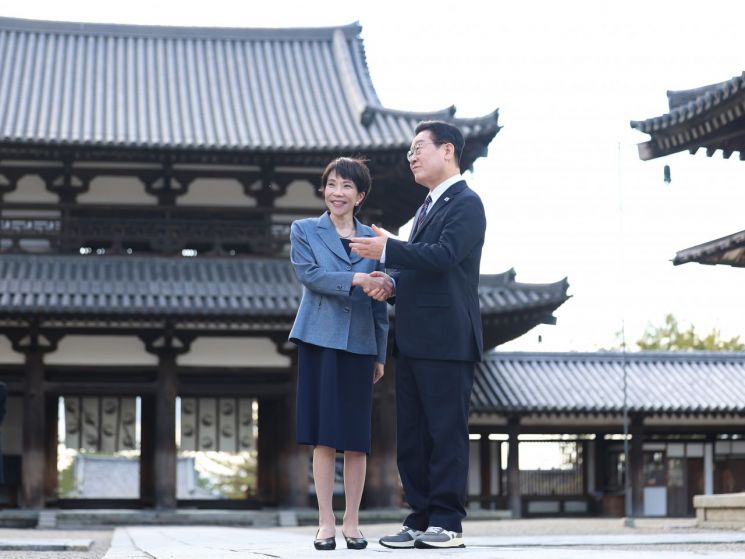 Following the agreement between the South Korean and Japanese leaders on the recovery of remains from the Japanese Josaitan Mine, the government is taking follow-up measures. The photo shows President Lee Jae-myung and Japanese Prime Minister Sanae Takaichi visiting Horyuji Temple, a representative cultural heritage site in Nara Prefecture, Japan, on the 14th. Photo by Yonhap News
The Josaitan Mine is an undersea coal mine located in Ube City, Yamaguchi Prefecture, in western Honshu, Japan. On February 3, 1942, a flooding accident caused by a tunnel leak resulted in the deaths of 183 people, including 136 Koreans and 47 Japanese.
The recovery of the victims’ remains was carried out by a Japanese civic group. This group used funds raised through crowdfunding to conduct a diving investigation for the collection of remains, and in August of last year, they discovered four human bones, including a skull, on the seabed.
Although the identification of the remains had been slow, on the 13th, the leaders of South Korea and Japan agreed during their summit to cooperate on DNA analysis of these remains. The Japanese government will commission a specialized company to determine whether the DNA from the remains is related to Korean families, while the South Korean government plans to utilize the National Forensic Service, a domestic DNA analysis institution.
The government also plans to investigate overall matters, including the burial locations of the victims and the internal structure of the undersea tunnels. Based on this, they intend to analyze the mining process at the time and establish scenarios for the burial locations. A representative from the support team explained, "Given that the recovery site is a hazardous undersea location, we believe it is essential to first assess safety during the investigation and excavation of the remains."
Some have raised the possibility that the scope of the South Korean government's participation could be adjusted during the working-level consultations following the summit agreement. In fact, the current research includes systematic proposals such as geological surveys and exploration methods prior to the excavation of remains at the Josaitan Mine. In particular, the application of the latest exploration technologies for identifying the underwater tunnel conditions and the locations of the submerged remains will also be considered.
Domestic research institutions are also calling for joint investigations by the government. The Center for Historical Truth and Justice stated, "Based on this agreement, the governments of both countries should promptly begin the investigation and repatriation of the remains of all victims of forced mobilization."
It appears that, in addition to diplomatic authorities, the Past Affairs Support Team and Japan’s Ministry of Health, Labour and Welfare will continue consultations between the governments. If kinship is established during the identification process, the return of the remains to the bereaved families is also anticipated. A government official commented, "Since remains were already discovered at the site last year and further measures are needed, practical working-level consultations between the authorities are expected to proceed swiftly."
© The Asia Business Daily(www.asiae.co.kr). All rights reserved.

















