First January Meeting in Five Years
Discussion Expected on Domestic Stock Allocation and Currency Hedging
The National Pension Service (NPS) is expected to raise the upper limit on its domestic stock investment ratio. This move comes as the KOSPI has been rising at one of the fastest rates globally, and without adjusting the allocation, the NPS could be forced to mechanically sell stocks, thereby suppressing the index.
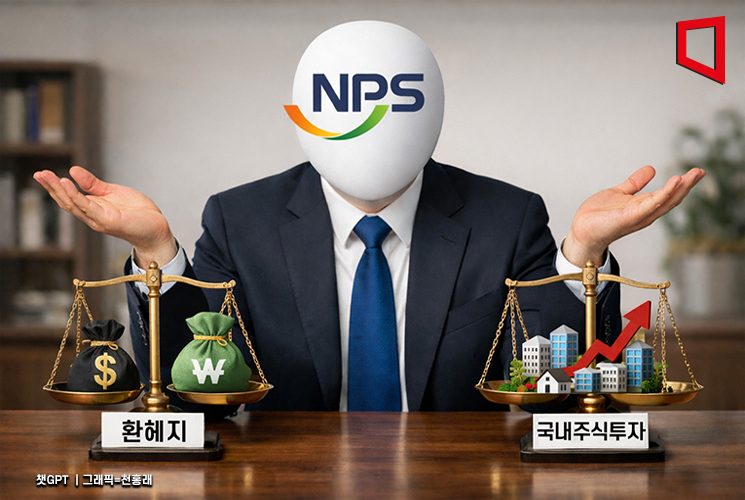
According to the financial investment industry on the 16th, the Ministry of Health and Welfare will convene a meeting of the NPS Fund Management Committee on the 26th. The committee is responsible for reviewing and deciding on the NPS's asset allocation strategy. While the first meeting is typically held in March each year, an emergency meeting in January marks the first time in five years. The committee is expected to review the entire portfolio, including the domestic stock allocation, and also discuss strategies such as currency hedging.
This year, the domestic stock target allocation set by the NPS Fund Management Committee is 14.4%. Under the Strategic Asset Allocation (SAA) guidelines, the allocation can be adjusted within a margin of ±3 percentage points. Including the permissible deviation for Tactical Asset Allocation (TAA, ±2 percentage points), the maximum investment can reach up to 19.4%. If this upper limit is fully utilized, the NPS's flexibility in managing its assets will inevitably be reduced. As of the end of October last year, the NPS's domestic stock allocation was already approaching 18%.
According to the Korea Exchange, from November last year to the 16th of this month, pension funds have been net sellers of 2.0701 trillion won worth of stocks in the KOSPI market. Pension funds include the NPS, Teachers' Pension, Government Employees Pension, and various mutual aid funds, but the NPS accounts for the majority based on assets under management. This has led to interpretations that some sales have already begun in consideration of the target allocation.
At the end of last year, President Lee Jaemyung also hinted at the need to adjust the domestic stock investment ratio. In a year-end work report from the Ministry of Health and Welfare, President Lee remarked, "As domestic stock prices rise, the NPS's stock holdings have exceeded the limit. Should we continue selling? There are opinions that if the NPS holds more as the domestic stock market performs well, it will benefit the public and better secure their retirement."
With the won-dollar exchange rate surging to the 1,470 won range, the industry expects the NPS Fund Management Committee to also adjust the strategic currency hedging ratio. Strategic currency hedging involves selling a portion of dollar-denominated overseas assets when the exchange rate exceeds a predetermined level, thereby reducing currency exposure risk. If implemented, this would increase the supply of dollars in the market and is expected to help lower the exchange rate.
At the end of last year, when the won-dollar exchange rate approached 1,480 won, the government formed a strategic currency hedging task force (TF) with members from the Ministry of Health and Welfare and the NPS Fund Management Headquarters. Previously, every execution of currency hedging required approval from the Fund Management Committee, but the task force enabled a more proactive response. Currently, the NPS Fund Management Headquarters operates its currency hedging strategies privately, taking into account market impact and other factors.
© The Asia Business Daily(www.asiae.co.kr). All rights reserved.
![User Who Sold Erroneously Deposited Bitcoins to Repay Debt and Fund Entertainment... What Did the Supreme Court Decide in 2021? [Legal Issue Check]](https://cwcontent.asiae.co.kr/asiaresize/183/2026020910431234020_1770601391.png)