Filipino Domestic Workers Receive Only 1.18 Million Won per Month
Half the Korean Average Wage
Lower Hourly Pay Than Korean Workers... "Labor Rights Must Be Guaranteed"
An analysis has found that Filipino domestic workers who participated in the pilot project for foreign domestic workers, introduced two years ago with the aim of alleviating career interruptions among women, suffered from low wages and excessive workloads. The issues they faced have led to calls not only for improved treatment but also for a fundamental reevaluation of the value of care work and stronger guarantees of labor rights.
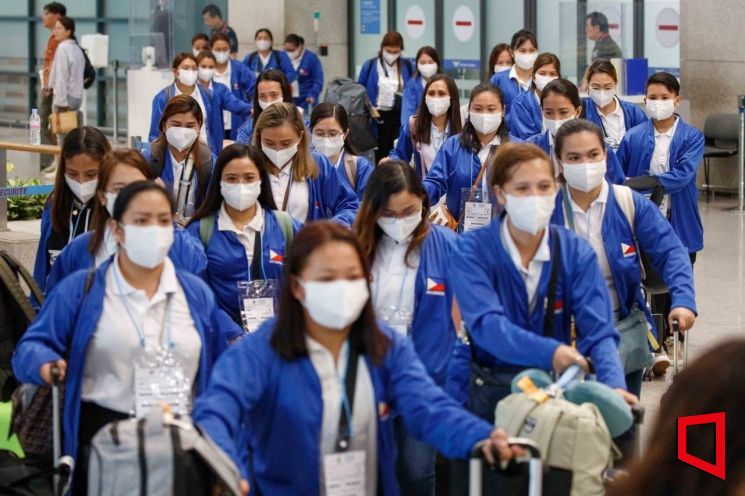 In 2024, Filipino workers participating in the pilot project for foreign domestic workers are entering through Incheon International Airport.
On January 17, Lee Miae, Research Professor at the Tamla Culture Research Institute of Jeju National University, presented these findings in her paper, "From Resistance to Rights Subjectification: Chinese Korean and Filipino Migrant Domestic and Care Workers," published in the Korean Journal of Immigration Policy. The study analyzed the working conditions of 21 Filipino domestic workers and 2 interpreters through surveys and in-depth interviews conducted between April and May 2024.
According to the survey, during the first six months of the project, the workers received an average monthly pre-tax wage of 1.92 million won. However, after deductions for housing, insurance, and communication expenses, their actual take-home pay was only 1.18 million won. This amount is just about half the average monthly wage in Korea for 2024, which was 3.737 million won. Their hourly wage was set at 9,860 won, which is 27-35% lower than that of Korean childcare providers (13,590 won) or domestic workers (14,000-15,000 won).
Even based on a 30-hour workweek, deductions of 470,000 to 520,000 won per month meant that their net pay fell below 1 million won. The research team also confirmed testimonies that these workers were tasked with a wide range of duties beyond their original childcare responsibilities, including house cleaning, dishwashing, pet care, and English education.
Professor Lee Miae pointed to the exclusion of migrant domestic care workers' voices during the policy design process as a key reason for these issues. She stated, "If worker experiences are not reflected in the planning, operation, and evaluation stages of policy, a disconnect with the field is inevitable," and added, "It is necessary to allow workers to maintain their residency status when changing workplaces and to guarantee the three basic labor rights."
Professor Lee also emphasized, "The discussion should not be limited to wage levels; we must reevaluate the social and economic value of childcare," and suggested, "We need to design a virtuous cycle structure in which 'quality care and jobs' are promoted by recognizing the economic contribution of domestic work."
The government has decided not to continue the pilot project for foreign domestic workers. The project, which was launched in September 2024 by the Seoul Metropolitan Government and the Ministry of Employment and Labor to reduce the burden of childcare, was abolished after just one year. Measures have been taken to allow domestic workers who have already entered the country to continue their activities, such as extending their stay through other E-9 visa options.
© The Asia Business Daily(www.asiae.co.kr). All rights reserved.
![Clutching a Stolen Dior Bag, Saying "I Hate Being Poor but Real"... The Grotesque Con of a "Human Knockoff" [Slate]](https://cwcontent.asiae.co.kr/asiaresize/183/2026021902243444107_1771435474.jpg)
















