Support Funds Distributed Across Regions Ahead of Lunar New Year
"Cash Handouts Ahead of Elections" Spark Criticism
"One-Off Policies Could Lead to Populism"
With the Lunar New Year holiday just a month away, some local governments are accelerating the distribution of livelihood stabilization support funds. While these initiatives are being promoted as efforts to stabilize residents’ lives and boost local consumption, criticism is mounting that they are “cash handout policies” aimed at the upcoming local elections in June.
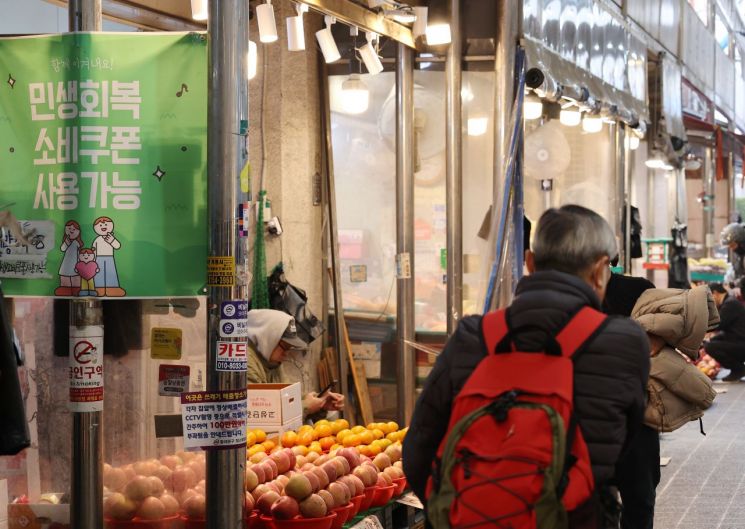 A notice about the Livelihood Recovery Consumption Coupon is posted at Cheongnyangni Market in Dongdaemun-gu, Seoul (photo for article understanding purposes and unrelated to the article content). Photo by Yonhap News Agency
Boeun County and Yeongdong County in North Chungcheong Province will begin distributing the support funds on January 26. Boeun County will provide 600,000 won per resident, split into two payments. Applications are open from January 26 to February 27, and anyone registered as a resident as of December 31, 2025, is eligible. This includes marriage immigrants and permanent residents. The funds will be distributed in the form of anonymous prepaid local currency cards, which can only be used at small businesses in the county with annual sales of 3 billion won or less. The cards can be used at Hanaro Mart in township areas, but not at the Hanaro Mart in the town center. The usage period is until September 30, after which any remaining balance will automatically expire.
Yeongdong County will also distribute 500,000 won per resident starting on the same day. The recipients are approximately 43,000 people, including residents and registered foreigners with an address in Yeongdong County as of January 1 of this year. The distribution will take place until February 27.
Goesan County, also in North Chungcheong Province, will provide 500,000 won per resident starting January 19. Anyone whose resident registration was maintained as of the end of last year is eligible to apply, with applications accepted at township and town offices. To reduce congestion during the first week, applications will be accepted on certain days based on the last digit of the applicant’s birth year-for example, those with a last digit of 1 or 6 can apply on Monday, and those with 2 or 7 on Tuesday. After the first week, this restriction will be lifted. Goesan County has decided to waive all fees for issuing required certificates during the application period. Residents who do not have a mobile phone in their name, have difficulty receiving a card, or are aged 75 or older will receive the funds via prepaid card recharge. The funds will be distributed within one to two days after application, and the usage period lasts until May 31.
Namywon City in North Jeolla Province will distribute 200,000 won per resident to all citizens from February 2 to February 27. Eligible recipients include citizens and marriage immigrants or permanent residents with an address in Namwon as of the end of last year. The funds will be provided in the form of anonymous prepaid cards, which can only be used at Namwon Love Gift Certificate affiliate stores. The city expects to distribute a total of 15.2 billion won to approximately 76,000 people.
Imsil County in North Jeolla Province has already started distributing the funds on January 12. Residents registered as of November 30 of last year can apply until February 6. The funds will be distributed as anonymous prepaid cards, with the usage period lasting until June.
Boseong County in South Jeolla Province has also passed a revised budget for 2026 that includes a provision to distribute 300,000 won per resident to all citizens. The county plans to complete the distribution before this year’s Lunar New Year holiday.
However, these support fund policies continue to face criticism as “cash populism” ahead of the elections. Critics argue that local governments with low fiscal self-reliance are injecting large amounts of budget to hand out cash to residents, which may increase consumption in the short term but could lead to reductions in other welfare and administrative budgets in the long term. Additionally, there are concerns over fairness, as the eligibility criteria and amounts differ by local government. One resident commented, “Our area isn’t receiving any support funds, but other places are getting cash, which feels unfair.”
Local government officials claim that cash-based support is effective in revitalizing local businesses, but economic experts warn that the boost in consumption could quickly fade if the support is only a one-off measure, emphasizing the need for ongoing regional economic strategies. They also cautioned that if such cash handouts become routine, it could ultimately worsen local government finances and make life more difficult for residents.
© The Asia Business Daily(www.asiae.co.kr). All rights reserved.

















