Decrease in Public Jeonse Guarantee Subrogation Payments
"Seen as a Sign of Jeonse Fraud Stabilizing"
Last year, for the first time, the total amount of jeonse deposit payments made by the national guarantee agency to tenants on behalf of landlords decreased. Analysts say this indicates that the public burden of compensation, which had surged due to the wave of jeonse fraud, is now entering a phase of decline.
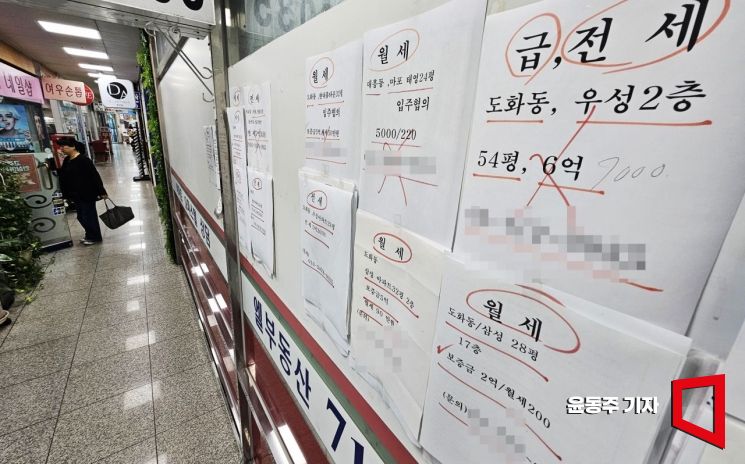 A rental notice on a real estate listing board in Mapo, Seoul, has an X mark on the lease information.
According to the Housing and Urban Guarantee Corporation (HUG) on January 17, the amount paid to tenants under the jeonse deposit return guarantee in 2025 totaled 1.7935 trillion won. This represents a reduction of more than half compared to the 3.9948 trillion won paid in 2024. Since HUG began making subrogation payments for jeonse deposits in 2015, this is the first time that the annual repayment amount has decreased.
The number of subrogation cases also declined sharply. Last year, there were 9,124 cases, down about 50% from 18,553 cases the previous year.
The jeonse deposit return guarantee system pays the tenant first if the landlord fails to return the deposit after the contract ends, after which the guarantee agency exercises its right of recourse against the landlord. Since the mid-2010s, the use of this system has steadily increased, leading to a consistent rise in repayments, but this trend has recently reversed.
In fact, the number of guarantee accidents has noticeably decreased. Last year, the total amount of guarantee accidents caused by non-returned jeonse deposits was 1.2446 trillion won, a drop of more than 70% compared to the record high of 4.4896 trillion won the previous year. The number of such cases also fell from around 20,000 to the 6,000 range during the same period.
Court statistics show a similar trend. Last year, the number of tenants nationwide who applied to the court for a leasehold registration order after failing to recover their deposit at the end of the contract was around 28,000. This is a decrease of more than 40% compared to the peak of around 47,000 cases in 2024, when the jeonse fraud issue was at its height. The decline was particularly pronounced in areas such as Seoul and Incheon, where damage had been concentrated.
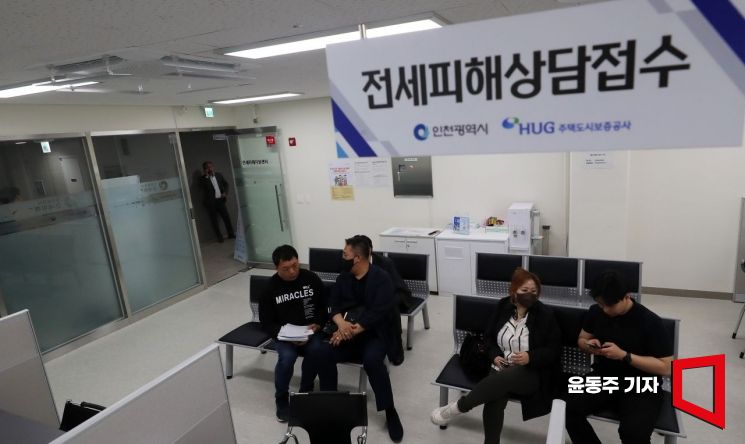 Tenants who have fallen victim to lease fraud are receiving consultations at the Jeonse Damage Support Counseling Center in Bupyeong District, Incheon.
Experts view these changes as a sign that the spread of jeonse fraud is subsiding. They attribute this to HUG strengthening the requirements for joining the jeonse deposit return guarantee since 2023, thereby restricting high-risk landlords from enrolling. At the time, adjustments to the loan-to-value ratio criteria filtered out a significant portion of contracts with a high risk of guarantee accidents.
Improved conditions for recovering deposits have also contributed to the decline in repayments. HUG's recovery rate for jeonse guarantee claims has risen sharply in recent years, surpassing 80% last year compared to the single-digit or 10% range in the past. This means the guarantee agency is now able to recover a much higher proportion of the amounts paid, either from landlords or through auction procedures.
A HUG official stated, "As guarantee accidents are rapidly decreasing, the scale of subrogation payments is also showing a clear downward trend," adding, "If this trend continues, the public financial burden is likely to ease further in the future."
© The Asia Business Daily(www.asiae.co.kr). All rights reserved.


















