Government Announces Administrative Integration Incentives...
Prime Minister Kim: "Status Equivalent to Seoul to Be Granted"
Daejeon-Chungnam and Gwangju-Jeonnam Set to Benefit
Could Become a Major Variable in the June 3 Local Elections
The government is planning an unprecedented level of financial support for administrative integration special cities, with up to 5 trillion won per year and a maximum of 20 trillion won over four years. These integrated special cities will be granted a status equivalent to that of Seoul. The government also intends to give priority to these cities when relocating public institutions in the future.
Currently, Daejeon-Chungnam and Gwangju-Jeonnam, where discussions on administrative integration have become tangible, are expected to be the primary beneficiaries. This announcement by the government has emerged as the biggest variable in the Chungcheong and Honam regional elections ahead of the 9th nationwide local elections scheduled for June 3.
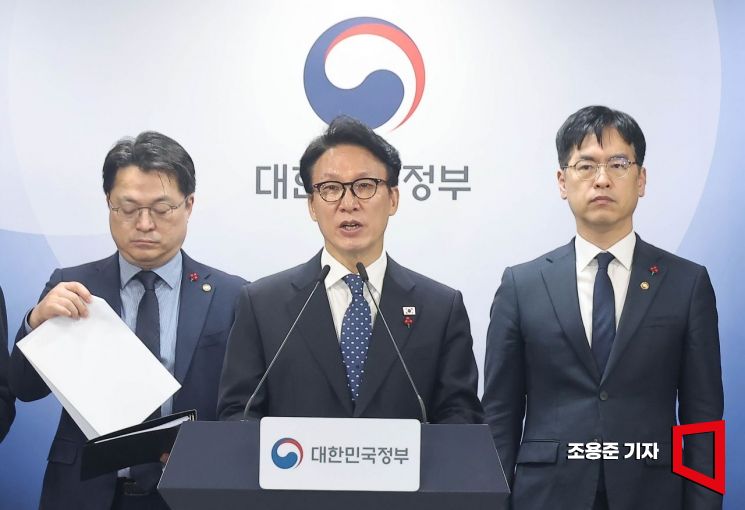 Prime Minister Kim Minseok is giving a briefing on administrative integration incentives at the Government Complex Seoul in Jongno-gu, Seoul on the 16th. Attending the announcement were Lee Hyungil, Vice Minister of Strategy and Finance; Choi Eunok, Vice Minister of Education; Kim Minjae, Vice Minister of the Interior and Safety; Moon Sinhak, Vice Minister of Industry; Kim Itak, First Vice Minister of Land, Infrastructure and Transport; and Lim Gikun, Vice Minister of Planning. January 16, 2026. Photo by Jo Yongjun
On the morning of January 16, Prime Minister Kim Minseok held a briefing at the Government Complex Seoul to announce these "administrative integration incentives." Prime Minister Kim stated, "To ensure Korea's new leap forward, shifting from growth centered around the Seoul metropolitan area to region-led growth will be the government's top priority this year." He added, "To successfully promote administrative integration and ensure that integration leads directly to regional growth, we have prepared groundbreaking incentives in four key areas." The four major incentives prepared by the government are: ▲financial support, ▲enhanced status for integrated special cities, ▲priority relocation of public institutions, and ▲industrial revitalization.
Prime Minister Kim explained, "Local governments that integrate will be given clear incentives, along with corresponding autonomy and responsibility," and added, "We will pursue the redistribution of national resources, including the establishment of the Administrative Integration Grant and the Administrative Integration Support Fund (tentative names)." To this end, he said, "We will quickly finalize detailed plans through a joint 'Integrated Local Government Financial Support Task Force' composed of relevant ministries, and work closely with the National Assembly."
The government plans to provide up to 20 trillion won in financial support to integrated special cities over four years, and will establish new grants such as the Administrative Integration Grant and the Administrative Integration Support Fund to this end. In addition, the number of deputy mayors under the head of the integrated special city will be increased to four, and their rank will be elevated to vice-ministerial level. Autonomy in organizational and personnel management will also be strengthened.
Starting in 2027, the government plans to actively pursue the second phase of public institution relocations, with integrated special cities being given top priority as relocation destinations. The aim is to create quality public sector jobs and build various living infrastructure to improve local conditions. The government will also support business activities by providing employment subsidies, training support funds, and reduced land lease fees to companies moving into integrated special cities. Prime Minister Kim emphasized, "We will ensure that integrated special cities successfully launch and grow as the core pillars of the 'Five Mega-Regions and Three Special Autonomous Provinces' (5-3 Special Structure)."
The name of the integrated special city has not yet been determined. Kim Minjae, Vice Minister of the Interior and Safety, explained, "Regarding whether it should be 'Daejeon-Chungnam' or 'Chungnam-Daejeon,' some people use 'Chungnam-Daejeon' because the integration is based on grouping the entire Chungnam region as one administrative area." He added, "As for Gwangju-Jeonnam, the name reflects the symbolic significance of Gwangju in the Honam region." However, he noted, "Ultimately, the final decision will be made after fully gathering residents' opinions during the legislative process in the National Assembly."
The Daejeon-Chungnam integration has been promoted by the opposition People Power Party, and with President Lee Jaemyung lending his support, discussions have gained momentum. In the case of Gwangju-Jeonnam, the Democratic Party's metropolitan mayors have jointly expressed their intention to promote integration, and local lawmakers are also actively involved in the discussions.
This government announcement could become a decisive factor in shaping the landscape of the June 3 local elections, which are now less than five months away. If the plan is expedited, the heads of the integrated Daejeon-Chungnam and Gwangju-Jeonnam special cities could be elected in this upcoming election. Currently, both the Mayor of Daejeon and the Governor of Chungnam are members of the People Power Party. The issue is that if the integrated special city is realized through the bold support of the Lee Jaemyung administration, it could become a political boon for the ruling party. While the People Power Party agrees on the principles of administrative integration and the need for support, it remains wary of potential political repercussions.
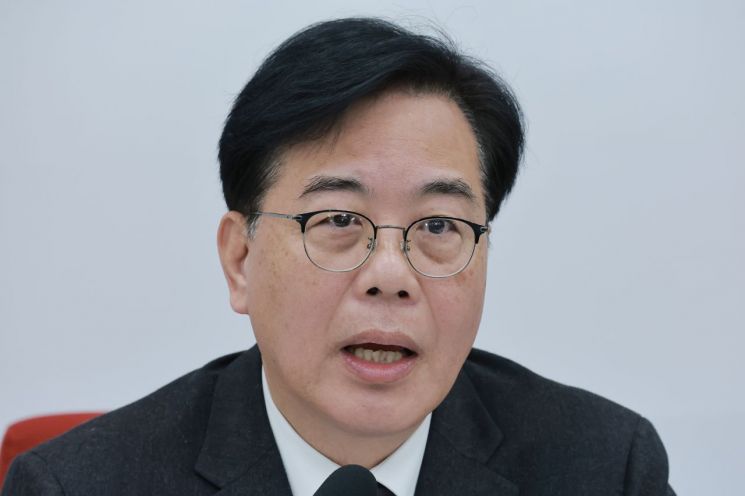 Song Unseok, Floor Leader of the People Power Party, is holding a press briefing at the National Assembly on the 16th. Photo by Yonhap News Agency
At a press conference that day, Song Unseok, Floor Leader of the People Power Party, said, "Combining local governments that share the same roots will lead to greater development." However, he pointed out, "When the bill was first proposed, there was no response, but now, just before the election, calling for integration seems more like a political statement." He continued, "Most importantly, the People Power Party is taking the lead from the fundamental position that the country's success depends on the success of its regions. We will do our best to discuss this thoroughly in the legislative process going forward."
Hwang Myungseon, a Democratic Party lawmaker, stated, "The plan to support metropolitan administrative integration is a significant turning point that will break the dominance of the Seoul metropolitan area and open the door to a true era of regional development." He added, "Integration should be a process that unites living and economic spheres, creating a land of opportunity where people can find quality jobs without having to leave their hometowns."
© The Asia Business Daily(www.asiae.co.kr). All rights reserved.
![User Who Sold Erroneously Deposited Bitcoins to Repay Debt and Fund Entertainment... What Did the Supreme Court Decide in 2021? [Legal Issue Check]](https://cwcontent.asiae.co.kr/asiaresize/183/2026020910431234020_1770601391.png)

















