Supreme Court Finalizes Ruling on Unjust Enrichment from Difference Franchise Fees
Pizza Hut Under Rehabilitation Proceedings... Repayment Faces Obstacles
Franchise Act Revision Expands Collective Bargaining Rights... Concerns Over On-Site Confusion
Korea Pizza Hut is now at a crossroads of survival. The Supreme Court has finalized a ruling ordering the headquarters to return the difference in franchise fees it gained by supplying raw materials to franchisees at higher prices. With the recent revision of the Franchise Business Act expanding collective bargaining rights for franchisees, concerns are growing about increasing uncertainty in the franchise market as these changes put pressure on the management structure of franchise headquarters.
According to the industry on the 16th, the Supreme Court ruled the previous day that Korea Pizza Hut headquarters must consider the difference in franchise fees-charged by supplying raw and subsidiary materials to franchisees at prices above wholesale-as unjust enrichment. As a result, Korea Pizza Hut is required to return approximately 21.5 billion won, collected as difference franchise fees over seven years from 2016 to 2022, to its franchisees. The difference franchise fee refers to the amount the headquarters receives by adding distribution margins when supplying raw and subsidiary materials. While this has been permitted under the Franchise Business Act, the core issue in this lawsuit was that the relevant details were not specified in the contract.
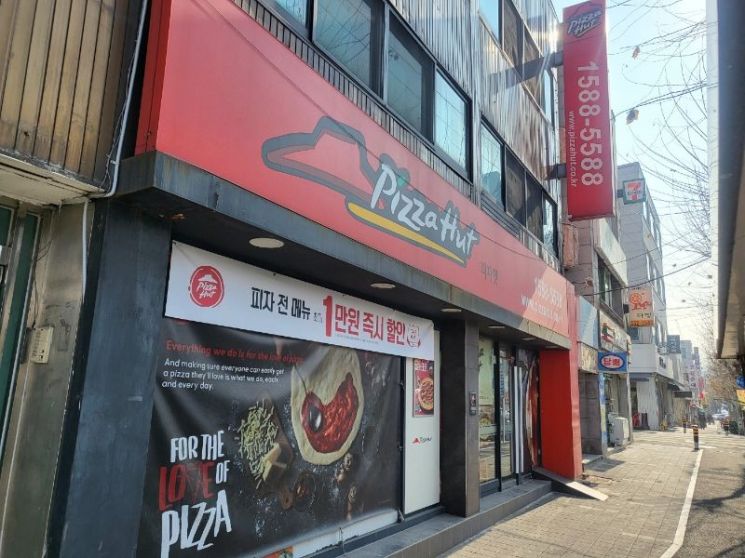
According to documents submitted to the court, the average difference franchise fee per franchise store was 25.91 million won in 2022, accounting for 5.27% of the average sales per store. The Supreme Court stated, "For the headquarters to collect difference franchise fees, there must be a clear agreement between the headquarters and the franchisees. An implicit agreement that disadvantages franchisees should not be easily recognized, and the social and economic status of both parties, the circumstances of contract formation, and whether information was provided, must all be comprehensively considered."
However, the return of difference franchise fees by Pizza Hut is expected to face significant challenges. Korea Pizza Hut entered rehabilitation proceedings at the end of 2024, which restricts repayment to individual creditors. Even if the finalized ruling recognizes the claim for the return of difference franchise fees, this claim will be classified as a rehabilitation claim and will be repaid according to the rehabilitation plan.
If rehabilitation fails and liquidation follows, repayment will be made from any remaining assets only after secured creditors and public interest claims have been paid, making full recovery unlikely. As of 2024, Korea Pizza Hut's total equity stands at minus 17.7 billion won, indicating capital impairment. Reflecting the provision for the lawsuit regarding difference franchise fees, the net loss for the current period amounts to 27.3 billion won. Cash and cash equivalents are also only about 1.6 billion won, making it financially difficult to immediately repay fixed liabilities with internal funds.
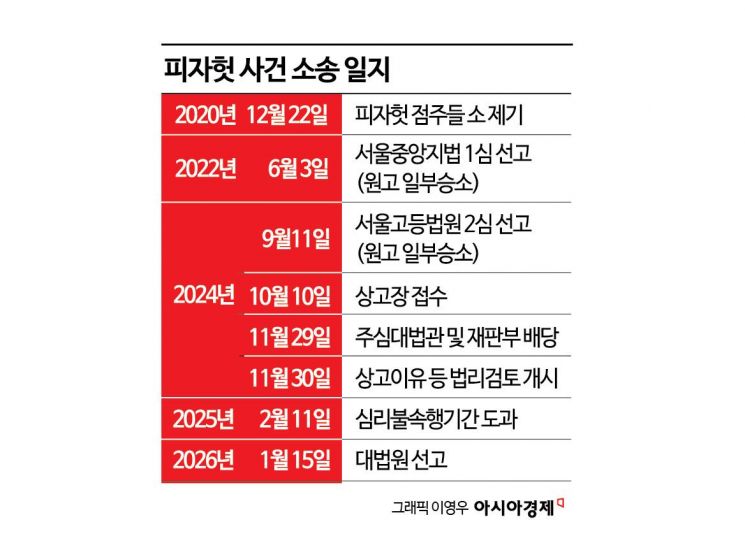
At the end of last year, the rehabilitation court approved a conditional investment agreement (stalking horse) for the merger and acquisition (M&A) of Korea Pizza Hut and began the sale process. The sale includes all related businesses such as the development and operation of Pizza Hut restaurants and the franchise business, and will proceed through a business transfer. After the main bidding, the actual repayment rate and timing of the difference franchise fee claims will be determined according to the acquisition terms and the rehabilitation plan.
The industry is concerned that this ruling may spread to other franchise companies, such as chicken, burger, and coffee brands. Currently, about 20 brands-including BBQ, bhc, Kyochon, Goobne, Cheogajip Yangnyeom Chicken, Puradak, Burger King, Mom's Touch, Baskin Robbins, and Twosome Place-are involved in lawsuits related to difference franchise fees. According to last year's Fair Trade Commission survey, 61.5% of franchise headquarters collected difference franchise fees. The fact that some law firms are actively promoting additional lawsuits is also cited as a factor heightening industry anxiety.
However, some point out that since each franchise company has a different business structure and contract type, it is difficult to apply the Pizza Hut case across the entire industry. An industry insider said, "Pizza Hut collected both royalties and difference franchise fees, but many brands do not collect royalties. Currently, the system has been revised to require that details related to difference franchise fees be specified in franchise agreements, so the likelihood of the same issue recurring is low."
Furthermore, industry tension is rising as the recently passed amendment to the Franchise Business Act comes into effect. The amendment recognizes franchisee organizations as legal bargaining parties and allows them to demand negotiations with the headquarters regardless of the size of the organization. While the intent is to protect franchisee rights, there are concerns on the ground that unclear negotiation scope and standards will inevitably lead to confusion. An industry insider said, "Contrary to the intent of the system, there is a possibility that conflicts may intensify in practice," and added, "Supplementary measures will be needed during implementation."
© The Asia Business Daily(www.asiae.co.kr). All rights reserved.


















