Considering Differentiated Standards and Point Allocation for the "From Scratch" Criterion
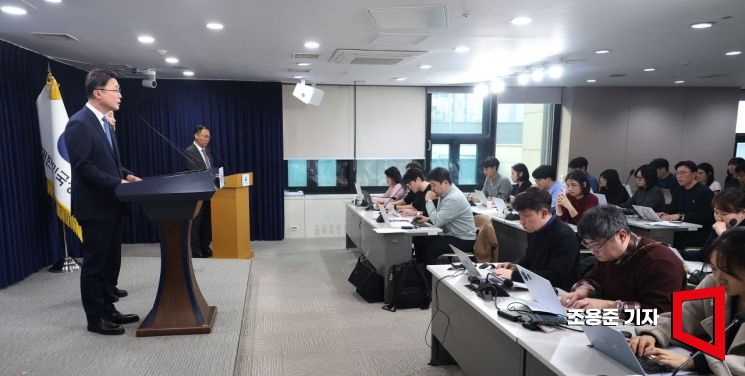 Ryu Jemyung, Vice Minister of Science and ICT, is announcing the "First Phase Evaluation Results of the Independent AI Foundation Model Project" at the Government Seoul Office in Jongno-gu, Seoul on January 15, 2026. Photo by Jo Yongjun
In the first phase evaluation of the Independent Artificial Intelligence (AI) Foundation Model Project, an unexpected outcome occurred as both Naver Cloud and NC AI, considered strong contenders, failed to advance to the second phase, breaking the initial expectation that only one team would be eliminated. As a result, whether the projects meet the "independence" requirement has emerged as the most significant variable for future selection. The government, aware of ongoing industry controversies over the unauthorized use of Chinese open-source models, is considering refining the relevant criteria for the second evaluation to reduce confusion, possibly by differentiating or adjusting the scoring system.
The Ministry of Science and ICT conducted the first phase evaluation based on benchmarks (40 points), expert assessments (35 points), and user feedback (25 points), comprehensively judging performance, usability, and cost efficiency. As a result, LG AI Research, SK Telecom, and Upstage advanced to the second phase. Based on scores alone, only NC AI would have been eliminated. However, for Naver Cloud, whether it met the "independent AI foundation model" criteria ultimately determined its fate, resulting in its failure to advance to the next phase.
The central issue was the "from scratch" criterion, which determines the extent to which independence is recognized. The government explained, "Even if open-source is used, it must be demonstrated that the weights have been reinitialized and retrained using proprietary data." It stated that Naver Cloud failed to meet the independence requirement because it used the encoder weights from Alibaba's Qwen model without modification. Naver submitted an explanation asserting that it possesses its own encoder and that the use of the Qwen encoder within the project was minimal. However, the government clarified, "Since this explanation was submitted after the evaluation process had already begun, it was not reflected in the procedure."
The "from scratch" controversy was not limited to Naver Cloud. Kim Kyungman, Director General for AI Policy at the Ministry of Science and ICT, said, "In the case of Upstage, evaluators also pointed out issues regarding the lack of reference to open-source models. SK Telecom faced similar criticism, but it did not function as an absolute evaluation criterion." He emphasized once again that all issues raised were reflected in the evaluators' scores and that the criteria were not applied disadvantageously to any particular company.
Based on this experience, the government plans to further refine the independence criteria, particularly the "from scratch" standard, in the second evaluation. Director General Kim stated, "The overall framework of benchmark, expert, and user evaluations will remain, but for the 'from scratch' issue, we plan to gather additional input from academia, industry, and experts to clarify the differentiation and scoring methods."
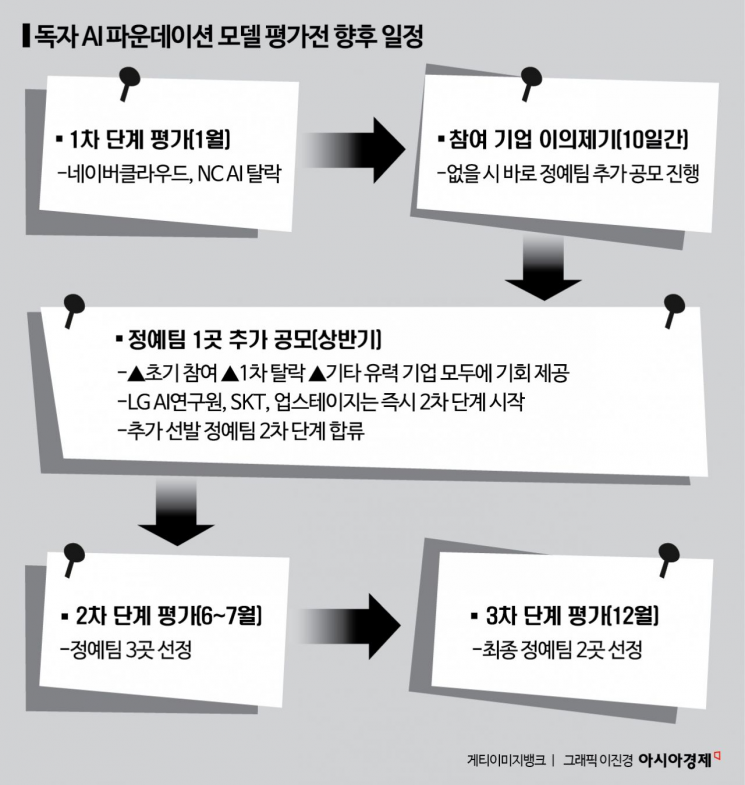
The government acknowledged, however, that a certain level of uncertainty is unavoidable in the second evaluation as well. The scale of support may vary depending on whether additional GPUs (graphics processing units) are secured, and there is a possibility that the target level will be raised to keep pace with the technological competition among global AI companies. Participating companies, including those eliminated this time, may file objections to the evaluation results for ten days. Once this process is complete, the government will select a fourth elite team through an additional open call to fill the vacant spot. By the end of this year, the government plans to select a final total of two elite teams.
© The Asia Business Daily(www.asiae.co.kr). All rights reserved.


















