Maximum Working Hours Reached 328 in December 2024
Controller Staffing Rate Only 35% of ICAO Standard
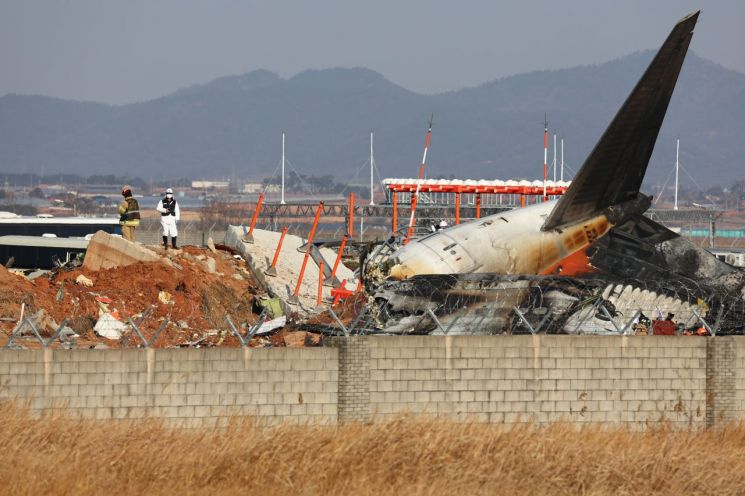 Wreckage of the aircraft that collided and exploded during landing at Muan International Airport, Muan County, Jeollanam-do on the afternoon of the 29th. Photo by Yonhap News
At the time of the Jeju Air passenger plane disaster on December 29, air traffic controllers at Muan International Airport were found to have been suffering from overwork, working more than 300 hours per month.
According to data submitted by Assemblyman Jung Junho (Gwangju Buk-gu Gap) of the Democratic Party of Korea to the Ministry of Land, Infrastructure and Transport on January 15, the average monthly working hours for air traffic controllers at Muan International Airport in December 2024, when the disaster occurred, was calculated at 282.7 hours.
The maximum working hours reached 328 hours, which is 100 hours more than the average monthly working hours (about 220 hours) for controllers at 15 other airports nationwide.
In 2022, there were cases of controllers working more than 300 hours in a month at both Ulsan and Yeosu control towers, each for one month. In 2023, Ulsan control tower saw such cases for three months, and Yeosu control tower for one month.
In 2024, Ulsan and Uljin approach control centers each had two months with over-300-hour work, and Yeosu control tower had one such month. However, at Muan control tower, the frequency of over-300-hour monthly work has shown a steady increase each year from 2022 to 2024, and is significantly higher than at other control facilities.
In December 2024, when the disaster occurred, the maximum working hours for controllers at Muan Airport reached 328 hours, and the average was 282.7 hours. This is nearly double the typical monthly working hours for ordinary employees (about 160 to 170 hours).
The reason controllers are forced to endure such grueling work schedules is an absolute shortage of personnel. In 2019, the Ministry of Land, Infrastructure and Transport conducted a public participation organizational diagnosis for air traffic control to address the need for more air traffic controllers.
According to the International Civil Aviation Organization (ICAO) standards at that time, the appropriate total number of air traffic controllers was calculated at 552, meaning there was a shortfall of 200 compared to the actual domestic workforce of 352. The staffing rate was only 63.8%. Especially at Muan Airport, there were only 6 controllers compared to the ICAO standard of 17, leaving a gap of 11, and the staffing rate was the lowest among all control centers at 35.3%.
The diagnosis also projected that, due to increased air traffic and the rapid growth of low-cost carriers, air passenger numbers would reach 99 million by 2030. Consequently, the overall volume of air traffic control would rise, overloading controllers and making normal operations difficult. The report concluded that additional personnel would be needed to meet demand appropriately. A year-by-year staffing plan was presented, calling for nine additional controllers at Muan Airport by 2022, but the Ministry of Land, Infrastructure and Transport only managed to add one.
Limits on controller working hours are also operated as discretionary guidelines, not mandatory rules, under the Ministry’s notification. By allowing heads of air traffic control agencies to set their own standards “based on operational circumstances,” a structure has become entrenched where controllers work more than 300 hours a month with less than half the internationally recommended manpower. The “self-regulation” structure, where the Ministry of Land, Infrastructure and Transport serves as both the safety regulator and the operator of control agencies, has also been cited as a problem.
Assemblyman Jung Junho stated, “Long working hours and staff shortages for controllers are not simply labor issues, but serious matters that undermine the very foundation of aviation safety. It is urgent to upgrade the working hour limits from a Ministry notification to a legally binding regulation, and to improve the system by staffing according to international recommendations.”
© The Asia Business Daily(www.asiae.co.kr). All rights reserved.

















