Mayor Lee Unveils Goyang’s Vision for the Future
Daegok Station Area to Become the Heart of Knowledge Convergence
Declaring an End to the Bedroom Community Era... Expansion of Economic Territory
Preserving the Daegok Station “Knowledge Convergence Complex”
Building an “AI School Zone” with the Creation of an AI Campus
On January 15, Lee Donghwan, Mayor of Goyang Special City, held the "2026 New Year Press Conference" in the main conference room at City Hall, unveiling a blueprint to transform Goyang from a residential-focused bedroom community into a "future self-sustaining city" where industry and AI are integrated, based on the city's achievements over the past four years.
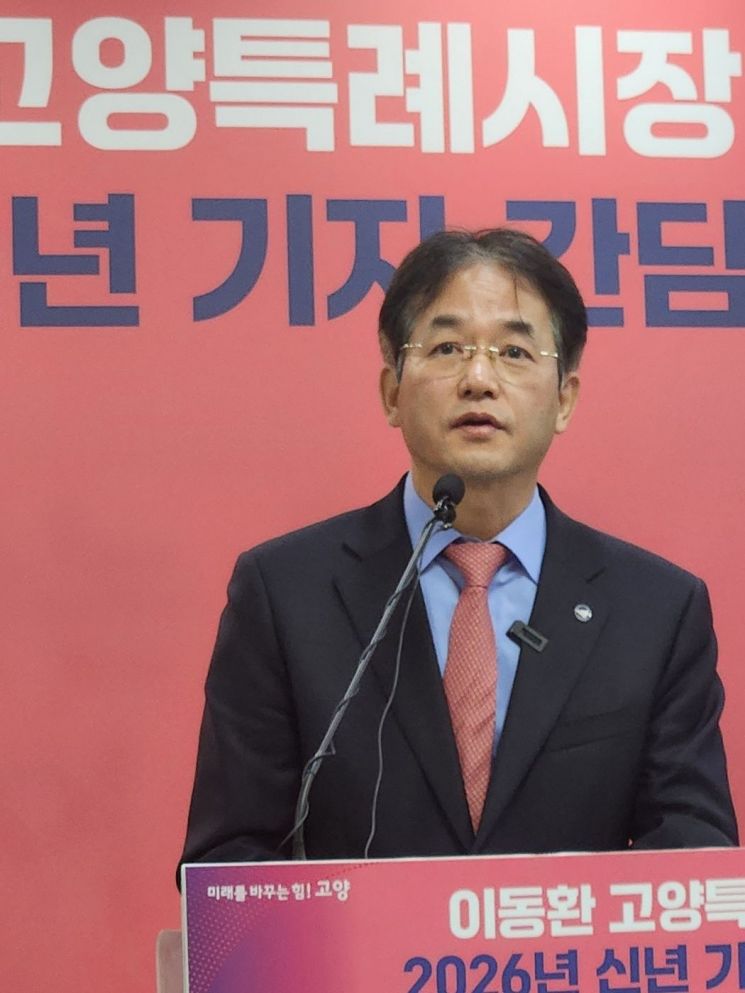 Mayor Donghwan Lee of Goyang City held the "2026 New Year Press Conference" on the 15th at the city hall's main conference room, presenting the administrative achievements of the past four years and future vision. Photo by Jonggu Lee
During the press conference, Mayor Lee emphasized that "urban growth is the result of design," and declared that the urban redesign that will change the destiny of Goyang has been completed. He expressed his determination by stating, "Now, with overwhelming execution, I will take responsibility and fulfill the promise of Goyang's leap forward made to our 1.08 million citizens."
Mayor Lee cited the utilization of Goyang's limited available land for economic foundations rather than housing supply as the city's greatest achievement. He particularly highlighted the preservation of the Daegok Station area as a "knowledge convergence complex" where companies and technology gather, despite pressures for residential-focused development.
These efforts are already yielding tangible results. Mayor Lee noted, "Recently, the headquarters of a KOSPI-listed company with annual sales of 1.2 trillion won decided to relocate to Goyang," explaining that "this is a strong signal that Goyang is transforming into a city where companies choose to stay." He also added that, since being designated as the first venture business promotion district in northern Gyeonggi Province, the number of venture companies has increased by 16%, indicating a revitalized industrial ecosystem.
The "creation of added value from cultural assets" was also a key topic. The Goyang Sports Complex, which had seen little use despite an investment of 130 billion won in the past, has recently been transformed into a venue for world-renowned artists. Over the past year, the complex hosted 26 performances, attracting 850,000 visitors and generating approximately 12.5 billion won in direct revenue. Mayor Lee announced plans to establish this as a "Con-Trip" structure, combining performances, exhibitions, and consumption.
In the environmental sector, the city is restoring access to the Han River and investing 320 billion won in national funds to develop Changneungcheon into a riverside cultural space. Through these efforts, the city plans to expand per capita urban park area to at least 9.7 square meters, in line with WHO recommendations.
Efforts to expand energy and production infrastructure have also been pursued in parallel. The city has reorganized agriculture and energy as future industries by establishing the first mini hydrogen city in northern Gyeonggi Province and expanding smart farms, while also experimenting with using underground urban walkways as profitable production spaces. In areas prone to flooding, the city plans to fundamentally improve disaster safety by investing large amounts of national and provincial funds.
The city's landscape and living spaces have also been revamped. After more than 50 years of disconnection, access to the Han River has been restored with the creation of riverside parks, and both Changneungcheon and Gongneungcheon are being transformed into riverside cultural spaces. By expanding urban forests and increasing park area, the city aims to become a green city that exceeds WHO standards. Thanks to these changes, Goyang has achieved successive recognition in both domestic and international urban evaluations.
On this day, Mayor Lee presented a vision to transform the entire city into "AI station areas" and "AI school zones." The plan includes revolutionizing transportation accessibility through autonomous shuttle buses, intelligent transport systems, and urban air mobility demonstration projects, as well as building a talent development ecosystem that combines AI education and industry.
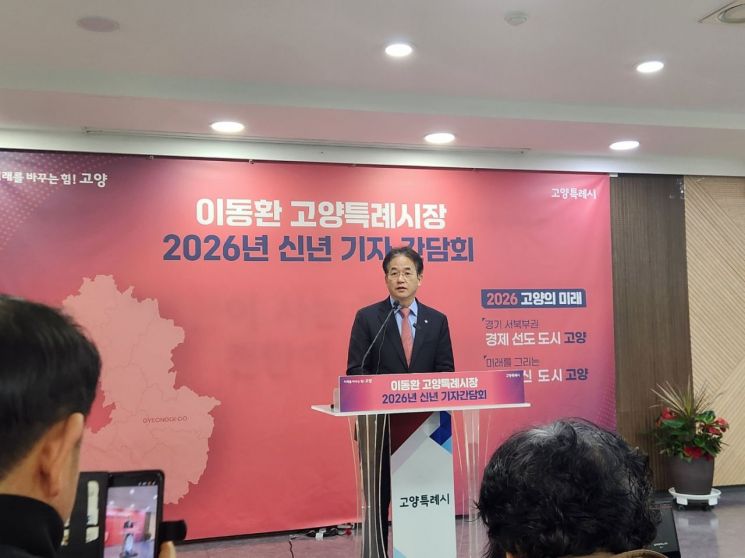 Lee Donghwan, Mayor of Goyang City, is holding the "2026 New Year Press Conference" on the 15th at the city hall's main conference room, presenting the administrative achievements of the past four years and the future vision. Photo by Lee Jonggu
With the designation as a leading area for educational development, the city plans to invest approximately 16.6 billion won by 2026 to establish an innovative public education model, attract international schools and overseas universities, and create an "AI campus," thereby forming a "global school district."
In terms of transportation, with the opening of the GTX-A and Seohae lines, the city has secured 16-minute access to Seoul Station and 19-minute access to Gimpo Airport. Based on this, it will fully launch the development of "AI station areas" that combine autonomous shuttle buses and intelligent transport systems (ITS). Mayor Lee promised, "We will create a campus city where no neighborhood is left behind in education and technology."
Mayor Lee Donghwan reiterated, "I will transform previously unused land into economic territory and turn empty spaces into the heart of AI jobs," adding, "With the heart of a parent investing in their children's future, I will take full responsibility for Goyang's future."
© The Asia Business Daily(www.asiae.co.kr). All rights reserved.
![Clutching a Stolen Dior Bag, Saying "I Hate Being Poor but Real"... The Grotesque Con of a "Human Knockoff" [Slate]](https://cwcontent.asiae.co.kr/asiaresize/183/2026021902243444107_1771435474.jpg)

















