Emergency Snow Removal Shifts from Preliminary Advisories
Proactive Measures Before Snowfall
Focused Management of Major Roads for Early Morning Snow and Black Ice
Minimizing Citizen Inconvenience with Community Snow Removal Teams and Equipment Deployment
Gwangsan District in Gwangju has been focusing on managing citizen safety during the winter season by proactively responding to snowstorms even before heavy snowfall warnings are issued. From the preliminary advisory stage, the district initiated emergency work shifts and preemptive inspections, and before the snowfall, they applied de-icing agents and managed areas vulnerable to freezing, thereby minimizing daily inconveniences even during recent heavy snow periods.
According to Gwangsan District on January 15, since November of last year, the district has been operating a "Comprehensive Countermeasure Plan for Natural Disasters in Winter." The core response strategies include protecting groups vulnerable to cold waves, operating community snow removal teams centered on each dong (neighborhood) during heavy snow, and deploying vehicle-mounted snow removal equipment. This is a meticulous response system aimed at ensuring everyday safety that citizens can truly feel.
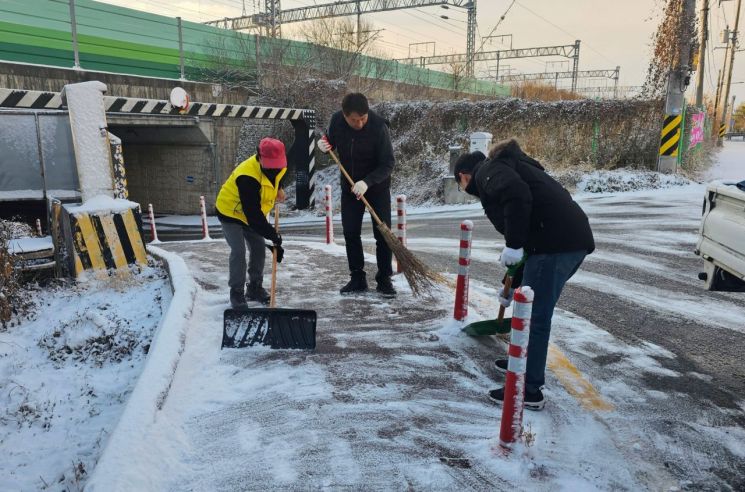 On the morning of the 11th, the day after the snowfall, public officials in Dosan-dong, Gwangsan District, conducted snow removal work focusing on vulnerable areas. Provided by Gwangsan District
These preparations were put into action on the ground during the heavy snow warning issued from January 9 to 13. From the preliminary heavy snow advisory stage, Gwangsan District began emergency work shifts for initial snow removal and intensified preemptive inspections of major roads and facilities. On January 10, when the advisory was upgraded to a heavy snow warning, the district increased its response personnel and deployed nine vehicle-mounted snow removal machines to conduct snow removal on 69 major arterial roads and snow-affected areas, including Eodeung-daero, Yeonggwang-ro, and Donggok-ro (a total of 143 km, or 286 km round-trip).
In particular, in areas with heavy traffic such as Imbangul-daero and Sangmu-daero, as well as on some back roads, de-icing agents were applied in advance during nighttime hours before the snowfall to prevent early morning icing. In two locations, including Songsan Bridge and Sanjeong Overpass, automatic brine spraying devices were operated to reduce traffic inconveniences and accident risks caused by icing.
After the heavy snow warning was lifted, intensive removal work was carried out during early morning hours to prevent "black ice" accidents on roads. Equipment such as spreaders and excavators was mobilized to focus on areas vulnerable to freezing.
Information dissemination was also carried out in parallel. Gwangsan District promptly communicated weather updates and snow removal progress through safety text messages, and District Mayor Park Byungkyu shared updates on snow removal operations and road conditions via his personal social media accounts.
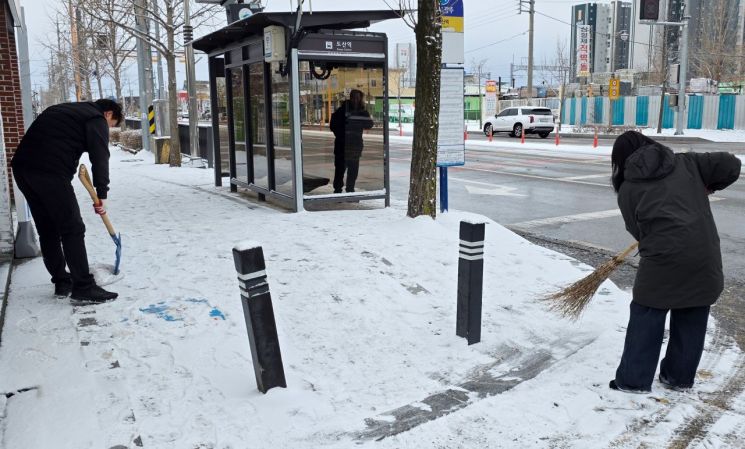 On the morning of the 11th, the day after the snowfall, public officials in Dosan-dong, Gwangsan District, conducted snow removal work focusing on vulnerable areas. Provided by Gwangsan District
To prepare for this winter, Gwangsan District secured a total of 1,571 tons of snow removal materials, including 1,278 tons of salt and 193 tons of eco-friendly de-icing agents. To address snow on village roads, the district additionally supplied each dong with four vehicle-mounted snow removal machines, 14 cart-type spreaders, about 1,400 snow removal tools, and 111 tons of eco-friendly de-icing agents. Pre-inspections were also completed for 12 snow-prone structures, seven areas vulnerable to freezing, nine areas expected to become isolated, and 16 brine spraying facilities.
Gwangsan District plans to maintain its winter response system until March 15, focusing on safety management in 220 locations vulnerable to icing and snow accumulation. The district is also conducting promotional activities and campaigns to encourage participation in "clearing snow in front of homes and shops." For back roads and village alleys where it is difficult to deploy large equipment, community snow removal teams consisting of 985 people across 21 dongs will lead the response.
In addition, the district is operating 350 cold wave shelters (such as senior centers), checking in on elderly residents living alone and those with chronic illnesses, and strengthening support for vulnerable groups by providing heating cost assistance to daycare centers and child welfare facilities.
A Gwangsan District official stated, "We are responding quickly from the forecast stage to prevent citizens from experiencing inconvenience or being exposed to accident risks due to heavy snowfall," adding, "We will remain vigilant throughout the winter and focus our administrative capacity on ensuring the safety of citizens in their daily lives."
© The Asia Business Daily(www.asiae.co.kr). All rights reserved.
![Clutching a Stolen Dior Bag, Saying "I Hate Being Poor but Real"... The Grotesque Con of a "Human Knockoff" [Slate]](https://cwcontent.asiae.co.kr/asiaresize/183/2026021902243444107_1771435474.jpg)

















